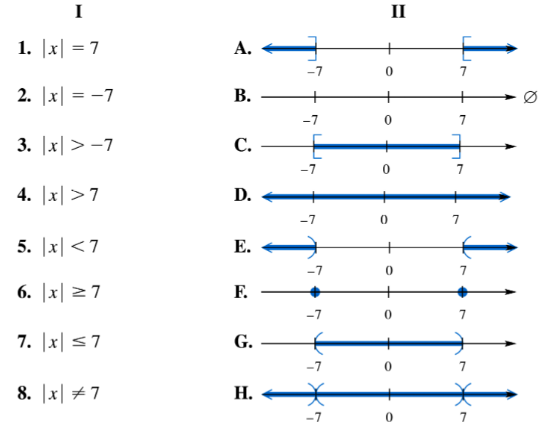
Match each equation or inequality in Column I with the graph ofits solution set in Column II. | x | = -7
Verified step by step guidance
1
Step 1: Understand the absolute value concept. The absolute value of a number, denoted as |x|, represents its distance from zero on the number line, which is always non-negative.
Step 2: Analyze the given equation |x| = -7. Since absolute values are always non-negative, they cannot equal a negative number.
Step 3: Conclude that there is no real number x that satisfies the equation |x| = -7.
Step 4: Recognize that the solution set for this equation is the empty set, meaning there are no solutions.
Step 5: Match this understanding with the graph in Column II that represents an empty solution set, typically shown as no points on the number line.
Verified video answer for a similar problem:
This video solution was recommended by our tutors as helpful for the problem above
Video duration:
59s
Play a video:
Was this helpful?
Key Concepts
Here are the essential concepts you must grasp in order to answer the question correctly.
Absolute Value
The absolute value of a number is its distance from zero on the number line, regardless of direction. It is denoted by vertical bars, such as |x|. For example, |3| = 3 and |-3| = 3. In the context of equations, |x| = a means x can be either a or -a, provided a is non-negative.
An absolute value equation like |x| = -7 has no solution because the absolute value cannot be negative. The definition of absolute value ensures that it is always zero or positive, thus making it impossible for |x| to equal a negative number. This concept is crucial for understanding the limitations of absolute value equations.
The graph of an absolute value function, such as y = |x|, forms a 'V' shape, opening upwards. The vertex of the graph is at the origin (0,0), and it reflects symmetrically across the y-axis. Understanding how to graph these functions helps visualize the solution sets of absolute value equations and inequalities.