Identify the radical expressions to simplify: \$4\sqrt[3]{16} + 5\sqrt[3]{2}$.
Express the radicands in terms of prime factors or powers to see if they can be simplified: \$16 = 2^4\( and \)2 = 2^1$.
Rewrite the cube roots using the prime factorization: \(\sqrt[3]{16} = \sqrt[3]{2^4} = \sqrt[3]{2^3 \cdot 2} = \sqrt[3]{2^3} \cdot \sqrt[3]{2} = 2 \cdot \sqrt[3]{2}\).
Substitute back into the original expression: \$4 \cdot (2 \cdot \sqrt[3]{2}) + 5 \cdot \sqrt[3]{2}$.
Factor out the common cube root term \(\sqrt[3]{2}\): \((4 \cdot 2 + 5) \cdot \sqrt[3]{2}\) and simplify inside the parentheses.
Verified video answer for a similar problem:
This video solution was recommended by our tutors as helpful for the problem above
Video duration:
5m
Play a video:
Was this helpful?
Key Concepts
Here are the essential concepts you must grasp in order to answer the question correctly.
Simplifying Radicals
Simplifying radicals involves rewriting the expression so that the radicand (the number inside the root) has no perfect powers corresponding to the root's index. For cube roots, this means factoring out perfect cubes to simplify the expression. This process makes the radical easier to work with or combine.
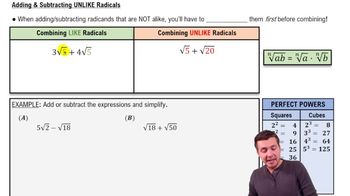
Adding & Subtracting Unlike Radicals by Simplifying
Properties of Cube Roots
Cube roots are the inverse operation of cubing a number. The cube root of a product equals the product of the cube roots, i.e., ∛(a * b) = ∛a * ∛b. This property allows breaking down complex radicands into simpler factors to simplify or combine terms.
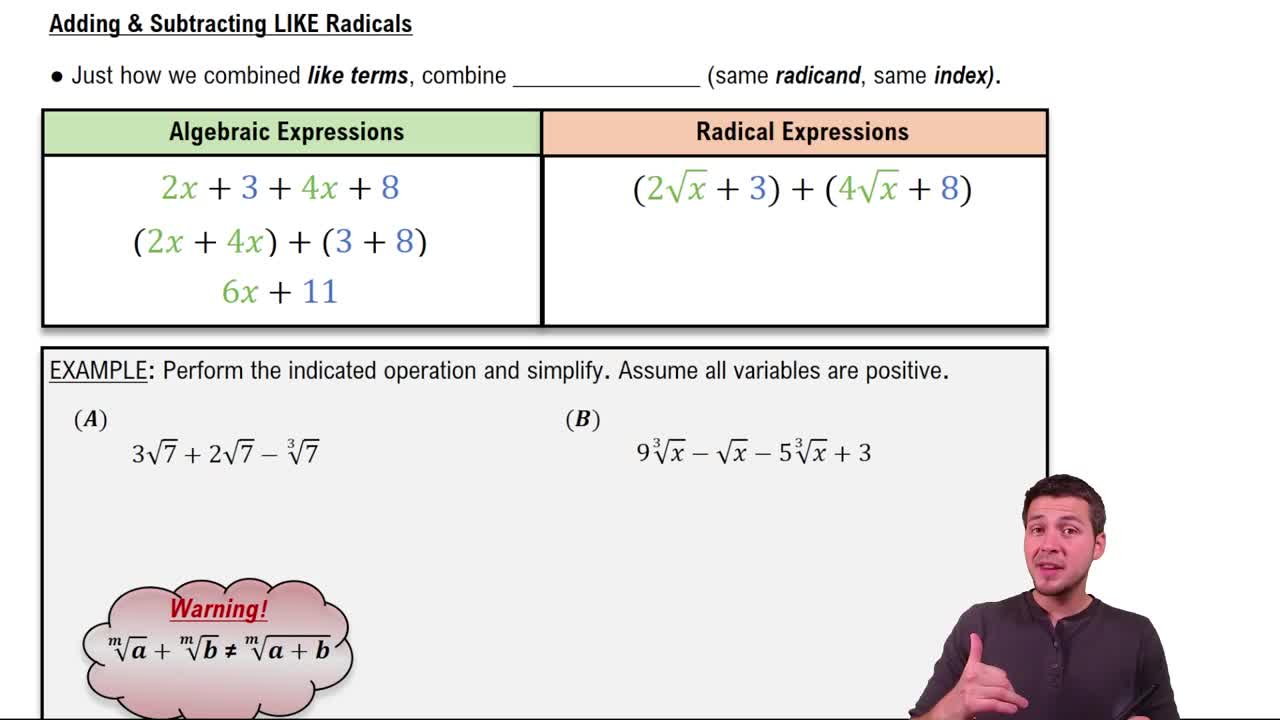
Like radicals have the same index and radicand after simplification. Only like radicals can be added or subtracted by combining their coefficients. Recognizing and simplifying radicals to their simplest form is essential before combining them.