For the pair of functions defined, find (ƒ+g)(x).Give the domain of each. See Example 2. ƒ(x)=2x^2-3x, g(x)=x^2-x+3
Verified step by step guidance
1
To find (ƒ+g)(x), start by writing the sum of the two functions: (ƒ+g)(x) = ƒ(x) + g(x).
Substitute the given functions into the expression: (ƒ+g)(x) = (2x^2 - 3x) + (x^2 - x + 3).
Combine like terms by adding the coefficients of the same powers of x: (ƒ+g)(x) = (2x^2 + x^2) + (-3x - x) + 3.
Simplify the expression to get the final form of (ƒ+g)(x): (ƒ+g)(x) = 3x^2 - 4x + 3.
Determine the domain of each function. Since both ƒ(x) and g(x) are polynomials, their domains are all real numbers, so the domain of (ƒ+g)(x) is also all real numbers.
Verified video answer for a similar problem:
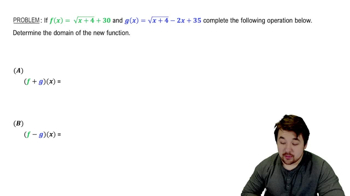
This video solution was recommended by our tutors as helpful for the problem above
Video duration:
2m
Play a video:
Was this helpful?
Key Concepts
Here are the essential concepts you must grasp in order to answer the question correctly.
Function Addition
Function addition involves creating a new function by adding the outputs of two given functions for the same input value x. For functions ƒ(x) and g(x), (ƒ+g)(x) = ƒ(x) + g(x). This operation combines the expressions algebraically to form a single function.
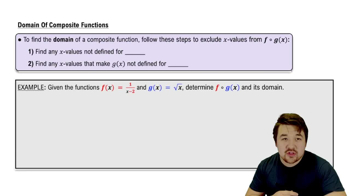
The domain of a function is the set of all input values (x) for which the function is defined. When adding functions, the domain of (ƒ+g)(x) is the intersection of the domains of ƒ(x) and g(x), meaning only values valid for both functions are included.
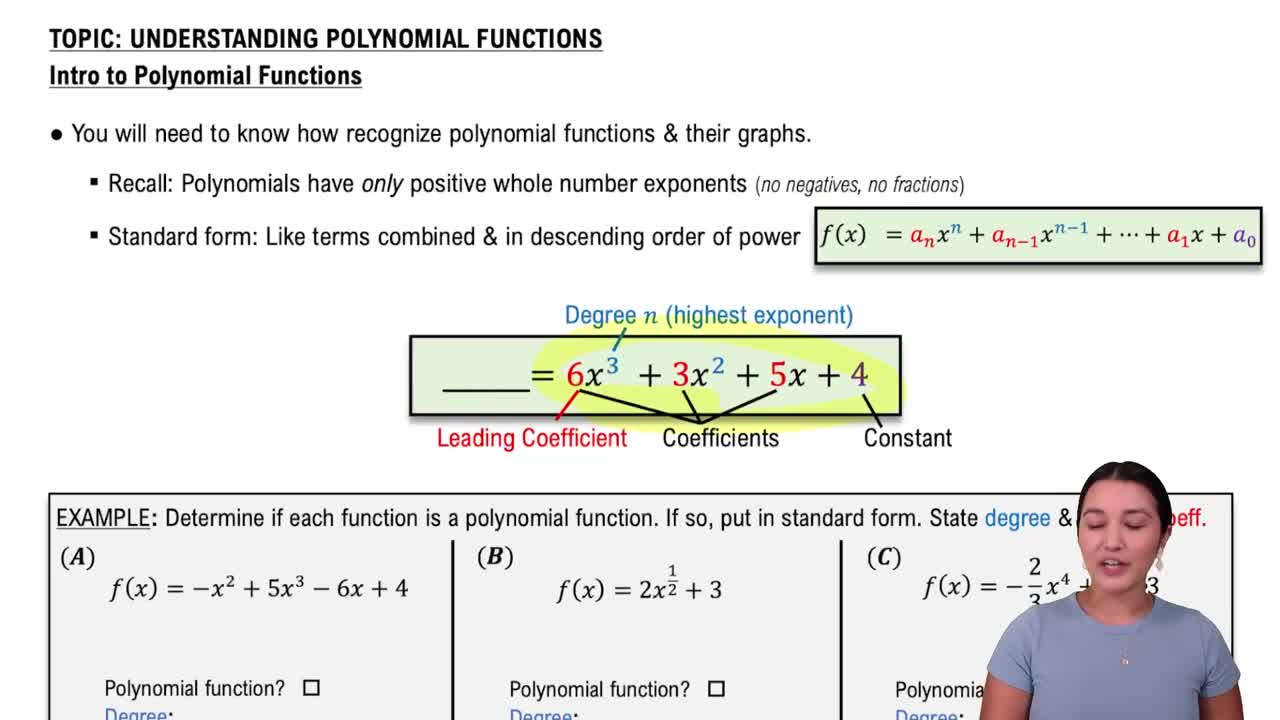
Polynomial functions are expressions involving variables raised to whole-number exponents with coefficients. Both ƒ(x) and g(x) are polynomials, which are defined for all real numbers, simplifying domain considerations and making addition straightforward.