Perform the indicated operations and/or simplify each expression. Assume all variables represent positive real numbers. √(2/3x)
Table of contents
- 0. Review of Algebra4h 18m
- 1. Equations & Inequalities3h 18m
- 2. Graphs of Equations1h 43m
- 3. Functions2h 17m
- 4. Polynomial Functions1h 44m
- 5. Rational Functions1h 23m
- 6. Exponential & Logarithmic Functions2h 28m
- 7. Systems of Equations & Matrices4h 5m
- 8. Conic Sections2h 23m
- 9. Sequences, Series, & Induction1h 22m
- 10. Combinatorics & Probability1h 45m
0. Review of Algebra
Radical Expressions
Problem 147
Textbook Question
Perform the indicated operations and/or simplify each expression. Assume all variables represent positive real numbers. 33−4+3241−3812
Verified step by step guidance1
Identify the expression to simplify: \(\left(-\frac{4}{\sqrt[3]{3}}\right) + \left(\frac{1}{\sqrt[3]{24}}\right) - \left(\frac{2}{\sqrt[3]{81}}\right)\).
Rewrite each cube root in terms of prime factors or simpler cube roots if possible: For example, \(\sqrt[3]{24} = \sqrt[3]{8 \times 3} = \sqrt[3]{8} \times \sqrt[3]{3}\) and \(\sqrt[3]{81} = \sqrt[3]{3^4} = \sqrt[3]{3^3 \times 3} = 3 \times \sqrt[3]{3}\).
Express each term with the simplified cube roots: Replace \(\sqrt[3]{24}\) and \(\sqrt[3]{81}\) with their factored forms to have a common cube root base if possible.
Find a common denominator involving \(\sqrt[3]{3}\) to combine all terms into a single fraction. This may involve multiplying numerator and denominator of each term appropriately.
Combine the numerators over the common denominator and simplify the resulting expression by combining like terms.
Verified video answer for a similar problem:This video solution was recommended by our tutors as helpful for the problem above
Video duration:
7mPlay a video:
Was this helpful?
Key Concepts
Here are the essential concepts you must grasp in order to answer the question correctly.
Cube Roots and Radicals
A cube root of a number is a value that, when multiplied by itself three times, gives the original number. It is denoted as ∛x. Understanding how to work with cube roots is essential for simplifying expressions involving radicals.
Recommended video:
Guided course
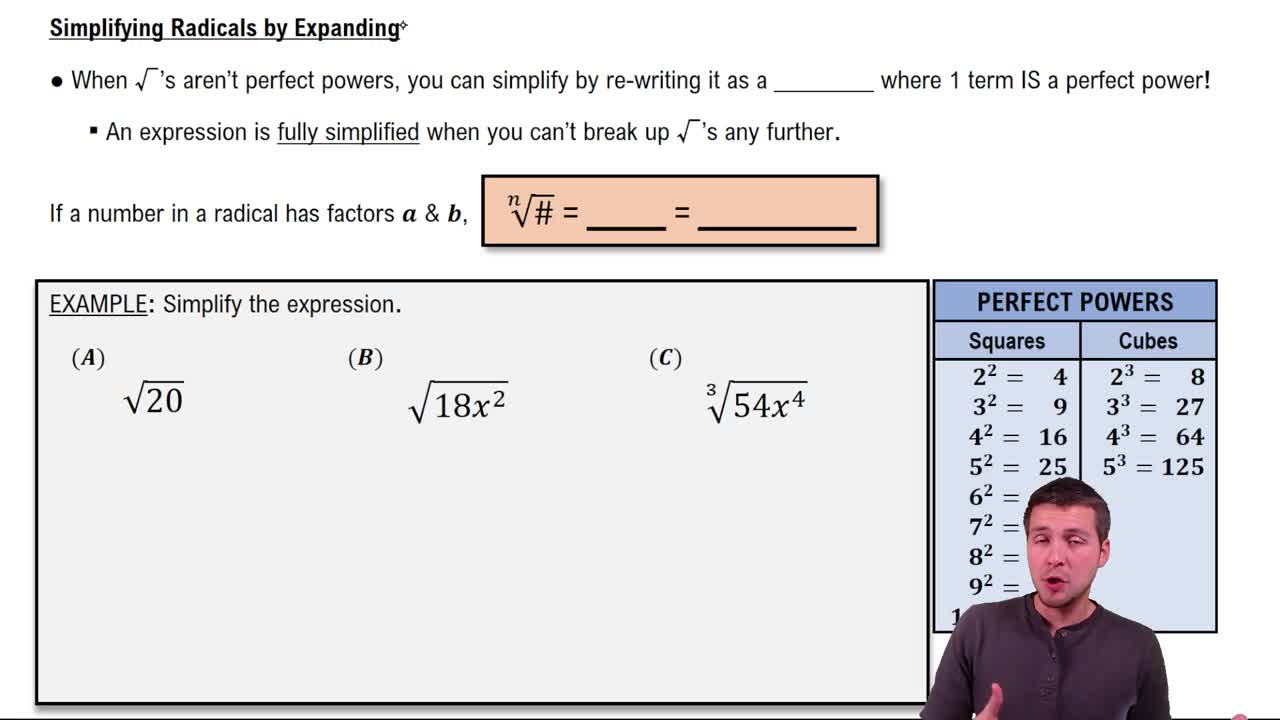
Expanding Radicals
Simplifying Radicals
Simplifying radicals involves rewriting the radical expression in its simplest form by factoring out perfect cubes (for cube roots) or other powers. This process makes it easier to perform addition or subtraction of radical terms.
Recommended video:
Guided course
Adding & Subtracting Unlike Radicals by Simplifying
Adding and Subtracting Radical Expressions
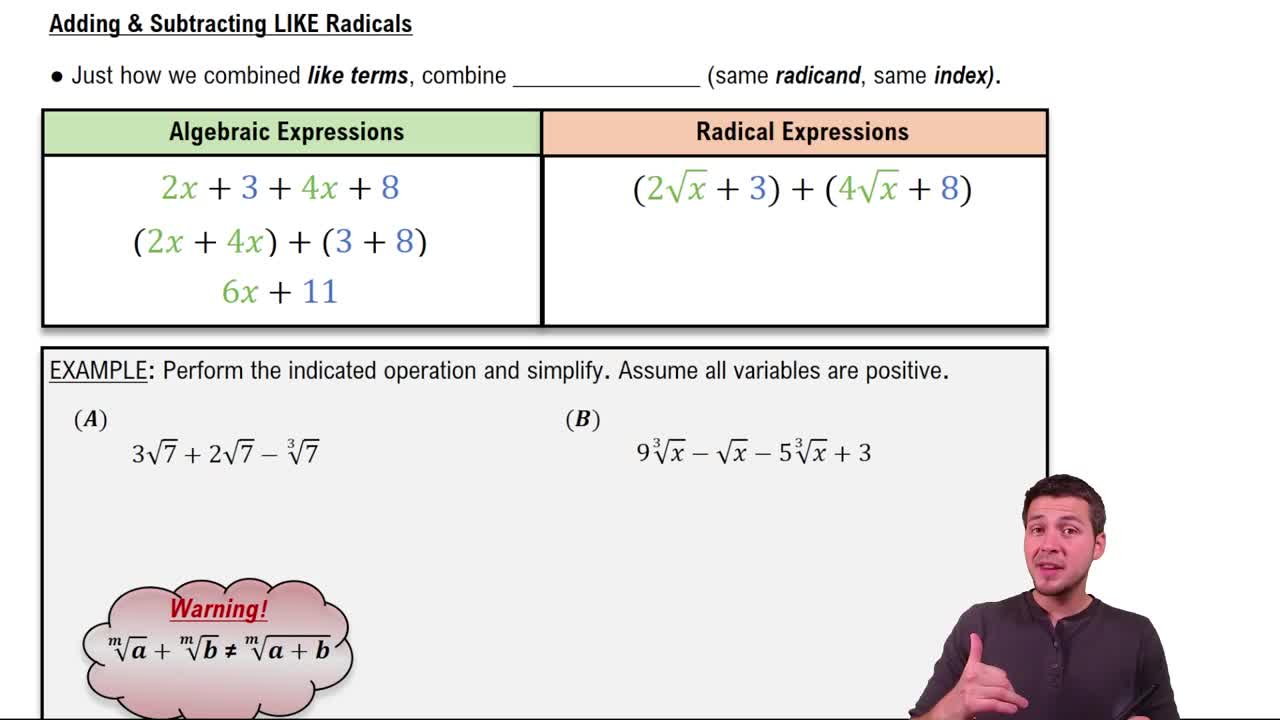
To add or subtract radicals, the radicals must have the same radicand (the number inside the root) and index. If they differ, you must simplify or rewrite them to have a common radical form before combining the terms.
Recommended video:
Guided course
Adding & Subtracting Like Radicals
Related Videos
Related Practice
Textbook Question
710
views