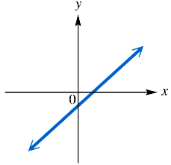
Determine whether each function graphed or defined is one-to-one.
Verified step by step guidance
1
Identify the function type: The graph is a straight line, indicating a linear function.
Recall the definition of a one-to-one function: A function is one-to-one if each output value corresponds to exactly one input value.
Apply the Horizontal Line Test: A function is one-to-one if no horizontal line intersects the graph more than once.
Observe the graph: Any horizontal line will intersect this linear graph at most once.
Conclude: Since the graph passes the Horizontal Line Test, the function is one-to-one.
Verified video answer for a similar problem:
This video solution was recommended by our tutors as helpful for the problem above
Video duration:
2m
Play a video:
Was this helpful?
Key Concepts
Here are the essential concepts you must grasp in order to answer the question correctly.
One-to-One Function
A one-to-one function is a type of function where each output value is associated with exactly one input value. This means that no two different inputs produce the same output. To determine if a function is one-to-one, one can use the horizontal line test: if any horizontal line intersects the graph of the function more than once, the function is not one-to-one.
Interpreting graphs involves understanding the visual representation of functions. The slope, direction, and shape of the graph provide insights into the function's behavior. For instance, a linear graph with a negative slope, like the one shown, indicates that as the x-values increase, the y-values decrease, which can help in assessing whether the function is one-to-one.
The horizontal line test is a method used to determine if a function is one-to-one. If any horizontal line drawn across the graph intersects the curve at more than one point, the function fails the test and is not one-to-one. This test is particularly useful for quickly assessing the uniqueness of output values for given input values in a function's graph.