Identify the given function on the graph. Notice the curve is in the fourth quadrant, starting near the y-axis and moving downward as x increases.
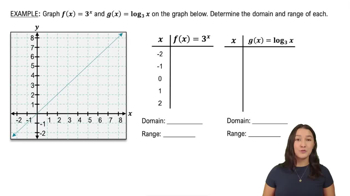
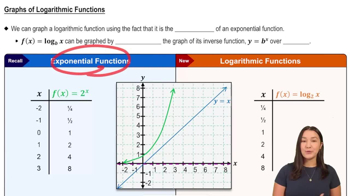
Recall that the inverse of a function swaps the roles of x and y. This means the inverse function's graph is a reflection of the original graph across the line \(y = x\).
To graph the inverse, take several points from the original function, such as \((x, y)\), and switch their coordinates to \((y, x)\). Plot these new points on the coordinate plane.
Draw a smooth curve through the new points to form the inverse function. Ensure the shape mirrors the original graph across the line \(y = x\).
Label the inverse function clearly and verify that it passes the horizontal line test to confirm it is indeed a function.
Verified video answer for a similar problem:
This video solution was recommended by our tutors as helpful for the problem above
Video duration:
1m
Play a video:
Was this helpful?
Key Concepts
Here are the essential concepts you must grasp in order to answer the question correctly.
One-to-One Functions
A one-to-one function assigns each input exactly one unique output, and no two different inputs share the same output. This property ensures the function has an inverse, as each output corresponds to only one input.
The inverse of a function reverses the roles of inputs and outputs, swapping x and y values. Graphically, the inverse reflects the original function across the line y = x, meaning points (a, b) on the function become (b, a) on its inverse.
To graph an inverse function, reflect the original function's graph over the line y = x. This involves swapping coordinates of key points and ensuring the inverse is also a function, which is guaranteed if the original function is one-to-one.