In Exercises 27–38, evaluate each function at the given values of the independent variable and simplify.f(x)=4x+5 a. f(6)
Table of contents
- 0. Review of Algebra4h 18m
- 1. Equations & Inequalities3h 18m
- 2. Graphs of Equations1h 43m
- 3. Functions2h 17m
- 4. Polynomial Functions1h 44m
- 5. Rational Functions1h 23m
- 6. Exponential & Logarithmic Functions2h 28m
- 7. Systems of Equations & Matrices4h 5m
- 8. Conic Sections2h 23m
- 9. Sequences, Series, & Induction1h 22m
- 10. Combinatorics & Probability1h 45m
2. Graphs of Equations
Graphs and Coordinates
Problem 33a
Textbook Question
In Exercises 27–38, evaluate each function at the given values of the independent variable and simplify. f(r) = √(r + 6) +3 a. f(-6)
Verified step by step guidance1
Step 1: Understand the problem. The function f(r) = √(r + 6) + 3 is given, and you are tasked with evaluating it at r = -6. This means substituting -6 for r in the function.
Step 2: Substitute r = -6 into the function. Replace r in the expression √(r + 6) + 3 with -6, resulting in √((-6) + 6) + 3.
Step 3: Simplify the expression inside the square root. Calculate (-6) + 6, which equals 0. The function now becomes √(0) + 3.
Step 4: Evaluate the square root. The square root of 0 is 0, so the expression simplifies further to 0 + 3.
Step 5: Add the remaining terms. Add 0 and 3 to complete the simplification, resulting in the final value of the function at r = -6.
Verified video answer for a similar problem:This video solution was recommended by our tutors as helpful for the problem above
Video duration:
1mPlay a video:
Was this helpful?
Key Concepts
Here are the essential concepts you must grasp in order to answer the question correctly.
Function Evaluation
Function evaluation involves substituting a specific value for the independent variable into a function to determine its output. In this case, we replace 'r' in the function f(r) = √(r + 6) + 3 with -6 to find f(-6). This process is fundamental in understanding how functions operate and how to compute their values.
Recommended video:
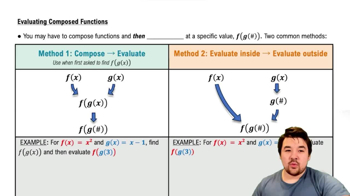
Evaluating Composed Functions
Square Root Function
The square root function, denoted as √x, returns the non-negative value whose square equals x. In the context of the given function, √(r + 6) requires that the expression inside the square root, r + 6, must be non-negative for real number outputs. Understanding the domain of the square root function is crucial for evaluating it correctly.
Recommended video:
Imaginary Roots with the Square Root Property
Simplification of Expressions
Simplification involves reducing an expression to its simplest form, making it easier to understand and work with. After evaluating the function at a specific value, such as f(-6), we may need to simplify the resulting expression, which can include combining like terms or reducing fractions. This skill is essential for clear mathematical communication and problem-solving.
Recommended video:
Guided course
Introduction to Algebraic Expressions
Watch next
Master Graphs & the Rectangular Coordinate System with a bite sized video explanation from Patrick
Start learningRelated Videos
Related Practice
Textbook Question
46
views