Solve each equation in Exercises 83–108 by the method of your choice.
Table of contents
- 0. Review of Algebra4h 18m
- 1. Equations & Inequalities3h 18m
- 2. Graphs of Equations1h 43m
- 3. Functions2h 17m
- 4. Polynomial Functions1h 44m
- 5. Rational Functions1h 23m
- 6. Exponential & Logarithmic Functions2h 28m
- 7. Systems of Equations & Matrices4h 5m
- 8. Conic Sections2h 23m
- 9. Sequences, Series, & Induction1h 22m
- 10. Combinatorics & Probability1h 45m
1. Equations & Inequalities
Intro to Quadratic Equations
Problem 111a
Textbook Question
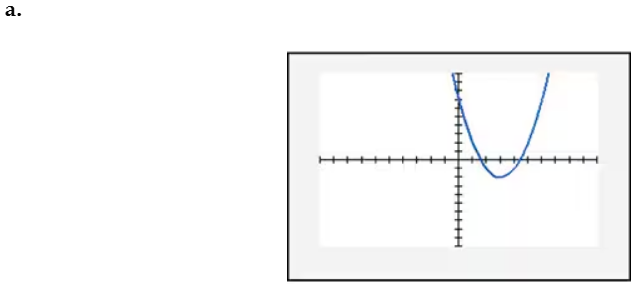
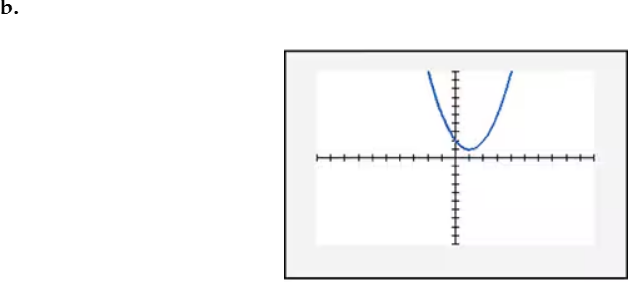
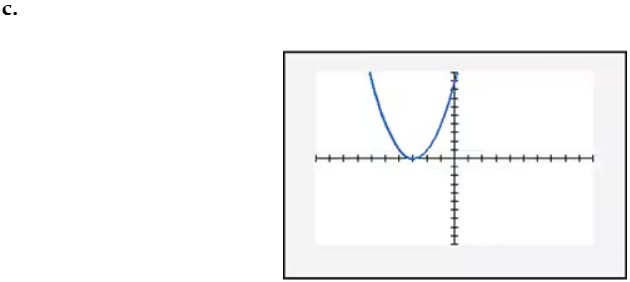
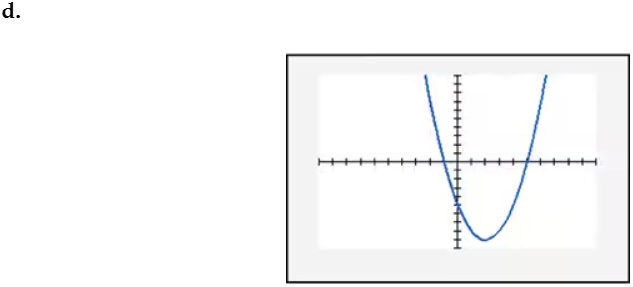
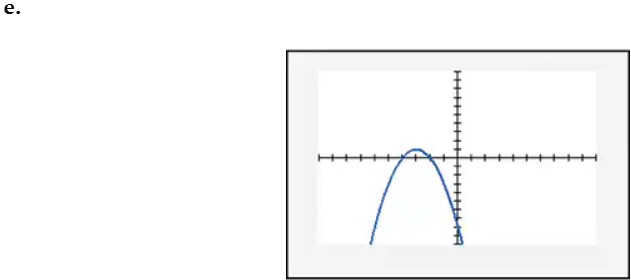
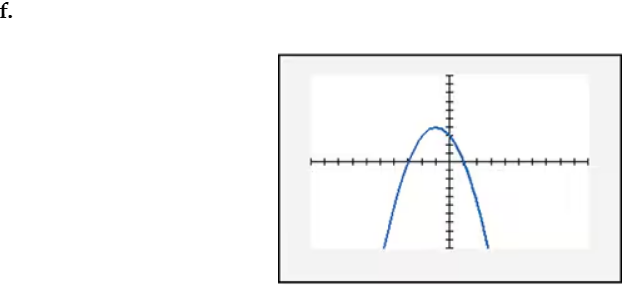
In Exercises 109–114, find the x-intercept(s) of the graph of each equation. Use the x-intercepts to match the equation with its graph. The graphs are shown in [- 10, 10, 1] by [- 10, 10, 1] viewing rectangles and labeled (a) through (f). y = - (x + 1)2 + 4


Verified step by step guidance1
To find the x-intercepts of the graph, set y = 0 in the given equation. The equation becomes 0 = - (x + 1)^2 + 4.
Rearrange the equation to isolate the squared term: (x + 1)^2 = 4.
Take the square root of both sides, remembering to include both the positive and negative roots: x + 1 = ±√4.
Simplify the square root: x + 1 = ±2. This gives two equations: x + 1 = 2 and x + 1 = -2.
Solve each equation for x: For x + 1 = 2, subtract 1 to get x = 1. For x + 1 = -2, subtract 1 to get x = -3. The x-intercepts are x = 1 and x = -3.
Verified video answer for a similar problem:This video solution was recommended by our tutors as helpful for the problem above
Video duration:
1mPlay a video:
Was this helpful?
Key Concepts
Here are the essential concepts you must grasp in order to answer the question correctly.
X-Intercept
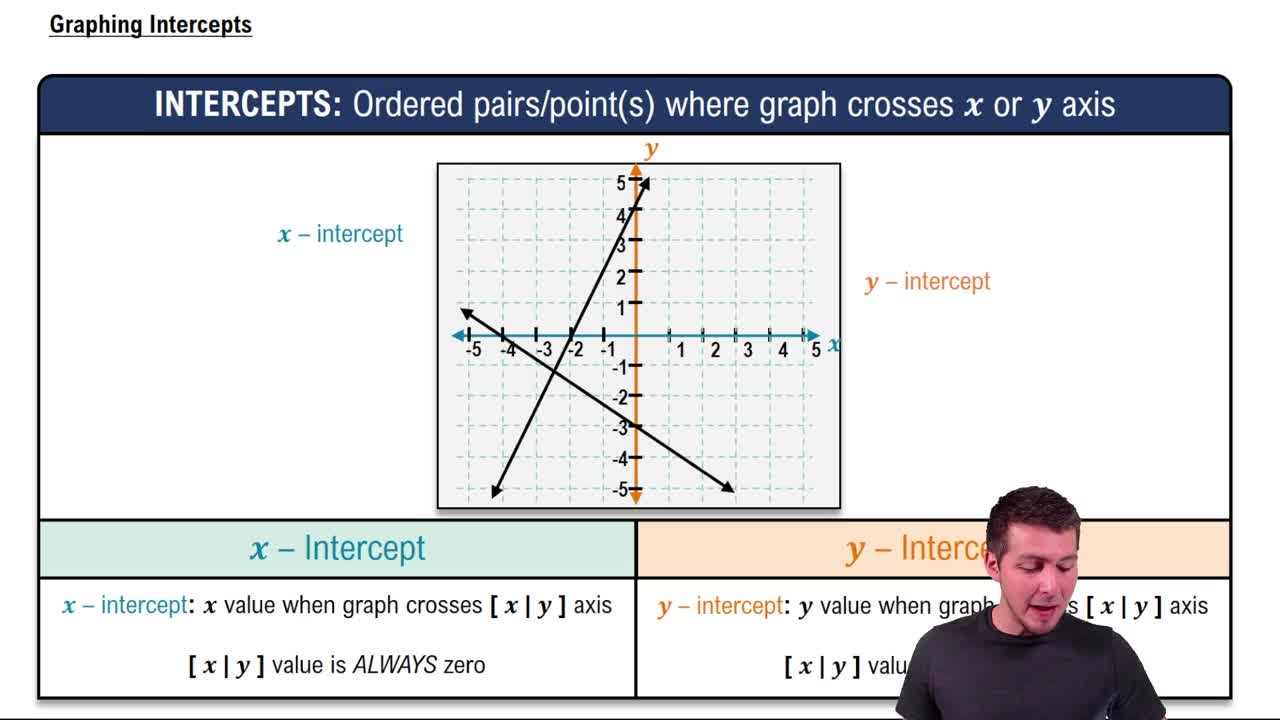
The x-intercept of a graph is the point where the graph intersects the x-axis. This occurs when the value of y is zero. To find the x-intercept, you set the equation equal to zero and solve for x. In the given equation, this means solving - (x + 1)^2 + 4 = 0.
Recommended video:
Guided course
Graphing Intercepts
Quadratic Functions
The equation provided is a quadratic function, which is typically in the form y = ax^2 + bx + c. Quadratic functions produce parabolic graphs, which can open upwards or downwards depending on the sign of 'a'. In this case, the negative sign indicates the parabola opens downwards, affecting the location of the x-intercepts.
Recommended video:
Solving Quadratic Equations Using The Quadratic Formula
Graphing Techniques
Understanding how to graph a quadratic function involves identifying key features such as the vertex, axis of symmetry, and intercepts. The vertex can be found using the formula x = -b/(2a), and the intercepts help in sketching the graph accurately. This knowledge is essential for matching the equation to its corresponding graph.
Recommended video:
Guided course
Graphs and Coordinates - Example
Watch next
Master Introduction to Quadratic Equations with a bite sized video explanation from Patrick
Start learningRelated Videos
Related Practice
Textbook Question
639
views