Solve each equation in Exercises 83–108 by the method of your choice. 1/x + 1/(x + 2) = 1/3
Table of contents
- 0. Review of Algebra4h 18m
- 1. Equations & Inequalities3h 18m
- 2. Graphs of Equations1h 43m
- 3. Functions2h 17m
- 4. Polynomial Functions1h 44m
- 5. Rational Functions1h 23m
- 6. Exponential & Logarithmic Functions2h 28m
- 7. Systems of Equations & Matrices4h 5m
- 8. Conic Sections2h 23m
- 9. Sequences, Series, & Induction1h 22m
- 10. Combinatorics & Probability1h 45m
1. Equations & Inequalities
Intro to Quadratic Equations
Problem 116
Textbook Question
Find all values of x satisfying the given conditions. y = 5x2 + 3x and y = 2
Verified step by step guidance1
Start by setting the two equations equal to each other since both represent y. This gives: .
Rearrange the equation to set it equal to 0, which is the standard form for a quadratic equation: .
Identify the coefficients of the quadratic equation: , , and . These will be used in the quadratic formula.
Apply the quadratic formula: . Substitute the values of , , and into the formula.
Simplify the discriminant and then compute the two possible solutions for by evaluating the formula with both the plus and minus options for the square root.
Verified video answer for a similar problem:This video solution was recommended by our tutors as helpful for the problem above
Video duration:
2mPlay a video:
Was this helpful?
Key Concepts
Here are the essential concepts you must grasp in order to answer the question correctly.
Quadratic Functions
A quadratic function is a polynomial function of degree two, typically expressed in the form y = ax^2 + bx + c. In this case, the function y = 5x^2 + 3x represents a parabola that opens upwards, where 'a' is positive. Understanding the properties of quadratic functions, such as their vertex, axis of symmetry, and roots, is essential for solving equations involving them.
Recommended video:
Solving Quadratic Equations Using The Quadratic Formula
Finding Intersections
Finding the intersection of two functions involves determining the values of x where the functions are equal. In this problem, we set the quadratic function equal to the constant function y = 2 to find the x-values that satisfy both equations. This process often requires rearranging the equation into standard form and applying methods such as factoring, completing the square, or using the quadratic formula.
Recommended video:
Finding the Domain of an Equation
The Quadratic Formula
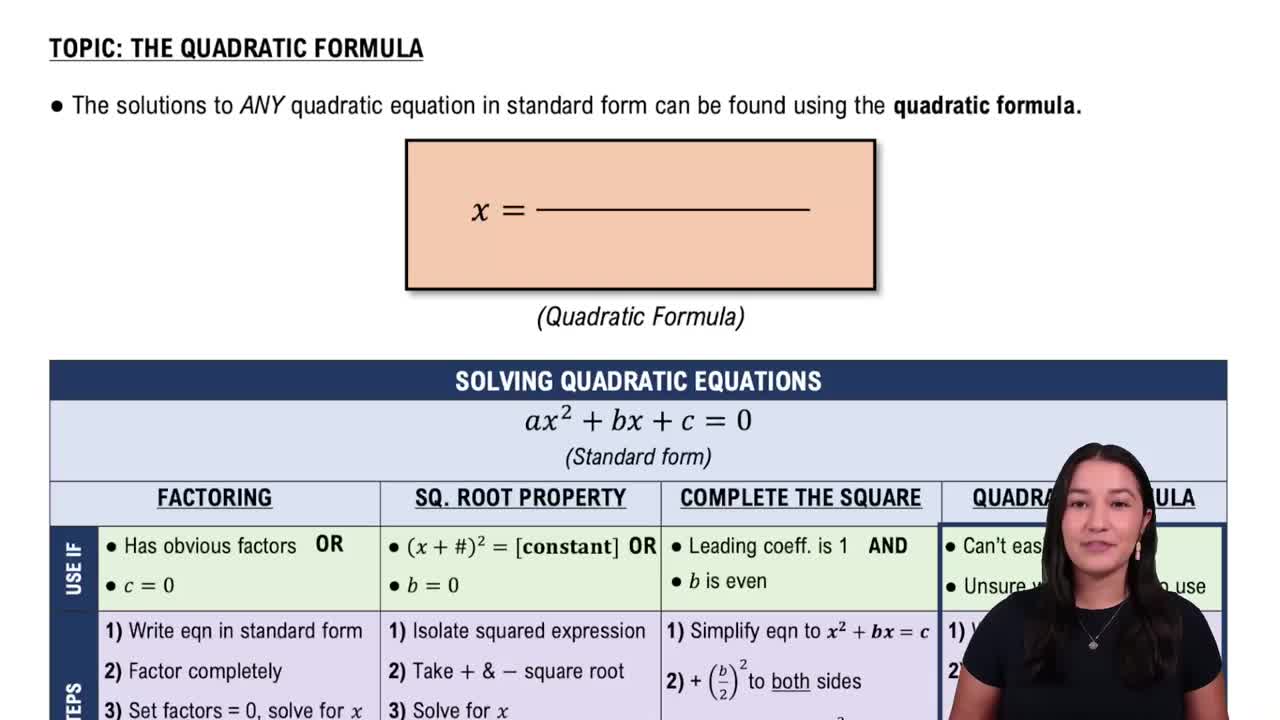
The quadratic formula, x = (-b ± √(b² - 4ac)) / (2a), is a powerful tool for solving quadratic equations of the form ax^2 + bx + c = 0. It provides the solutions for x based on the coefficients a, b, and c. In this context, once the equation is rearranged to standard form, applying the quadratic formula will yield the x-values where the two functions intersect.
Recommended video:
Solving Quadratic Equations Using The Quadratic Formula
Watch next
Master Introduction to Quadratic Equations with a bite sized video explanation from Patrick
Start learningRelated Videos
Related Practice
Textbook Question
654
views