In Exercises 1–20, use the product rule to multiply.
___ ___
√x+6 ⋅ √x-6
Verified step by step guidance
1
Identify the expression to be multiplied: \( (\sqrt{x} + 6)(\sqrt{x} - 6) \).
Recognize that this expression is in the form of \((a + b)(a - b)\), which is a difference of squares.
Recall the difference of squares formula: \((a + b)(a - b) = a^2 - b^2\).
Apply the formula: Let \(a = \sqrt{x}\) and \(b = 6\), so \((\sqrt{x})^2 - 6^2\).
Simplify the expression: \(x - 36\).
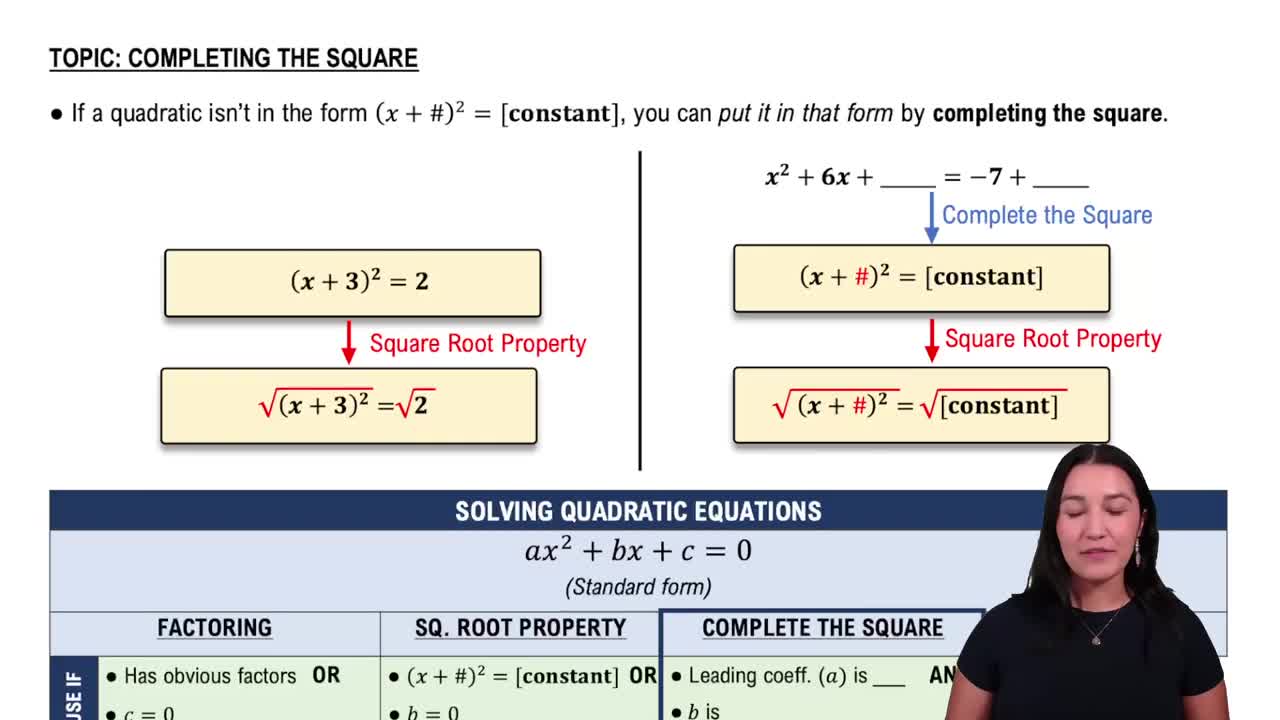
Verified video answer for a similar problem:
This video solution was recommended by our tutors as helpful for the problem above.
Video duration:
2m
Play a video:
0 Comments
Key Concepts
Here are the essential concepts you must grasp in order to answer the question correctly.
Product Rule
The product rule is a fundamental principle in algebra that states when multiplying two expressions, you can apply the distributive property. This involves multiplying each term in the first expression by each term in the second expression. In this case, it helps to simplify the multiplication of square roots by treating them as separate entities before combining them.
Square roots are a mathematical operation that finds a number which, when multiplied by itself, gives the original number. In this problem, the expressions involve square roots of 'x + 6' and 'x - 6'. Understanding how to manipulate square roots, including their properties and how they interact with addition and subtraction, is crucial for simplifying the expression correctly.
The difference of squares is a specific algebraic identity that states a² - b² = (a + b)(a - b). This concept is particularly relevant here, as the multiplication of √(x + 6) and √(x - 6) can be recognized as a difference of squares. Recognizing this allows for a more straightforward simplification of the expression, leading to a clearer solution.

 2:25 minutes
 Verified step by step guidance
 3:49
3:49