In Exercises 1–38, multiply as indicated. If possible, simplify any radical expressions that appear in the product.
(7 + √2) (8 + √2)
Verified step by step guidance
1
Identify the expression to be multiplied: \((7 + \sqrt{2})(8 + \sqrt{2})\).
Apply the distributive property (also known as the FOIL method for binomials): \((7)(8) + (7)(\sqrt{2}) + (\sqrt{2})(8) + (\sqrt{2})(\sqrt{2})\).
Calculate each term: \(7 \times 8\), \(7 \times \sqrt{2}\), \(\sqrt{2} \times 8\), and \(\sqrt{2} \times \sqrt{2}\).
Combine like terms: Add the terms involving \(\sqrt{2}\) together.
Simplify the expression: Remember that \(\sqrt{2} \times \sqrt{2} = 2\).
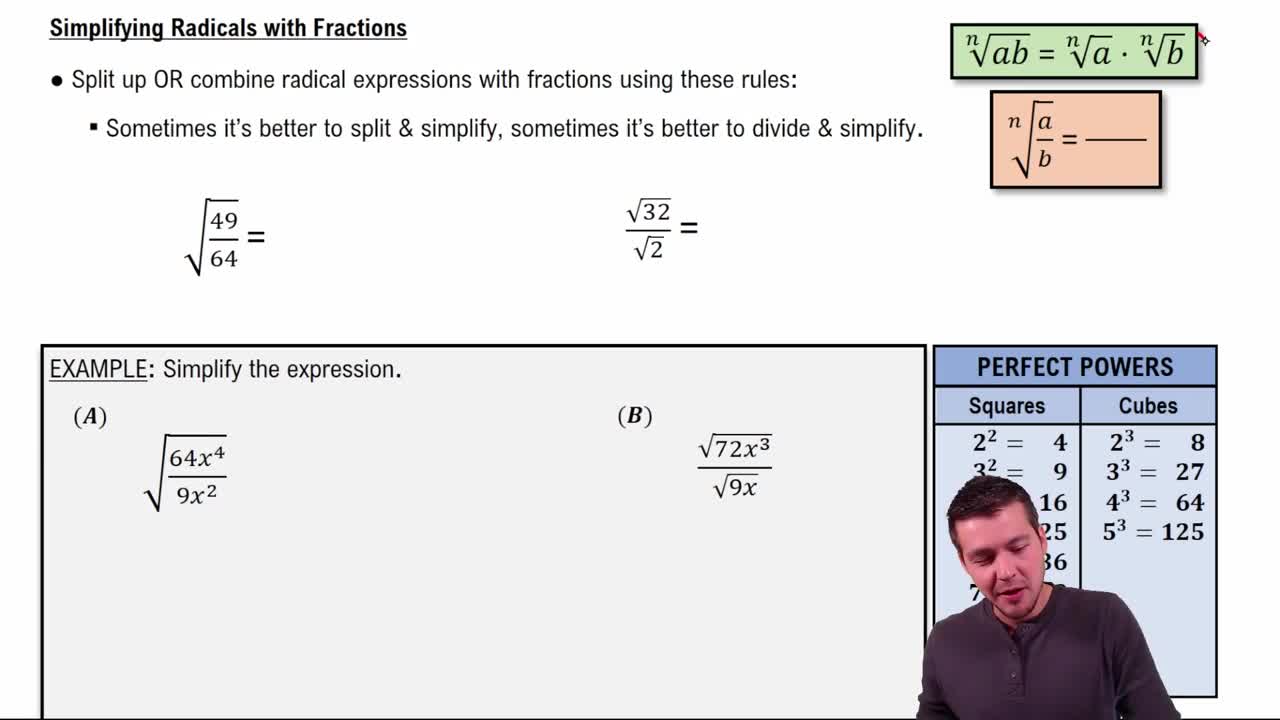
Verified video answer for a similar problem:
This video solution was recommended by our tutors as helpful for the problem above.
Video duration:
3m
Play a video:
0 Comments
Key Concepts
Here are the essential concepts you must grasp in order to answer the question correctly.
Multiplication of Binomials
Multiplying binomials involves applying the distributive property, often referred to as the FOIL method (First, Outside, Inside, Last). This technique helps in systematically multiplying each term in the first binomial by each term in the second binomial, ensuring that all combinations are accounted for in the final expression.
A radical expression contains a root symbol, indicating the extraction of a root from a number. In this context, simplifying radical expressions involves reducing them to their simplest form, which may include combining like terms or rationalizing denominators to eliminate radicals from the denominator.
Simplification of expressions refers to the process of reducing an expression to its most basic form. This can involve combining like terms, factoring, or simplifying radical expressions, making the final result easier to interpret and work with in further calculations.

 3:36 minutes
 Verified step by step guidance
 03:42
03:42