The functions in Exercises 11-28 are all one-to-one. For each function, a. Find an equation for f-1(x), the inverse function. b. Verify that your equation is correct by showing that f(ƒ-1 (x)) = = x and ƒ-1 (f(x)) = x. f(x) = (x+2)³
Table of contents
- 0. Review of Algebra4h 18m
- 1. Equations & Inequalities3h 18m
- 2. Graphs of Equations1h 43m
- 3. Functions2h 17m
- 4. Polynomial Functions1h 44m
- 5. Rational Functions1h 23m
- 6. Exponential & Logarithmic Functions2h 28m
- 7. Systems of Equations & Matrices4h 5m
- 8. Conic Sections2h 23m
- 9. Sequences, Series, & Induction1h 22m
- 10. Combinatorics & Probability1h 45m
3. Functions
Function Composition
Problem 11
Textbook Question
The functions in Exercises 11-28 are all one-to-one. For each function, a. Find an equation for f-1(x), the inverse function. b. Verify that your equation is correct by showing that f(ƒ-1 (x)) = = x and ƒ-1 (f(x)) = x. f(x) = x +3
Verified step by step guidance1
Start with the given function: \(f(x) = x + 3\). To find the inverse function \(f^{-1}(x)\), first replace \(f(x)\) with \(y\): \(y = x + 3\).
Next, interchange the variables \(x\) and \(y\) to reflect the inverse relationship: \(x = y + 3\).
Now, solve this equation for \(y\) to express the inverse function: subtract 3 from both sides to get \(y = x - 3\).
Rewrite \(y\) as \(f^{-1}(x)\) to write the inverse function explicitly: \(f^{-1}(x) = x - 3\).
To verify the inverse, compute \(f(f^{-1}(x))\) by substituting \(f^{-1}(x)\) into \(f\): \(f(f^{-1}(x)) = (x - 3) + 3 = x\). Then compute \(f^{-1}(f(x))\) by substituting \(f(x)\) into \(f^{-1}\): \(f^{-1}(f(x)) = (x + 3) - 3 = x\). Both compositions return \(x\), confirming the inverse is correct.
Verified video answer for a similar problem:This video solution was recommended by our tutors as helpful for the problem above
Video duration:
2mPlay a video:
Was this helpful?
Key Concepts
Here are the essential concepts you must grasp in order to answer the question correctly.
One-to-One Functions
A one-to-one function assigns each input a unique output, ensuring no two different inputs share the same output. This property is essential for a function to have an inverse, as the inverse must reverse the mapping without ambiguity.
Recommended video:
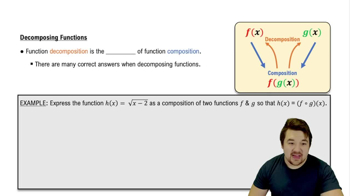
Decomposition of Functions
Inverse Functions
An inverse function reverses the effect of the original function, swapping inputs and outputs. For a function f(x), its inverse f⁻¹(x) satisfies f(f⁻¹(x)) = x and f⁻¹(f(x)) = x, effectively undoing the original operation.
Recommended video:
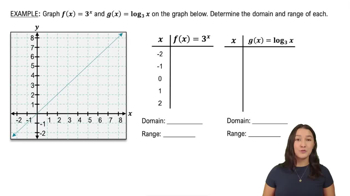
Graphing Logarithmic Functions
Verification of Inverse Functions
To confirm that two functions are inverses, you compose them in both orders: f(f⁻¹(x)) and f⁻¹(f(x)). If both compositions simplify to x, the identity function, the functions are true inverses, validating the correctness of the inverse equation.
Recommended video:
Graphing Logarithmic Functions
Watch next
Master Function Composition with a bite sized video explanation from Patrick
Start learningRelated Videos
Related Practice
Textbook Question
455
views