For each polynomial function, use the remainder theorem to find ƒ(k). ƒ(x) = - x3 + 8x2 + 63; k=4
Verified step by step guidance
1
Recall the Remainder Theorem, which states that the remainder when a polynomial ƒ(x) is divided by (x - k) is equal to ƒ(k). So, to find ƒ(4), we simply substitute x = 4 into the polynomial.
Write down the polynomial function: \(ƒ(x) = -x^{3} + 8x^{2} + 63\).
Substitute \(x = 4\) into the polynomial: \(ƒ(4) = -(4)^{3} + 8(4)^{2} + 63\).
Calculate each term separately: compute \(-(4)^{3}\), then \$8(4)^{2}$, and finally add 63.
Add the results of these calculations to find the value of \(ƒ(4)\), which is the remainder when dividing by \((x - 4)\).
Verified video answer for a similar problem:
This video solution was recommended by our tutors as helpful for the problem above
Video duration:
2m
Play a video:
Was this helpful?
Key Concepts
Here are the essential concepts you must grasp in order to answer the question correctly.
Polynomial Functions
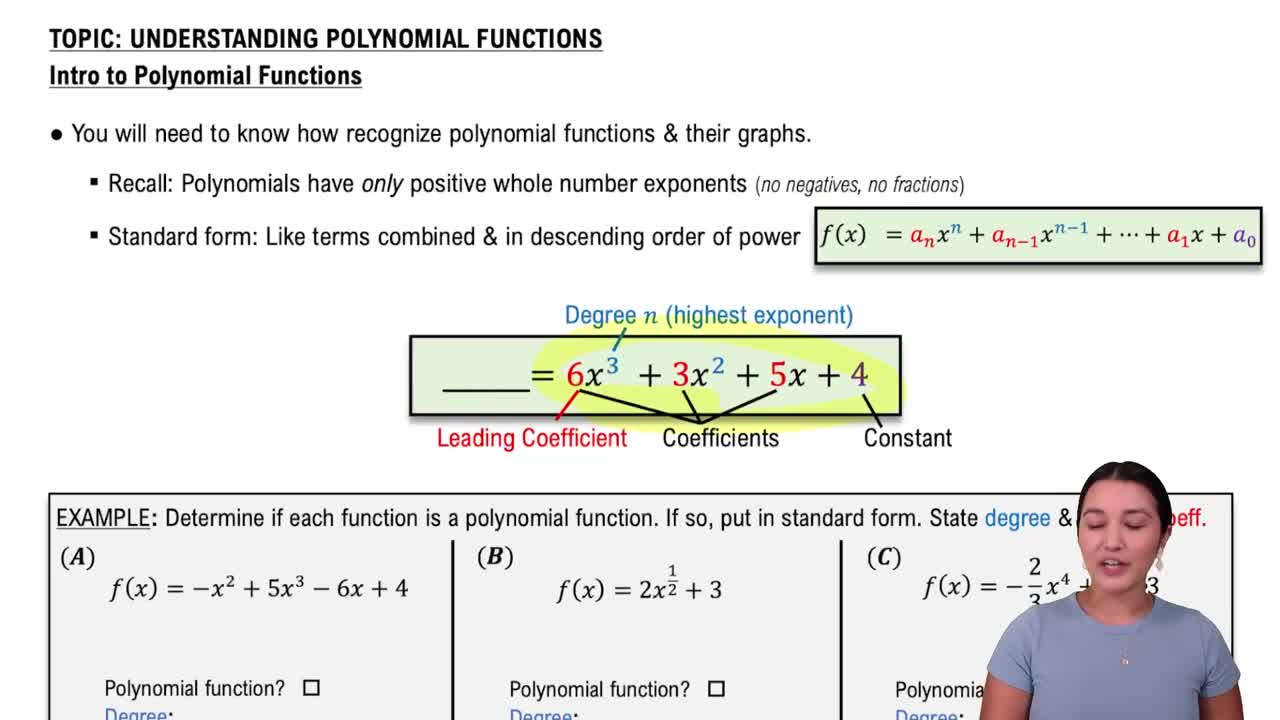
A polynomial function is an expression consisting of variables and coefficients combined using addition, subtraction, multiplication, and non-negative integer exponents. Understanding the structure of polynomial functions helps in evaluating them at specific values and applying related theorems.
The Remainder Theorem states that when a polynomial ƒ(x) is divided by (x - k), the remainder is equal to ƒ(k). This theorem allows us to find the value of the polynomial at k without performing full polynomial division.
Evaluating a polynomial at a given value involves substituting the variable with that value and simplifying. This process is essential for applying the Remainder Theorem and finding ƒ(k) efficiently.