Use the rules for radicals to perform the indicated operations. Assume all variable expressions represent positive real numbers. √7 • √28
Verified step by step guidance
1
Recognize that the problem involves multiplying two square roots: \( \sqrt{7} \cdot \sqrt{28} \).
Use the property of radicals that states \( \sqrt{a} \cdot \sqrt{b} = \sqrt{a \cdot b} \).
Multiply the numbers under the radicals: \( 7 \cdot 28 \).
Calculate the product inside the square root: \( \sqrt{196} \).
Simplify \( \sqrt{196} \) by finding its square root.
Verified video answer for a similar problem:
This video solution was recommended by our tutors as helpful for the problem above
Video duration:
1m
Play a video:
Was this helpful?
Key Concepts
Here are the essential concepts you must grasp in order to answer the question correctly.
Properties of Radicals
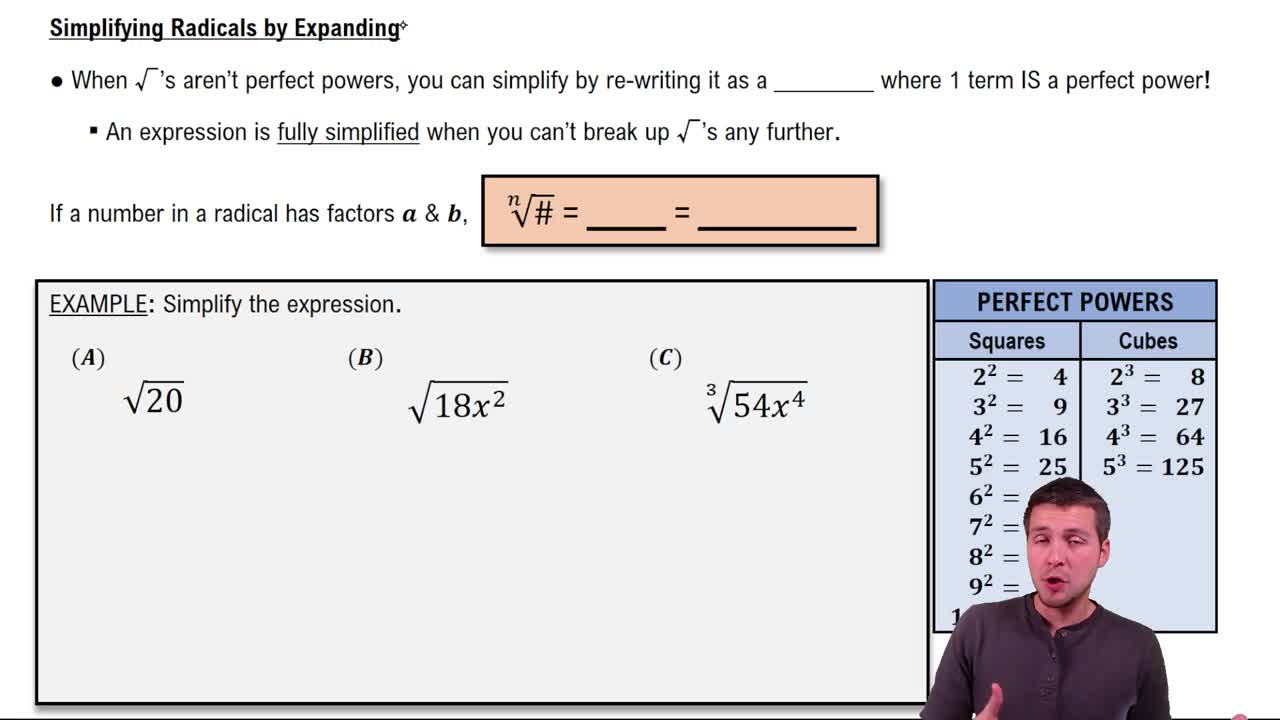
The properties of radicals include rules that govern how to simplify and manipulate square roots. Key properties include the product rule, which states that the square root of a product is the product of the square roots, and the quotient rule, which allows for the simplification of square roots of fractions. Understanding these properties is essential for performing operations involving radicals.
Simplifying radicals involves expressing a radical in its simplest form, which often includes factoring out perfect squares. For example, √28 can be simplified to √(4*7), which equals 2√7. This process is crucial for making calculations easier and clearer when working with radical expressions.
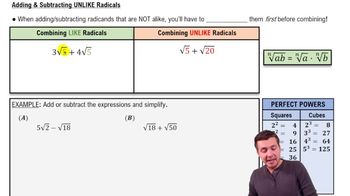
Adding & Subtracting Unlike Radicals by Simplifying
Assumption of Positive Real Numbers
In this context, assuming all variable expressions represent positive real numbers is important because it eliminates concerns about complex numbers or negative values under the square root. This assumption ensures that the operations performed on the radicals yield real number results, which is a fundamental aspect of working with square roots in algebra.