Work each problem. Show that √2/2 + √2/2 i is a square root of i.
Verified step by step guidance
1
Express the given complex number as \(z = \frac{\sqrt{2}}{2} + \frac{\sqrt{2}}{2}i\).
Recall that to show \(z\) is a square root of \(i\), we need to verify that \(z^2 = i\).
Calculate \(z^2\) by using the formula for squaring a complex number: \((a + bi)^2 = a^2 + 2abi + (bi)^2\) where \(a = \frac{\sqrt{2}}{2}\) and \(b = \frac{\sqrt{2}}{2}\).
Substitute the values of \(a\) and \(b\) into the formula and simplify each term carefully, remembering that \(i^2 = -1\).
After simplification, compare the result of \(z^2\) with \(i\) to confirm whether they are equal, thus proving \(z\) is a square root of \(i\).
Verified video answer for a similar problem:
This video solution was recommended by our tutors as helpful for the problem above
Video duration:
8m
Play a video:
Was this helpful?
Key Concepts
Here are the essential concepts you must grasp in order to answer the question correctly.
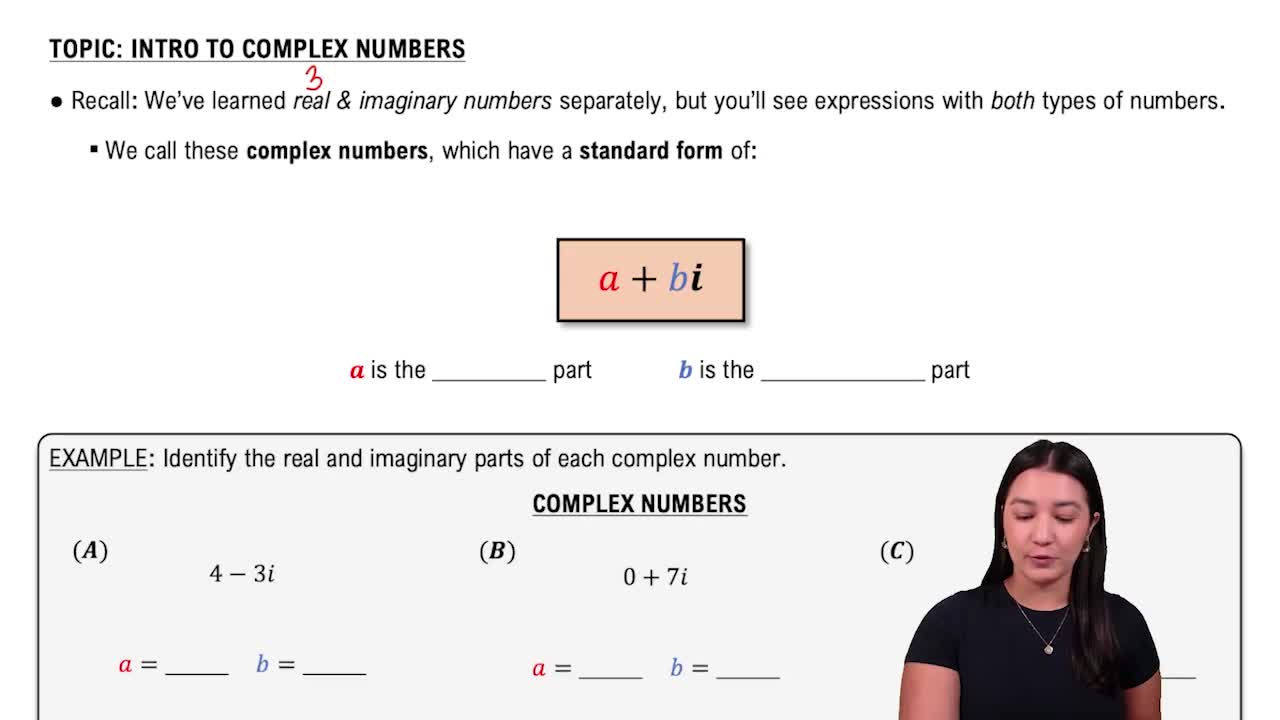
Complex Numbers and Imaginary Unit
Complex numbers are numbers in the form a + bi, where a and b are real numbers and i is the imaginary unit with the property i² = -1. Understanding how to work with i is essential for manipulating and interpreting expressions involving complex numbers.
Finding the square root of a complex number involves determining a complex number which, when squared, equals the original number. This requires knowledge of how to square complex numbers and equate real and imaginary parts to verify the root.
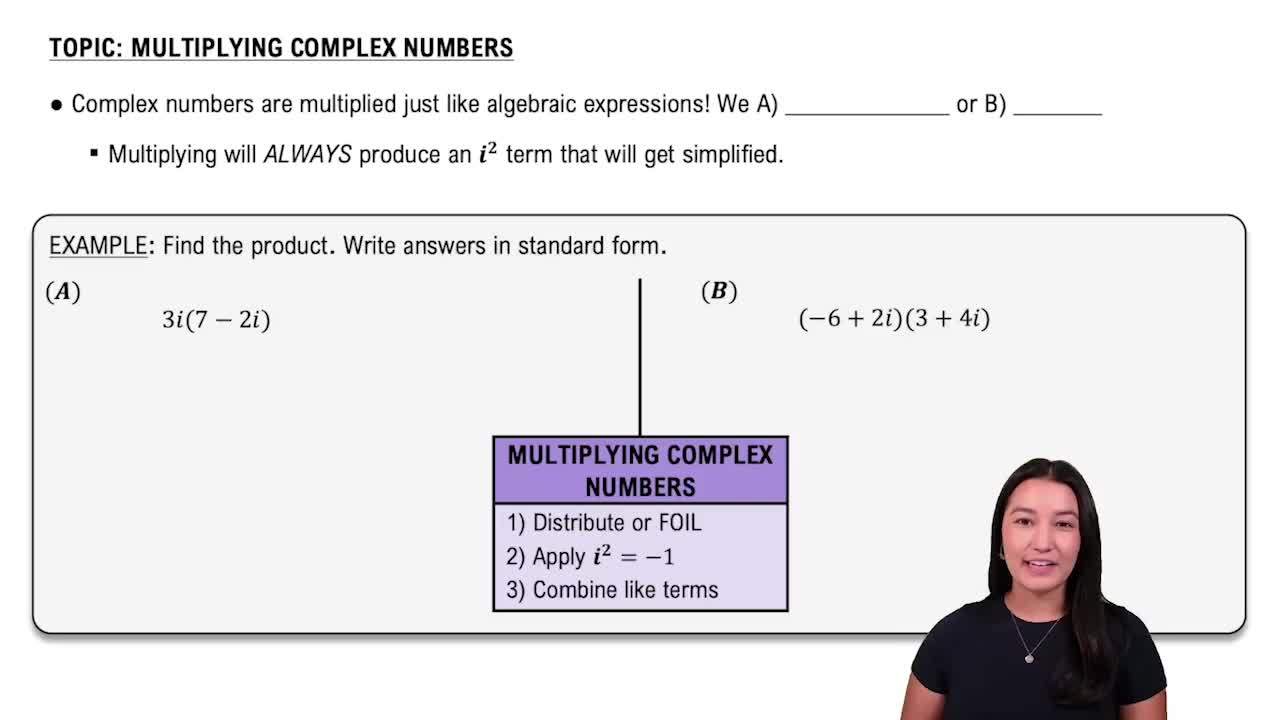
Multiplication of Complex Numbers in Standard Form
Multiplying complex numbers in the form a + bi involves using the distributive property and the fact that i² = -1. This process helps verify if a given complex number squared equals another complex number, such as checking if (√2/2 + √2/2 i)² equals i.