Ch. 1 - Equations and Inequalities
Lial - College Algebra 13th Edition
Lial13th EditionCollege AlgebraISBN: 9780136881063Not the one you use?Change textbook
Chapter 2, Problem 105

Work each problem. Show that -2+i is a solution of the equation x²+4x+5=0.

Verified step by step guidance
1
Start by understanding that to show \(-2 + i\) is a solution of the equation \(x^2 + 4x + 5 = 0\), you need to substitute \(x = -2 + i\) into the equation and verify that the left-hand side equals zero.
Substitute \(x = -2 + i\) into the equation: calculate \((-2 + i)^2 + 4(-2 + i) + 5\).
First, expand \((-2 + i)^2\) using the formula \((a + b)^2 = a^2 + 2ab + b^2\): \[(-2)^2 + 2(-2)(i) + i^2\]
Next, simplify the terms: - \((-2)^2 = 4\) - \(2(-2)(i) = -4i\) - \(i^2 = -1\) (since \(i\) is the imaginary unit) So, \((-2 + i)^2 = 4 - 4i - 1 = 3 - 4i\).
Now, substitute back and simplify the entire expression: \[(3 - 4i) + 4(-2 + i) + 5\] Calculate \(4(-2 + i) = -8 + 4i\), then combine all terms: \[3 - 4i - 8 + 4i + 5\] Group like terms and simplify to check if the result equals zero.

Verified video answer for a similar problem:

This video solution was recommended by our tutors as helpful for the problem above.
Video duration:
8m
Was this helpful?

Key Concepts

Here are the essential concepts you must grasp in order to answer the question correctly.

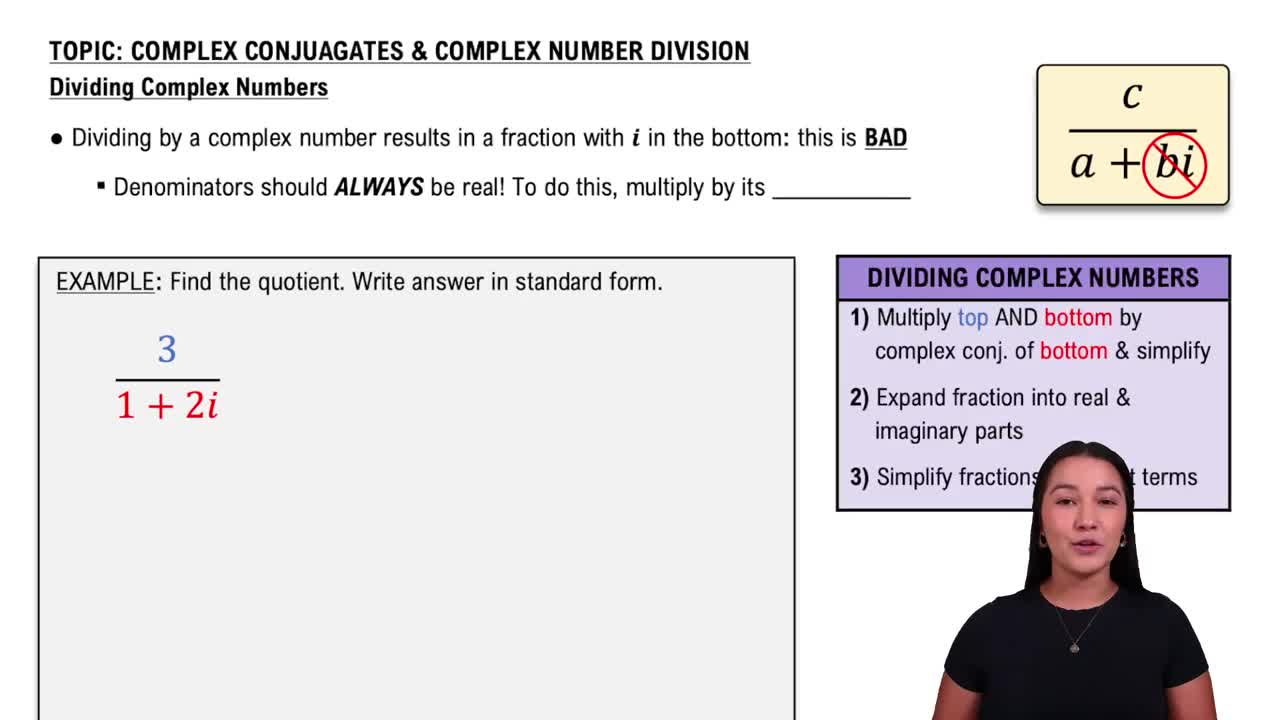
Complex Numbers

Complex numbers include a real part and an imaginary part, expressed as a + bi, where i is the imaginary unit with the property i² = -1. Understanding how to work with complex numbers is essential for evaluating expressions and verifying solutions involving imaginary components.
Recommended video:
04:22
Dividing Complex Numbers

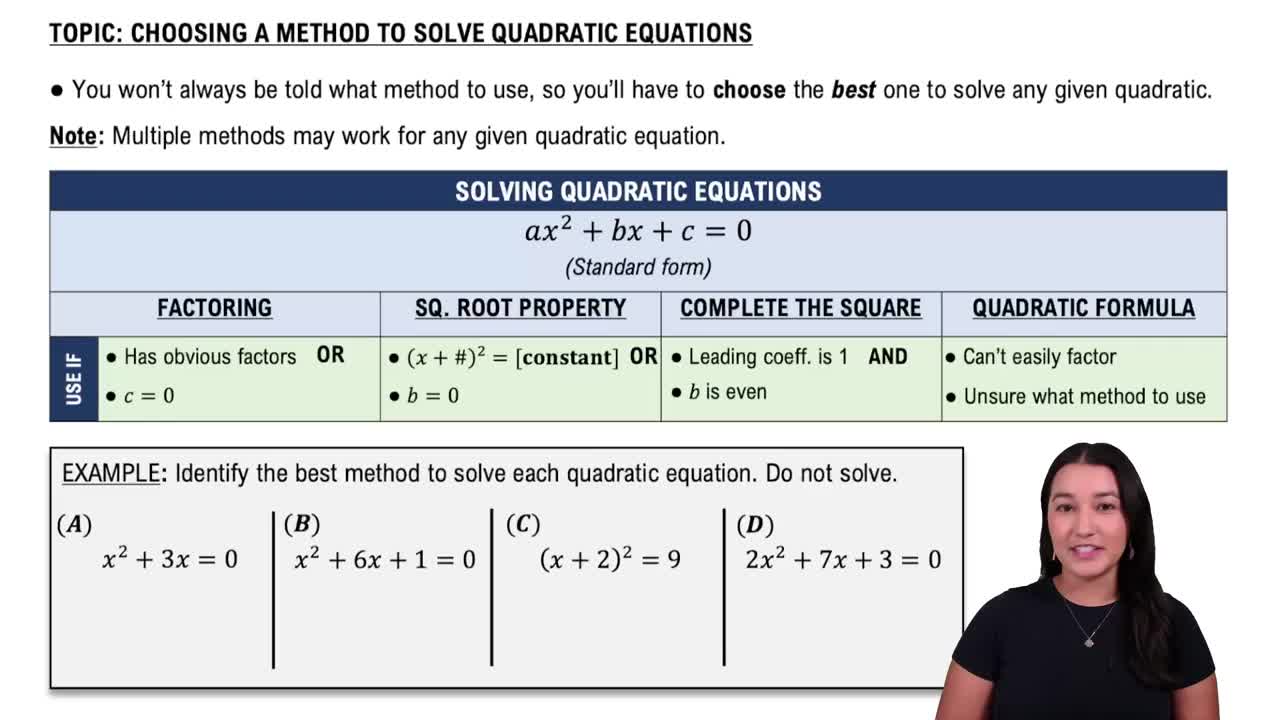
Substitution Method

The substitution method involves replacing the variable in an equation with a given value to check if it satisfies the equation. Here, substituting x = -2 + i into the quadratic equation helps verify whether it is a root.
Recommended video:
04:03
Choosing a Method to Solve Quadratics

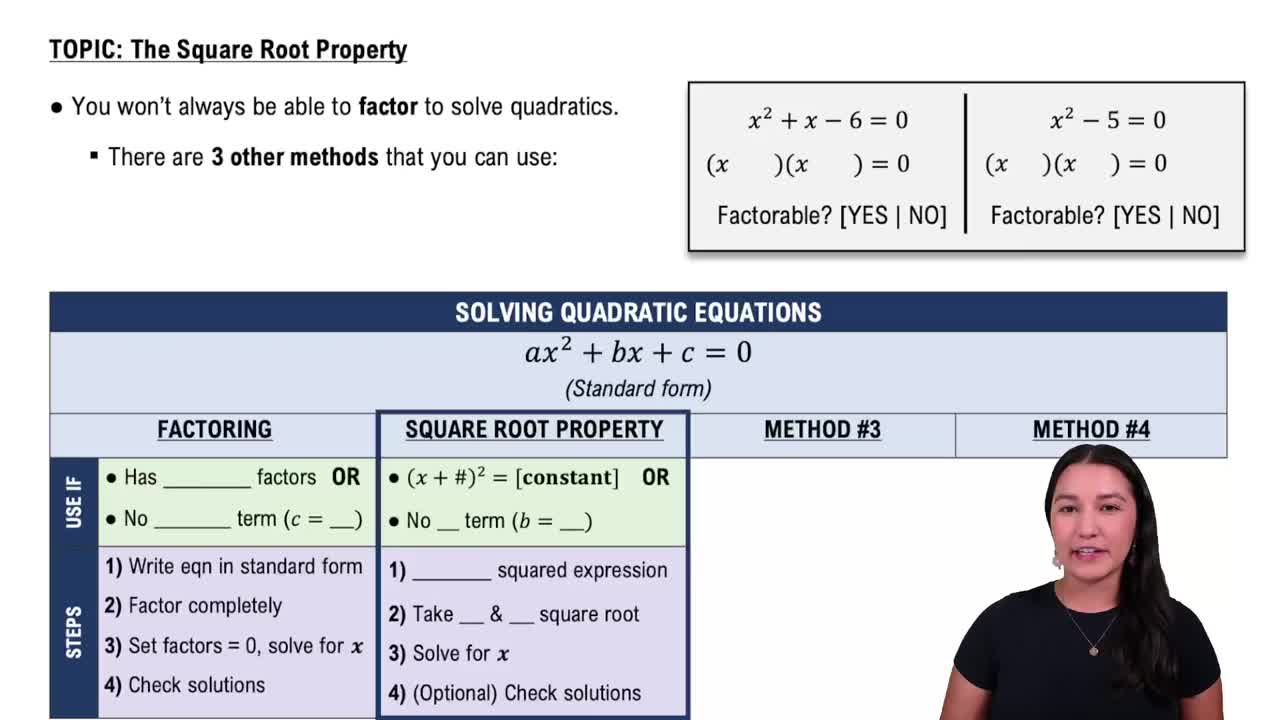
Quadratic Equations and Roots

Quadratic equations are polynomial equations of degree two, typically in the form ax² + bx + c = 0. Their solutions, or roots, can be real or complex, and verifying a root means confirming that substituting it into the equation yields zero.
Recommended video:
06:12
Solving Quadratic Equations by the Square Root Property