In Exercises 1–14, express each interval in set-builder notation and graph the interval on a number line. [- 3, ∞)
Verified step by step guidance
1
Identify the given interval: \([-3, \infty)\), which includes all real numbers starting from \(-3\) and extending to positive infinity.
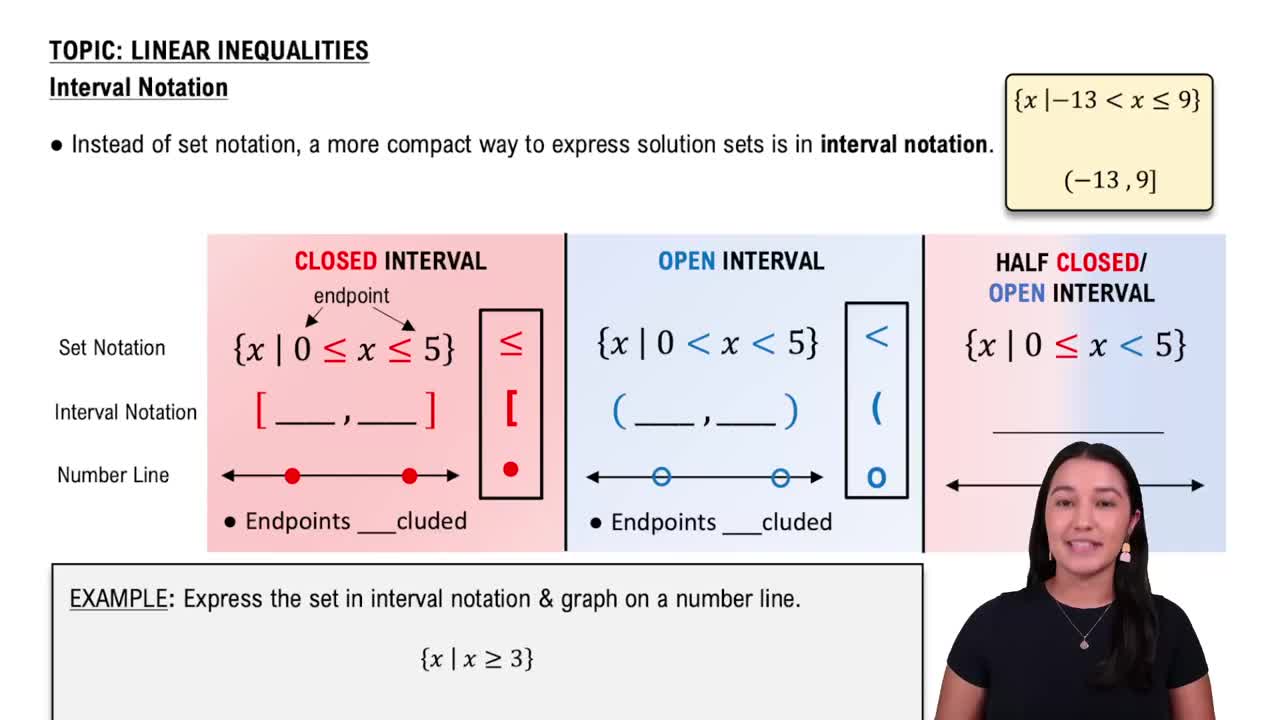
Understand that the square bracket '[' means the endpoint \(-3\) is included in the interval, so \(x\) can be equal to \(-3\).
The parenthesis ')' next to \(\infty\) means infinity is not a number we can reach or include, but the interval extends indefinitely to the right.
Write the set-builder notation by describing all \(x\) such that \(x\) is greater than or equal to \(-3\): \(\{ x \mid x \geq -3 \}\).
To graph this on a number line, draw a solid dot at \(-3\) to show it is included, and shade the line to the right extending towards infinity.
Verified video answer for a similar problem:
This video solution was recommended by our tutors as helpful for the problem above
Video duration:
1m
Play a video:
Was this helpful?
Key Concepts
Here are the essential concepts you must grasp in order to answer the question correctly.
Interval Notation
Interval notation is a way to represent a set of numbers between two endpoints. Square brackets [ ] indicate that an endpoint is included (closed interval), while parentheses ( ) mean the endpoint is excluded (open interval). For example, [-3, ∞) includes -3 and all numbers greater than -3.
Set-builder notation describes a set by specifying a property that its members satisfy. It uses a variable, a vertical bar or colon, and a condition, such as {x | x ≥ -3}, meaning the set of all x such that x is greater than or equal to -3.
Graphing intervals involves shading the portion of the number line that represents the interval. Closed endpoints are shown with solid dots, indicating inclusion, while open endpoints use hollow dots. For [-3, ∞), a solid dot is placed at -3, and the line extends infinitely to the right.