
Textbook Question
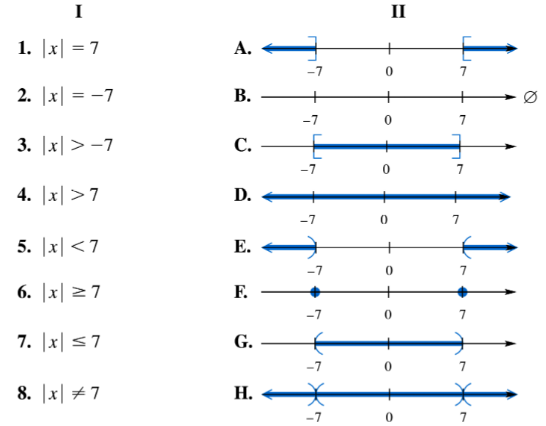
Match each equation or inequality in Column I with the graph of its solution set in Column II. | x | ≠ 7
721
views

 Verified step by step guidance
 06:07
06:07
 05:18
05:18 04:29
04:29Match each equation or inequality in Column I with the graph of its solution set in Column II. | x | ≠ 7
Solve each problem. Suppose two acid solutions are mixed. One is 26% acid and the other is 34% acid. Which one of the following concentrations cannot possibly be the concentration of the mixture? A. 24% B. 30% C. 31% D. 33%
Solve each problem. If x represents the number of pennies in a jar in an applied problem, which of the following equations cannot be a correct equation for finding x? (Hint:Solve the equations and consider the solutions.)
A. 5x+3 =11
B.12x+6 =-4
C.100x =50(x+3)
D. 6(x+4) =x+24
Decide whether each statement is true or false. The equation 5x=4x is an example of a contradiction.
Decide whether each statement is true or false. If false, correct the right side of the equation. i12 = 1
Match each equation in Column I with the correct first step for solving it in Column II. √(x+5) = 7