Solve each radical equation in Exercises 11–30. Check all proposed solutions. √(6x + 1) = x - 1
Table of contents
- 0. Review of Algebra4h 18m
- 1. Equations & Inequalities3h 18m
- 2. Graphs of Equations1h 43m
- 3. Functions2h 17m
- 4. Polynomial Functions1h 44m
- 5. Rational Functions1h 23m
- 6. Exponential & Logarithmic Functions2h 28m
- 7. Systems of Equations & Matrices4h 5m
- 8. Conic Sections2h 23m
- 9. Sequences, Series, & Induction1h 22m
- 10. Combinatorics & Probability1h 45m
1. Equations & Inequalities
Choosing a Method to Solve Quadratics
Problem 93
Textbook Question
Use the method described in Exercises 83–86, if applicable, and properties of absolute value to solve each equation or inequality. (Hint: Exercises 99 and 100 can be solved by inspection.) | x2 - 9 | = x + 3
Verified step by step guidance1
Start by recognizing that the equation involves an absolute value: \(|x^2 - 9| = x + 3\). Recall that the absolute value \(|A|\) equals \(A\) if \(A \geq 0\), and equals \(-A\) if \(A < 0\).
Set up two separate cases based on the definition of absolute value:
Case 1: \(x^2 - 9 \geq 0\), so \(|x^2 - 9| = x^2 - 9\). The equation becomes:
\(x^2 - 9 = x + 3\).
Case 2: \(x^2 - 9 < 0\), so \(|x^2 - 9| = -(x^2 - 9) = -x^2 + 9\). The equation becomes:
\(-x^2 + 9 = x + 3\).
Solve each case separately:
For Case 1, rearrange the equation to standard quadratic form:
\(x^2 - 9 = x + 3 \implies x^2 - x - 12 = 0\).
For Case 2, rearrange similarly:
\(-x^2 + 9 = x + 3 \implies -x^2 - x + 6 = 0\) or equivalently \(x^2 + x - 6 = 0\) after multiplying both sides by \(-1\).
Solve each quadratic equation using factoring, completing the square, or the quadratic formula to find the possible values of \(x\) for each case.
Check each solution against the original case condition (\(x^2 - 9 \geq 0\) for Case 1 and \(x^2 - 9 < 0\) for Case 2) to ensure the solution is valid. Discard any solutions that do not satisfy the respective condition.
Verified video answer for a similar problem:This video solution was recommended by our tutors as helpful for the problem above
Video duration:
3mPlay a video:
Was this helpful?
Key Concepts
Here are the essential concepts you must grasp in order to answer the question correctly.
Absolute Value Properties
Absolute value represents the distance of a number from zero on the number line, always non-negative. For an equation |A| = B, if B ≥ 0, then A = B or A = -B. Understanding how to split absolute value equations into two cases is essential for solving equations like |x² - 9| = x + 3.
Recommended video:
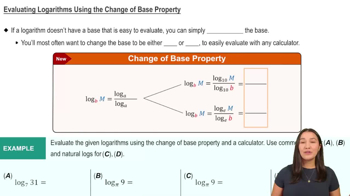
Change of Base Property
Quadratic Expressions and Factoring
The expression inside the absolute value, x² - 9, is a quadratic that can be factored as (x - 3)(x + 3). Factoring helps identify critical points and simplifies solving the equation by breaking it into manageable parts, especially when combined with absolute value properties.
Recommended video:
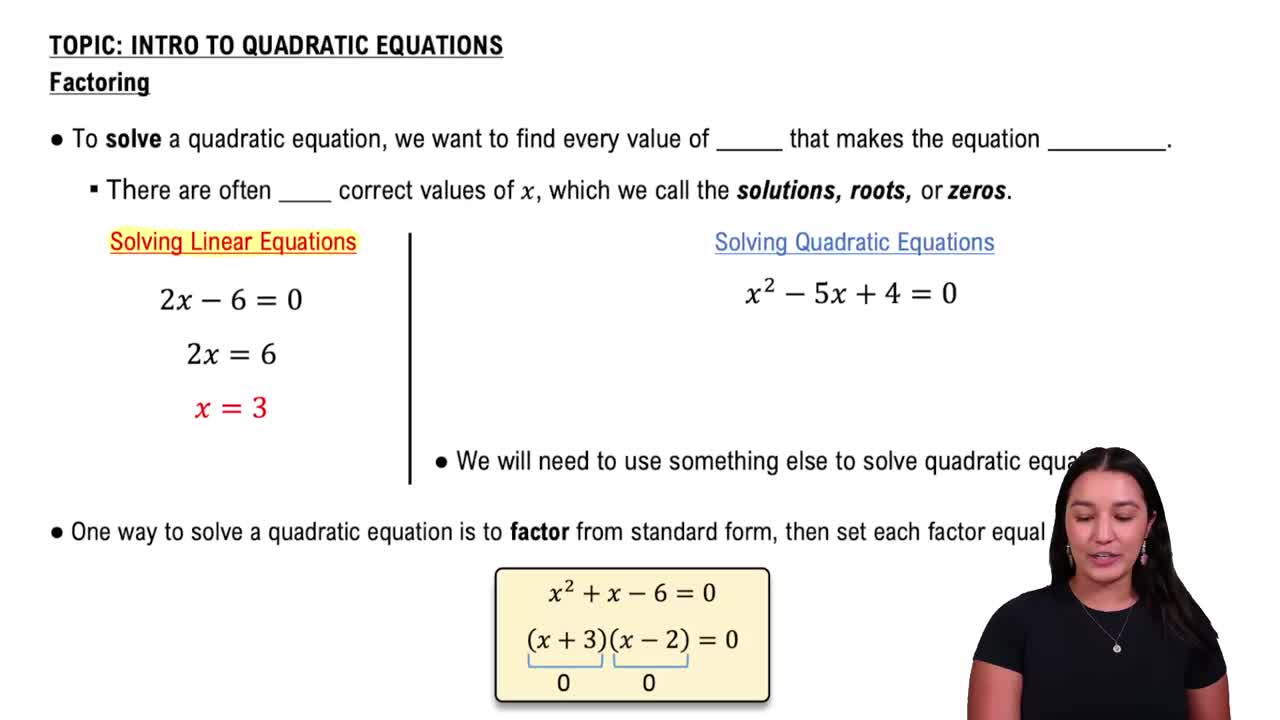
Solving Quadratic Equations by Factoring
Solving Equations Involving Absolute Values and Quadratics
To solve |x² - 9| = x + 3, consider the domain where the right side is non-negative, then split into cases: x² - 9 = x + 3 and -(x² - 9) = x + 3. Solve each quadratic equation separately and check for extraneous solutions, ensuring the solutions satisfy the original absolute value equation.
Recommended video:
Solving Quadratic Equations by Factoring
Watch next
Master Choosing a Method to Solve Quadratics with a bite sized video explanation from Patrick
Start learningRelated Videos
Related Practice
Textbook Question
335
views