Show that the real zeros of each polynomial function satisfy the given conditions. ƒ(x)=x5-3x3+x+2; no real zero greater than 2
Table of contents
- 0. Review of Algebra4h 18m
- 1. Equations & Inequalities3h 18m
- 2. Graphs of Equations1h 43m
- 3. Functions2h 17m
- 4. Polynomial Functions1h 44m
- 5. Rational Functions1h 23m
- 6. Exponential & Logarithmic Functions2h 28m
- 7. Systems of Equations & Matrices4h 5m
- 8. Conic Sections2h 23m
- 9. Sequences, Series, & Induction1h 22m
- 10. Combinatorics & Probability1h 45m
4. Polynomial Functions
Understanding Polynomial Functions
Problem 83
Textbook Question
Use a graphing calculator to find the coordinates of the turning points of the graph of each polynomial function in the given domain interval. Give answers to the nearest hundredth. ƒ(x)=2x3-5x2-x+1; [-1, 0]
Verified step by step guidance1
Understand that turning points of a polynomial function occur where the derivative equals zero, as these points correspond to local maxima or minima on the graph.
Find the first derivative of the function \( f(x) = 2x^3 - 5x^2 - x + 1 \). Use the power rule for differentiation: \( f'(x) = 6x^2 - 10x - 1 \).
Use the graphing calculator to graph the derivative function \( f'(x) = 6x^2 - 10x - 1 \) over the domain interval \( [-1, 0] \) and find the x-values where \( f'(x) = 0 \). These x-values are the critical points where turning points may occur.
For each critical x-value found, substitute it back into the original function \( f(x) = 2x^3 - 5x^2 - x + 1 \) to find the corresponding y-coordinate of the turning point.
Round the coordinates of each turning point to the nearest hundredth as requested, and verify that these points lie within the given domain interval \( [-1, 0] \).
Verified video answer for a similar problem:This video solution was recommended by our tutors as helpful for the problem above
Video duration:
2mPlay a video:
Was this helpful?
Key Concepts
Here are the essential concepts you must grasp in order to answer the question correctly.
Turning Points of a Polynomial Function
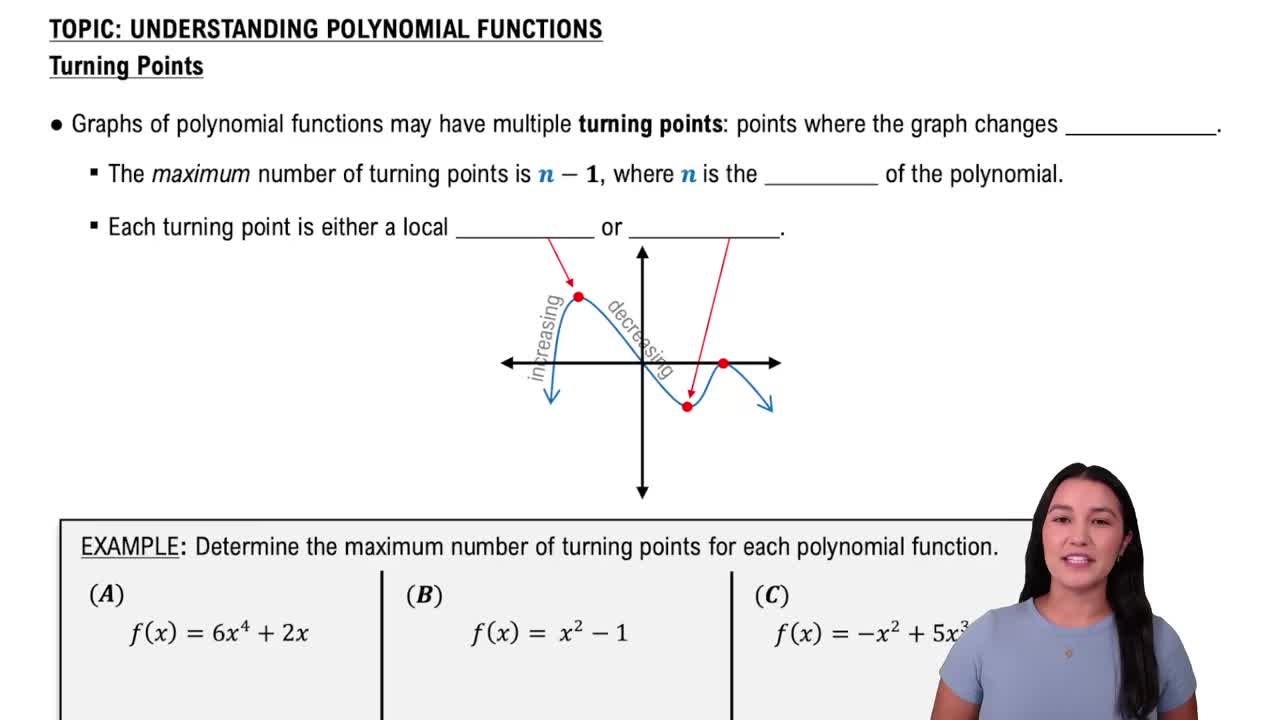
Turning points are points on the graph where the function changes direction from increasing to decreasing or vice versa. For polynomial functions, these correspond to local maxima or minima and occur where the derivative equals zero. Identifying turning points helps understand the shape and behavior of the graph.
Recommended video:
Maximum Turning Points of a Polynomial Function
Using a Graphing Calculator to Find Turning Points
A graphing calculator can plot the polynomial and use built-in features to locate turning points by finding where the slope (derivative) is zero. It allows zooming into the specified domain and provides coordinates of these points, often to a desired decimal precision, such as the nearest hundredth.
Recommended video:
Maximum Turning Points of a Polynomial Function
Domain Restriction and Interval Analysis
Restricting the domain to a specific interval, like [-1, 0], means only considering the graph and turning points within that range. This focuses the analysis and ensures that only relevant turning points are identified, which is important when the function has multiple turning points outside the interval.
Recommended video:
Domain Restrictions of Composed Functions
Watch next
Master Introduction to Polynomial Functions with a bite sized video explanation from Patrick
Start learningRelated Videos
Related Practice
Textbook Question
413
views