Determine the constant that should be added to the binomial so that it becomes a perfect square trinomial. Then write and factor the trinomial. x2 - 10x
Ch. 1 - Equations and Inequalities

Chapter 2, Problem 37
Solve each equation with rational exponents in Exercises 31–40. Check all proposed solutions. (x - 4)2/3 = 16
Verified step by step guidance1
Recognize that the equation involves a rational exponent: \( (x - 4)^{\frac{2}{3}} = 16 \). The exponent \(\frac{2}{3}\) means we first take the cube root of \(x - 4\) and then square the result.
To eliminate the rational exponent, raise both sides of the equation to the reciprocal power, which is \(\frac{3}{2}\). This gives: \(\left((x - 4)^{\frac{2}{3}}\right)^{\frac{3}{2}} = 16^{\frac{3}{2}}\).
Simplify the left side using the property of exponents \(\left(a^{m}\right)^{n} = a^{mn}\), so the left side becomes \(x - 4\). The equation now is \(x - 4 = 16^{\frac{3}{2}}\).
Evaluate \(16^{\frac{3}{2}}\) by first finding the square root of 16, which is 4, and then raising 4 to the 3rd power, which is \$4^3$. This gives the right side value.
Solve for \(x\) by adding 4 to both sides: \(x = 16^{\frac{3}{2}} + 4\). Finally, check all proposed solutions by substituting them back into the original equation to ensure they satisfy it.

Verified video answer for a similar problem:
This video solution was recommended by our tutors as helpful for the problem above.
Video duration:
3mWas this helpful?
Key Concepts
Here are the essential concepts you must grasp in order to answer the question correctly.
Rational Exponents
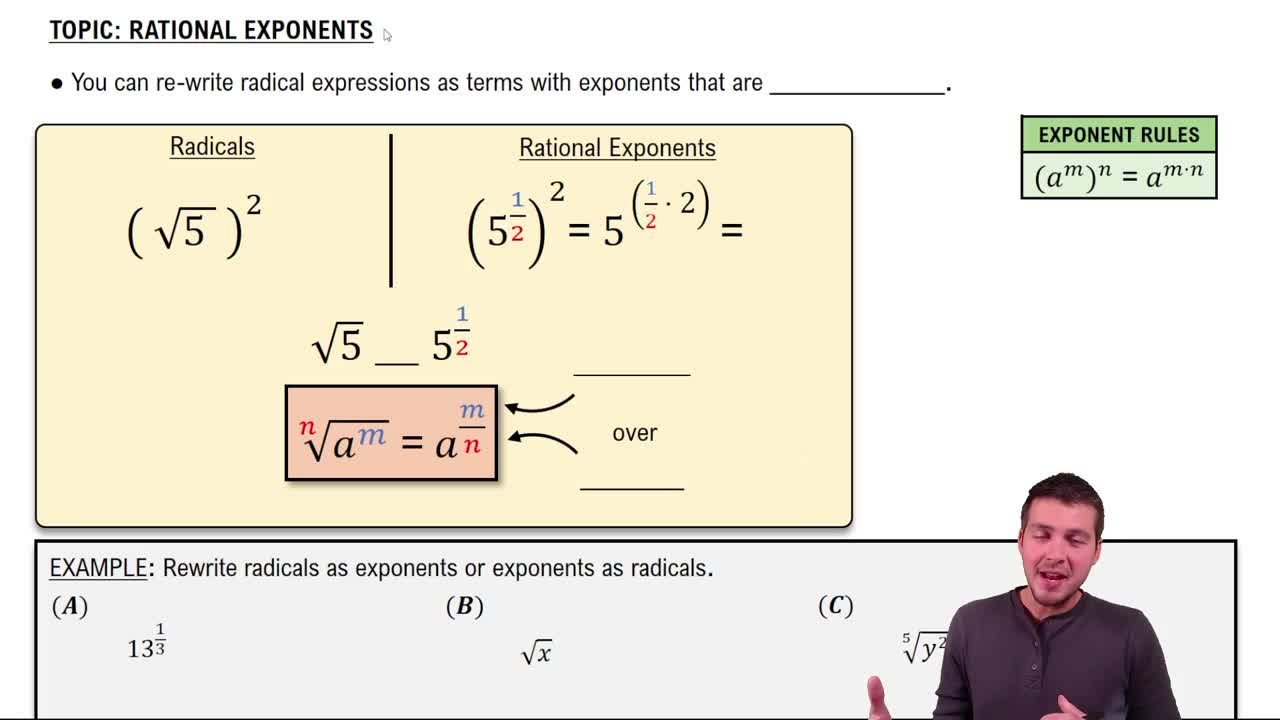
Rational exponents represent roots and powers combined; for example, an exponent of m/n means taking the nth root and then raising to the mth power. Understanding how to manipulate expressions with rational exponents is essential for solving equations like (x - 4)^(2/3) = 16.
Recommended video:
Guided course
Rational Exponents
Isolating the Variable
To solve equations, isolate the term containing the variable by undoing operations step-by-step. For rational exponents, this often involves raising both sides of the equation to the reciprocal power to eliminate the exponent and solve for the variable.
Recommended video:
Guided course
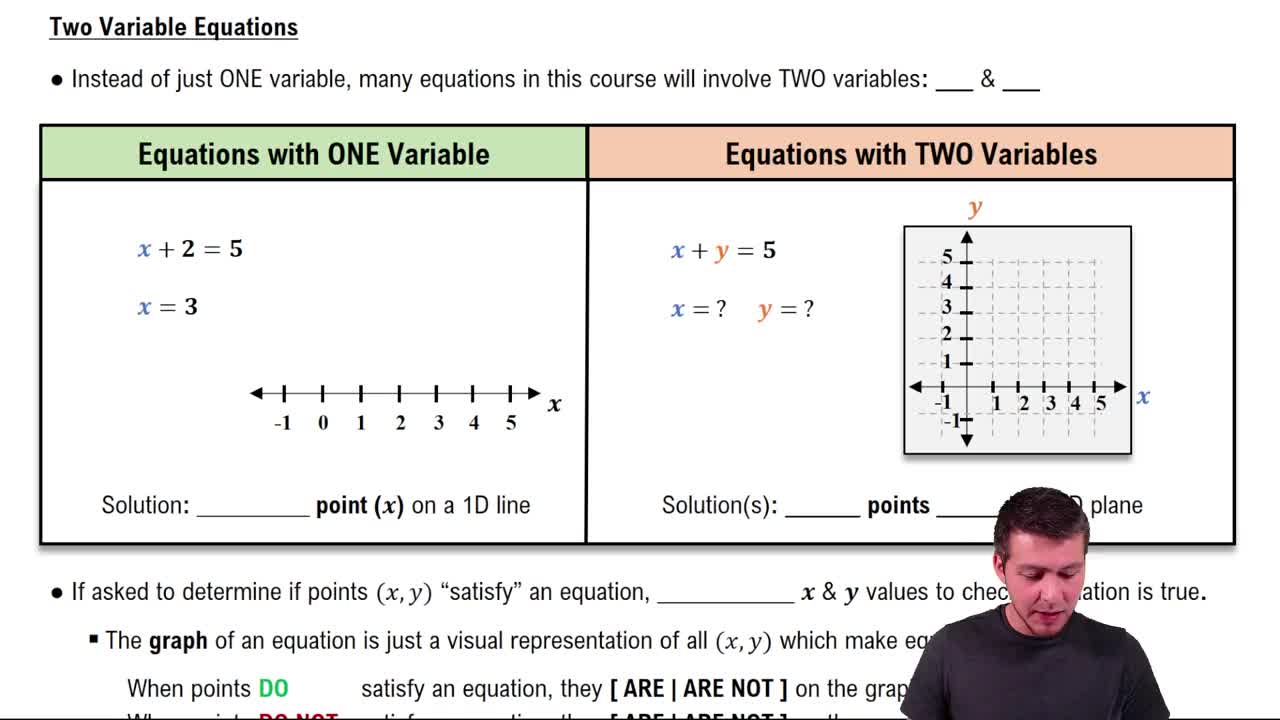
Equations with Two Variables
Checking Solutions
After solving, substitute proposed solutions back into the original equation to verify they satisfy it. This is crucial when dealing with rational exponents, as raising to even roots can introduce extraneous solutions that do not satisfy the original equation.
Recommended video:
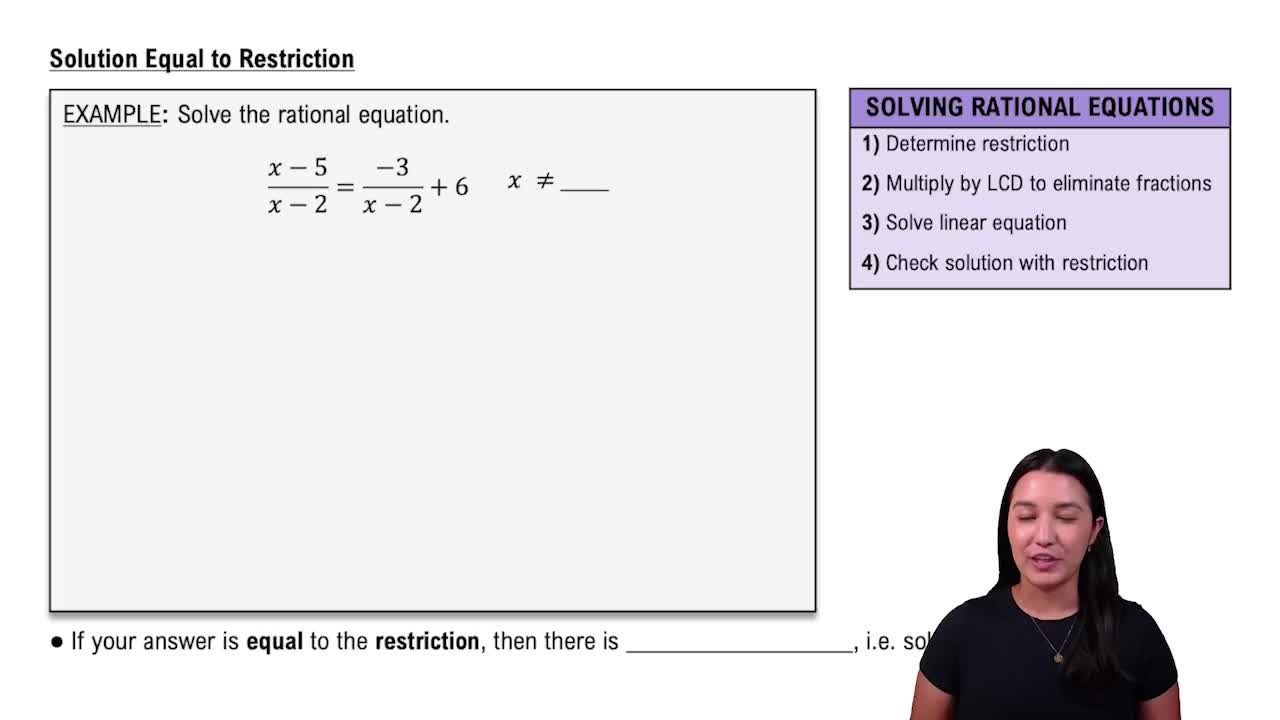
Restrictions on Rational Equations
Related Practice
Textbook Question
1318
views
Textbook Question
In Exercises 37–52, perform the indicated operations and write the result in standard form. √-64 - √-25
810
views
Textbook Question
In all exercises, other than exercises with no solution, use interval notation to express solution sets and graph each solution set on a number line. In Exercises 27–50, solve each linear inequality. 2x - 11 < - 3(x + 2)
1004
views
Textbook Question
In Exercises 35–54, solve each formula for the specified variable. Do you recognize the formula? If so, what does it describe? A = (1/2)bh for b
702
views
Textbook Question
Solve each formula for the specified variable. Do you recognize the formula? If so, what does it describe? V = (1/3)Bh for B
702
views
Textbook Question
Solve each formula for the specified variable. Do you recognize the formula? If so, what does it describe? D = RT for R
676
views