Evaluate each expression without using a calculator. log2 (1/√2)
Table of contents
- 0. Review of Algebra4h 18m
- 1. Equations & Inequalities3h 18m
- 2. Graphs of Equations1h 43m
- 3. Functions2h 17m
- 4. Polynomial Functions1h 44m
- 5. Rational Functions1h 23m
- 6. Exponential & Logarithmic Functions2h 28m
- 7. Systems of Equations & Matrices4h 5m
- 8. Conic Sections2h 23m
- 9. Sequences, Series, & Induction1h 22m
- 10. Combinatorics & Probability1h 45m
6. Exponential & Logarithmic Functions
Introduction to Logarithms
Problem 33
Textbook Question
Solve each equation.
Verified step by step guidance1
Recognize that the equation is given as \(x = \log_{4} \sqrt[3]{16}\), where you need to find the value of \(x\).
Rewrite the cube root expression using fractional exponents: \(\sqrt[3]{16} = 16^{\frac{1}{3}}\).
Express 16 as a power of 4, since the logarithm base is 4. Note that \$16 = 4^2\(, so substitute to get \)16^{\frac{1}{3}} = (4^2)^{\frac{1}{3}}$.
Use the power of a power property: \((a^m)^n = a^{m \cdot n}\), to simplify \((4^2)^{\frac{1}{3}}\) to \$4^{\frac{2}{3}}$.
Now the equation becomes \(x = \log_{4} 4^{\frac{2}{3}}\). Use the logarithm power rule \(\log_b (a^m) = m \log_b a\) and the fact that \(\log_b b = 1\) to simplify and solve for \(x\).
Verified video answer for a similar problem:This video solution was recommended by our tutors as helpful for the problem above
Video duration:
4mPlay a video:
Was this helpful?
Key Concepts
Here are the essential concepts you must grasp in order to answer the question correctly.
Logarithms and Their Properties
A logarithm answers the question: to what exponent must the base be raised to produce a given number? For example, log₄(16) asks, '4 raised to what power equals 16?' Understanding how to interpret and manipulate logarithms is essential for solving equations involving them.
Recommended video:
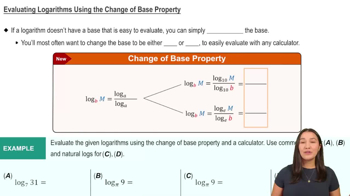
Change of Base Property
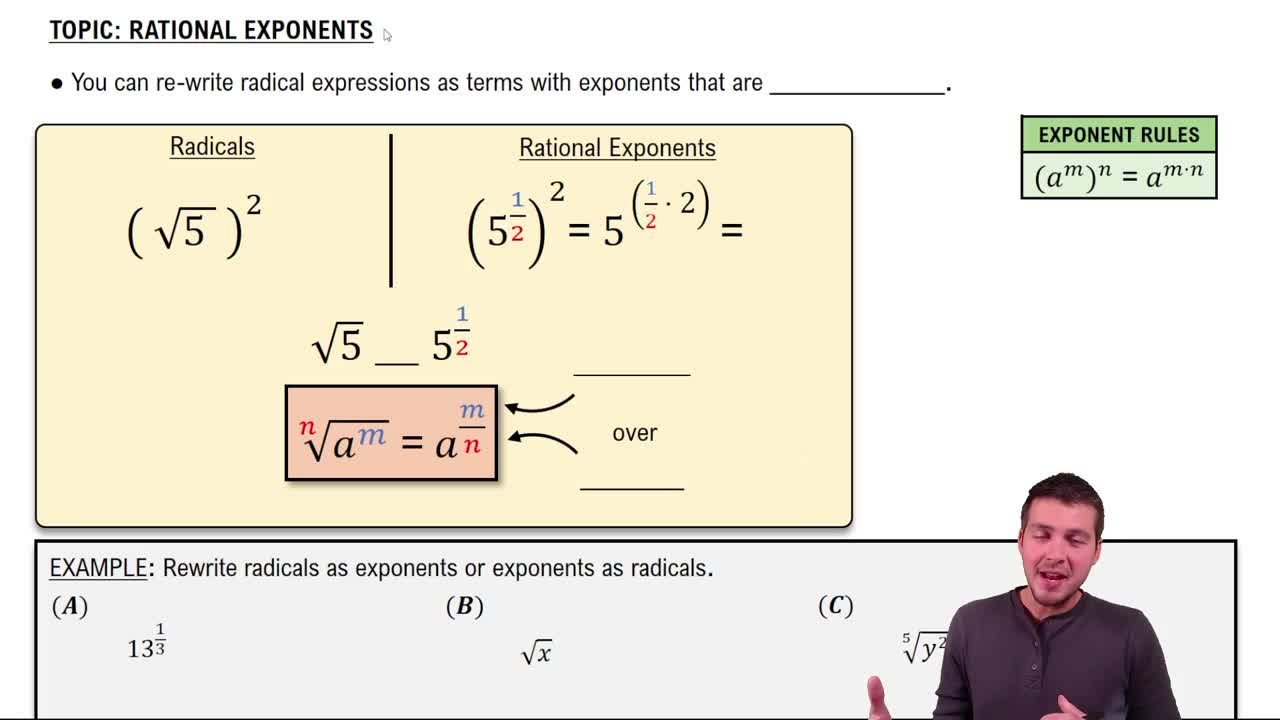
Radicals and Rational Exponents
Radicals like cube roots can be expressed as rational exponents; for instance, the cube root of 16 is 16^(1/3). Converting between radical notation and exponents helps simplify expressions and apply logarithmic rules effectively.
Recommended video:
Guided course
Rational Exponents
Change of Base and Simplification Techniques
Simplifying logarithmic expressions often requires rewriting numbers as powers of the same base or using properties like log(a^b) = b·log(a). Recognizing how to rewrite 16 and apply these properties is key to solving the given equation.
Recommended video:
Change of Base Property
Watch next
Master Logarithms Introduction with a bite sized video explanation from Patrick
Start learningRelated Videos
Related Practice
Textbook Question
661
views