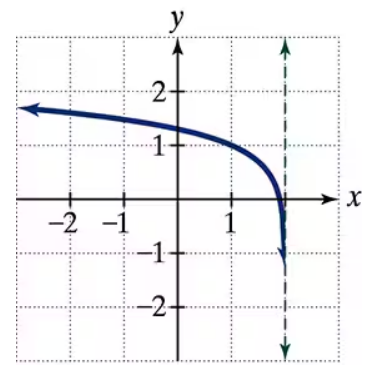
In Exercises 32–35, the graph of a logarithmic function is given. Select the function for each graph from the following options: f(x) = log x, g(x) = log(-x), h(x) = log(2-x), r(x)= 1+log(2-x)
Verified step by step guidance
1
Identify the domain of each logarithmic function option, since the domain determines where the function is defined and affects the graph's shape. For example, for \(f(x) = \log x\), the domain is \(x > 0\); for \(g(x) = \log(-x)\), the domain is \(x < 0\); for \(h(x) = \log(2 - x)\), the domain is \(x < 2\); and for \(r(x) = 1 + \log(2 - x)\), the domain is also \(x < 2\).
Examine the graph's x-values where the function exists. If the graph only shows values for \(x > 0\), it likely corresponds to \(f(x) = \log x\). If the graph exists only for negative \(x\) values, it could be \(g(x) = \log(-x)\). If the graph exists for \(x < 2\), it could be either \(h(x)\) or \(r(x)\).
Look for vertical shifts in the graph. The function \(r(x) = 1 + \log(2 - x)\) is a vertical shift of \(h(x) = \log(2 - x)\) by 1 unit upwards. If the graph appears shifted up compared to the standard logarithmic shape, it suggests \(r(x)\).
Check the behavior near the vertical asymptote. For \(f(x) = \log x\), the vertical asymptote is at \(x = 0\); for \(h(x)\) and \(r(x)\), it is at \(x = 2\). Confirm where the graph approaches negative infinity to identify the asymptote.
Match the graph's shape and domain with the function options based on the above observations to select the correct function for each graph.
Verified video answer for a similar problem:
This video solution was recommended by our tutors as helpful for the problem above
Video duration:
4m
Play a video:
Was this helpful?
Key Concepts
Here are the essential concepts you must grasp in order to answer the question correctly.
Logarithmic Functions and Their Domains
A logarithmic function is defined only for positive arguments inside the log. For example, f(x) = log(x) requires x > 0. Understanding the domain restrictions helps identify which function matches a given graph, as the graph exists only where the input to the log is positive.
Logarithmic functions can be shifted or reflected by modifying their input or output. For instance, g(x) = log(-x) reflects the graph of log(x) across the y-axis, while h(x) = log(2 - x) shifts and reflects it horizontally. The function r(x) = 1 + log(2 - x) also shifts the graph vertically by 1 unit.
Analyzing key features of the graph, such as domain, intercepts, and asymptotes, helps match it to the correct logarithmic function. For example, vertical asymptotes occur where the argument of the log is zero, and shifts in the graph indicate transformations applied to the basic log function.