In Exercises 21–42, evaluate each expression without using a calculator. log64 8
Verified step by step guidance
1
Recognize that the expression \( \log_{64} 8 \) is asking for the power to which 64 must be raised to get 8.
Express 64 and 8 as powers of a common base. Notice that 64 is \( 4^3 \) and 8 is \( 2^3 \).
Rewrite 64 as \( (2^2)^3 = 2^6 \) and 8 as \( 2^3 \).
Set up the equation \( 64^x = 8 \) which becomes \( (2^6)^x = 2^3 \).
Use the property of exponents \( (a^m)^n = a^{m \cdot n} \) to simplify to \( 2^{6x} = 2^3 \), then equate the exponents: \( 6x = 3 \).
Verified video answer for a similar problem:
This video solution was recommended by our tutors as helpful for the problem above
Video duration:
1m
Play a video:
Was this helpful?
Key Concepts
Here are the essential concepts you must grasp in order to answer the question correctly.
Logarithms
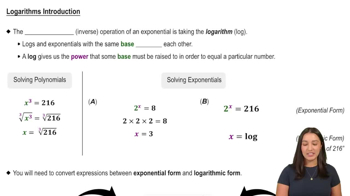
A logarithm is the inverse operation to exponentiation, answering the question: to what exponent must a base be raised to produce a given number? For example, in the expression log_b(a) = c, b^c = a. Understanding logarithms is essential for evaluating expressions like log64 8, as it allows us to express the relationship between the base, the result, and the exponent.
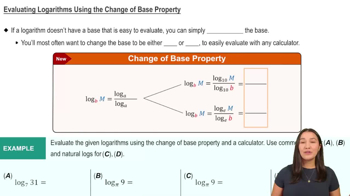
The change of base formula allows us to convert logarithms from one base to another, making calculations easier. It states that log_b(a) can be expressed as log_k(a) / log_k(b) for any positive k. This is particularly useful when dealing with logarithms that are not easily computed, such as log64 8, as it enables the use of more familiar bases like 10 or e.
Exponential relationships describe how a quantity grows or decays at a constant rate, which is fundamental in understanding logarithms. For instance, if 64 is expressed as 2^6, and 8 as 2^3, we can rewrite log64 8 in terms of base 2. Recognizing these relationships helps simplify logarithmic expressions and solve them without a calculator.