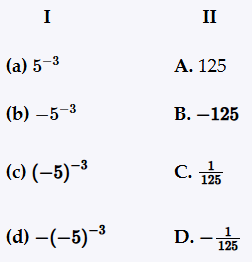
Match each expression in Column I with its equivalent expression in Column II. Choices may be used once, more than once, or not at all. a. 5-3 b. -5-3 c. (-5)-3 d. -(-5)-3 A. 125 B. -125 C. 1/125 D. -1/125
Verified step by step guidance
1
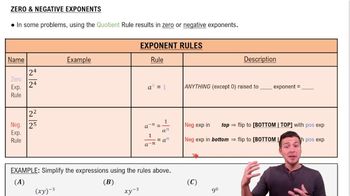
First, recall the meaning of negative exponents: for any nonzero number \(a\) and positive integer \(n\), \(a^{-n} = \frac{1}{a^n}\).
Evaluate each expression in Column I by applying the exponent rules carefully, paying attention to the placement of parentheses and the negative signs.
For expression (a) \$5^{-3}\(, rewrite it as \)\frac{1}{5^3}\( and recognize that \)5^3 = 125\(, so this expression equals \)\frac{1}{125}$.
For expression (b) \(-5^{-3}\), note that the negative sign is outside the exponent, so it is \(- (5^{-3}) = - \frac{1}{125}\).
For expression (c) \((-5)^{-3}\), apply the negative exponent to the entire base \(-5\), so it becomes \(\frac{1}{(-5)^3}\). Since \((-5)^3 = -125\), this equals \(\frac{1}{-125} = -\frac{1}{125}\).
Verified video answer for a similar problem:
This video solution was recommended by our tutors as helpful for the problem above
Video duration:
1m
Play a video:
Was this helpful?
Key Concepts
Here are the essential concepts you must grasp in order to answer the question correctly.
Negative Exponents
A negative exponent indicates the reciprocal of the base raised to the corresponding positive exponent. For example, a^-n = 1/a^n. This concept helps in rewriting expressions like 5^-3 as 1/5^3.
Understanding how negative signs interact with exponents is crucial. For instance, -5^-3 means the negative of 5^-3, while (-5)^-3 means the entire base -5 is raised to the negative exponent. Parentheses affect the base and thus the result.
Raising a negative number to an odd power results in a negative number, while raising it to an even power results in a positive number. This affects the sign of expressions like (-5)^-3, which equals 1/(-5)^3 = -1/125.