Table of contents
- 0. Review of Algebra4h 18m
- 1. Equations & Inequalities3h 18m
- 2. Graphs of Equations1h 43m
- 3. Functions2h 17m
- 4. Polynomial Functions1h 44m
- 5. Rational Functions1h 23m
- 6. Exponential & Logarithmic Functions2h 28m
- 7. Systems of Equations & Matrices4h 5m
- 8. Conic Sections2h 23m
- 9. Sequences, Series, & Induction1h 22m
- 10. Combinatorics & Probability1h 45m
2. Graphs of Equations
Two-Variable Equations
Problem 90
Textbook Question
Determine whether each equation has a graph that is symmetric with respect to the x-axis, the y-axis, the origin, or none of these.
Verified step by step guidance1
Rewrite the given equation: \(|y| = -x\).
Recall the symmetry tests:
- For symmetry about the x-axis, replace \(y\) with \(-y\) and check if the equation remains unchanged.
- For symmetry about the y-axis, replace \(x\) with \(-x\) and check if the equation remains unchanged.
- For symmetry about the origin, replace \(x\) with \(-x\) and \(y\) with \(-y\) and check if the equation remains unchanged.
Test for x-axis symmetry: Replace \(y\) with \(-y\) in \(|y| = -x\). Since \(|y| = |-y|\), the equation becomes \(|y| = -x\), which is the same as the original equation. So, the equation is symmetric with respect to the x-axis.
Test for y-axis symmetry: Replace \(x\) with \(-x\) in \(|y| = -x\). The equation becomes \(|y| = -(-x) = x\). This is not the same as the original equation, so it is not symmetric about the y-axis.
Test for origin symmetry: Replace \(x\) with \(-x\) and \(y\) with \(-y\). The equation becomes \(|-y| = -(-x)\), which simplifies to \(|y| = x\). This is not the same as the original equation, so it is not symmetric about the origin.
Verified video answer for a similar problem:This video solution was recommended by our tutors as helpful for the problem above
Video duration:
2mPlay a video:
Was this helpful?
Key Concepts
Here are the essential concepts you must grasp in order to answer the question correctly.
Symmetry in Graphs
Symmetry in graphs refers to how a graph mirrors itself across a line or point. Common symmetries include the x-axis, y-axis, and origin. Testing symmetry involves substituting variables (e.g., replacing y with -y for x-axis symmetry) and checking if the equation remains unchanged.
Recommended video:
Guided course
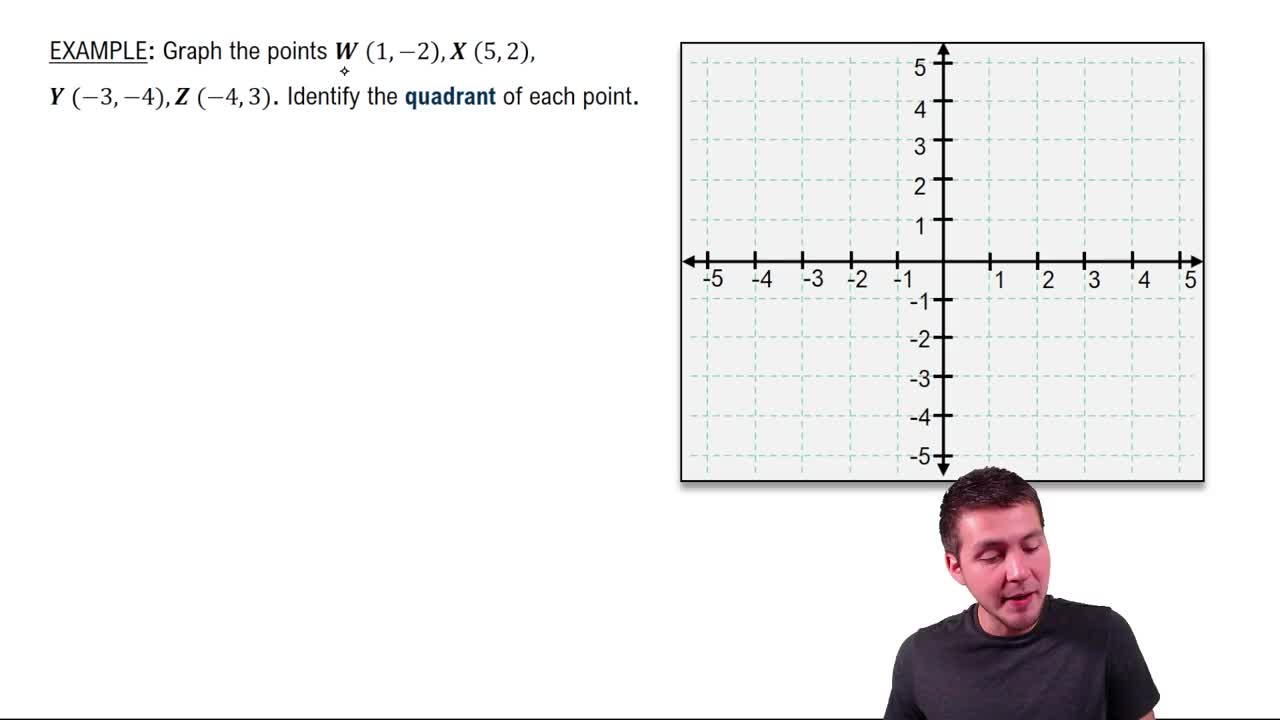
Graphs and Coordinates - Example
Absolute Value Function
The absolute value function, denoted |y|, represents the non-negative value of y regardless of its sign. It affects the graph by reflecting negative y-values to positive, which influences symmetry and the shape of the graph.
Recommended video:
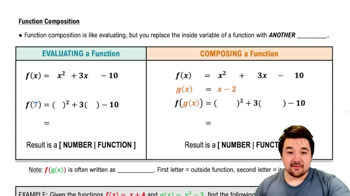
Function Composition
Domain and Range Restrictions
Understanding the domain and range is crucial, especially when absolute values and negative signs are involved. For example, |y| is always non-negative, so an equation like |y| = -x restricts x to values where the right side is non-negative, impacting the graph's existence and symmetry.
Recommended video:
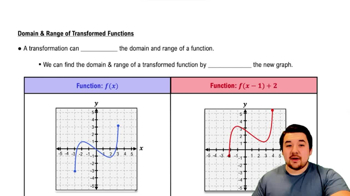
Domain & Range of Transformed Functions
Watch next
Master Equations with Two Variables with a bite sized video explanation from Patrick
Start learningRelated Videos
Related Practice
Textbook Question
Let ƒ(x)=-3x+4 and g(x)=-x^2+4x+1. Find each of the following. Simplify if necessary. See Example 6. ƒ(1/3)
552
views