Solve each problem. Find the radius and height (to the nearest thousandth) of an open-ended cylinder with volume 50 in.3 and lateral surface area 65 in.2.
Table of contents
- 0. Review of Algebra4h 18m
- 1. Equations & Inequalities3h 18m
- 2. Graphs of Equations1h 43m
- 3. Functions2h 17m
- 4. Polynomial Functions1h 44m
- 5. Rational Functions1h 23m
- 6. Exponential & Logarithmic Functions2h 28m
- 7. Systems of Equations & Matrices4h 5m
- 8. Conic Sections2h 23m
- 9. Sequences, Series, & Induction1h 22m
- 10. Combinatorics & Probability1h 45m
7. Systems of Equations & Matrices
Two Variable Systems of Linear Equations
Problem 71b
Textbook Question
Solve each problem. The supply and demand equations for a certain commodity are given. supply: p = √(0.1q + 9) - 2 and demand: p = √(25 - 0.1q).
Find the equilibrium price (in dollars).
Verified step by step guidance1
Identify the equilibrium point where supply equals demand, meaning the price \(p\) from the supply equation equals the price \(p\) from the demand equation.
Set the supply equation equal to the demand equation: \(\sqrt{0.1q + 9} - 2 = \sqrt{25 - 0.1q}\).
Isolate one of the square root terms on one side to prepare for squaring both sides. For example, add 2 to both sides to get \(\sqrt{0.1q + 9} = \sqrt{25 - 0.1q} + 2\).
Square both sides of the equation to eliminate the square roots, remembering to apply the formula \((a + b)^2 = a^2 + 2ab + b^2\) on the right side.
After squaring, simplify the resulting equation and solve for \(q\). Once you find \(q\), substitute it back into either the supply or demand equation to find the equilibrium price \(p\).
Verified video answer for a similar problem:This video solution was recommended by our tutors as helpful for the problem above
Video duration:
10mPlay a video:
Was this helpful?
Key Concepts
Here are the essential concepts you must grasp in order to answer the question correctly.
Equilibrium Price and Quantity
The equilibrium price is the price at which the quantity supplied equals the quantity demanded. This occurs where the supply and demand equations intersect, meaning their price values are equal for the same quantity. Finding this point involves setting the supply and demand price expressions equal and solving for the quantity.
Recommended video:
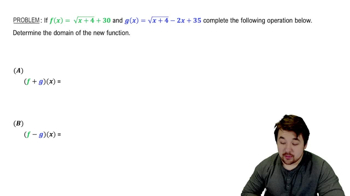
Adding & Subtracting Functions Example 1
Solving Equations Involving Square Roots
Both supply and demand equations contain square root expressions. To solve for the variable, you often need to isolate the square root term and then square both sides to eliminate the root. Care must be taken to check for extraneous solutions introduced by squaring.
Recommended video:
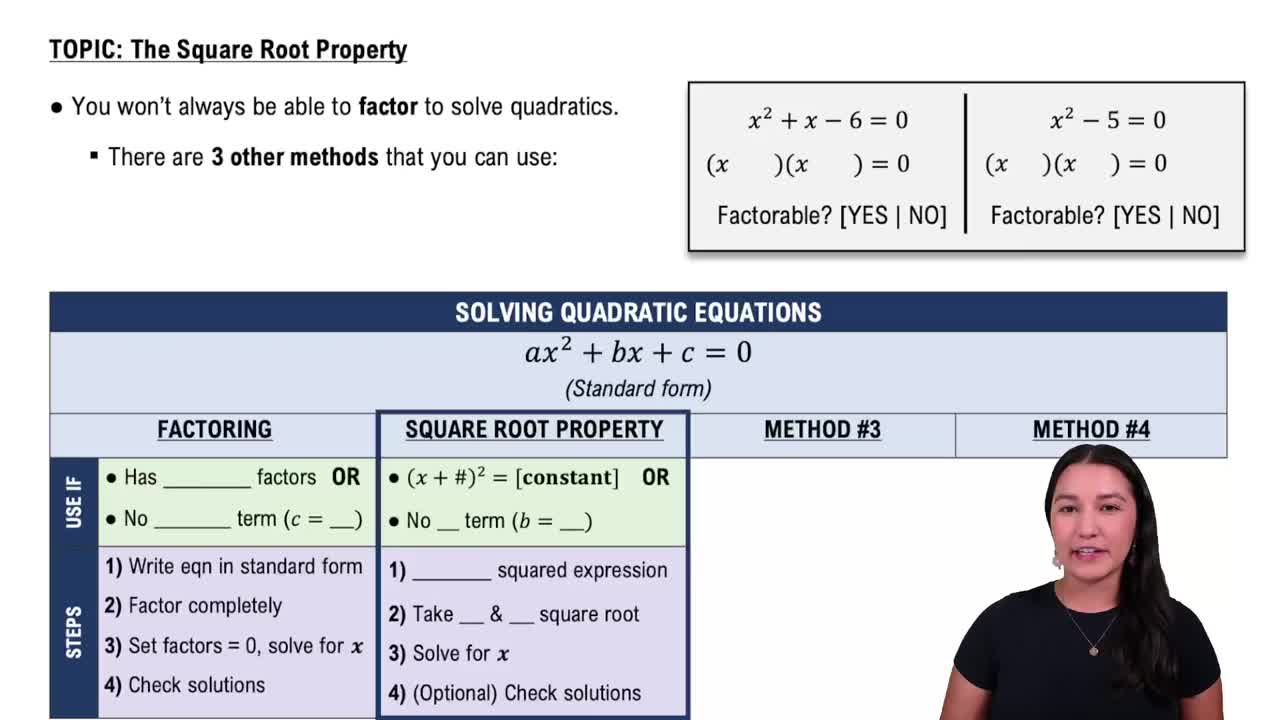
Solving Quadratic Equations by the Square Root Property
Algebraic Manipulation and Substitution
Solving the equilibrium involves algebraic manipulation such as isolating variables, substituting expressions, and simplifying equations. This process helps to reduce the problem to a solvable form, often a quadratic or linear equation, enabling the determination of the equilibrium quantity and price.
Recommended video:
Guided course
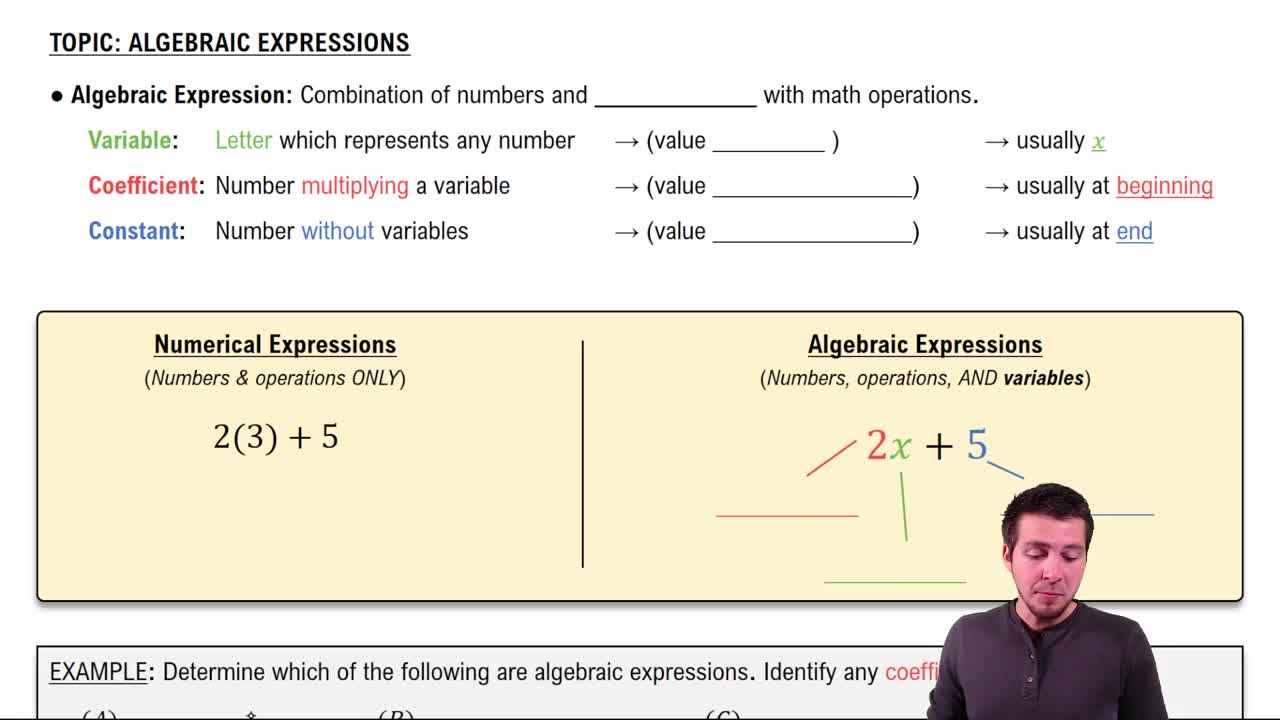
Introduction to Algebraic Expressions
Watch next
Master Introduction to Systems of Linear Equations with a bite sized video explanation from Patrick
Start learningRelated Videos
Related Practice
Textbook Question
371
views