Table of contents
- 0. Review of Algebra4h 18m
- 1. Equations & Inequalities3h 18m
- 2. Graphs of Equations1h 43m
- 3. Functions2h 17m
- 4. Polynomial Functions1h 44m
- 5. Rational Functions1h 23m
- 6. Exponential & Logarithmic Functions2h 28m
- 7. Systems of Equations & Matrices4h 5m
- 8. Conic Sections2h 23m
- 9. Sequences, Series, & Induction1h 22m
- 10. Combinatorics & Probability1h 45m
7. Systems of Equations & Matrices
Two Variable Systems of Linear Equations
Problem 70b
Textbook Question
Solve each problem. The supply and demand equations for a certain commodity are given. supply: p = 2000/(2000 - q) and demand: p = (7000 - 3q)/2q.
Find the equilibrium price (in dollars).
Verified step by step guidance1
Identify the equilibrium point where supply equals demand, meaning the price from the supply equation equals the price from the demand equation. Set the two expressions for price equal to each other: \(\frac{2000}{2000 - q} = \frac{7000 - 3q}{2q}\).
To solve for \(q\), eliminate the denominators by cross-multiplying: \$2000 \times 2q = (7000 - 3q)(2000 - q)$.
Expand both sides of the equation: On the left, multiply \$2000 \times 2q\(; on the right, use the distributive property to expand \)(7000 - 3q)(2000 - q)$.
After expanding, combine like terms and rearrange the equation to form a quadratic equation in standard form: \(ax^2 + bx + c = 0\).
Use the quadratic formula \(q = \frac{-b \pm \sqrt{b^2 - 4ac}}{2a}\) to solve for \(q\). Once you find the valid value(s) of \(q\), substitute back into either the supply or demand equation to find the equilibrium price \(p\).
Verified video answer for a similar problem:This video solution was recommended by our tutors as helpful for the problem above
Video duration:
10mPlay a video:
Was this helpful?
Key Concepts
Here are the essential concepts you must grasp in order to answer the question correctly.
Equilibrium Price and Quantity
The equilibrium price is the price at which the quantity supplied equals the quantity demanded. This occurs where the supply and demand equations intersect, meaning their price values are equal for the same quantity. Finding this price involves solving the system of equations for p and q.
Recommended video:
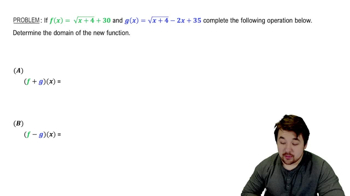
Adding & Subtracting Functions Example 1
Solving Rational Equations
Both supply and demand equations are rational expressions involving variables in denominators. To solve for equilibrium, you must set the two expressions equal and manipulate the equation carefully, often by cross-multiplying or clearing denominators, to find the variable values without losing valid solutions.
Recommended video:
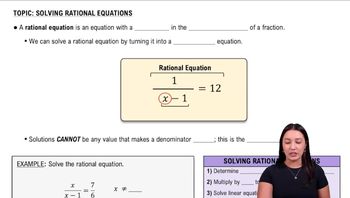
Introduction to Rational Equations
Interpreting Supply and Demand Functions
Supply and demand functions relate price (p) to quantity (q). Understanding how to interpret these functions helps in setting up the problem correctly. For example, recognizing that p depends on q and that the domain restrictions (like denominators not being zero) affect the solution is essential.
Recommended video:
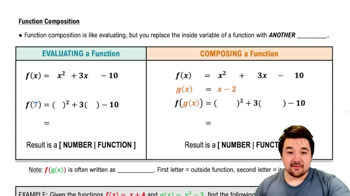
Function Composition
Watch next
Master Introduction to Systems of Linear Equations with a bite sized video explanation from Patrick
Start learningRelated Videos
Related Practice
Textbook Question
Answer each question. Does the straight line 3x - 2y = 9 intersect the circle x^2 + y^2 = 25? (Hint: To find out, solve the system formed by these two equations.)
381
views