In Exercises 23–34, find each product using either a horizontal or a vertical format.
(a−b)(a²+ab+b²)
Verified step by step guidance
1
Identify the expression to be multiplied: \((a-b)(a^2+ab+b^2)\).
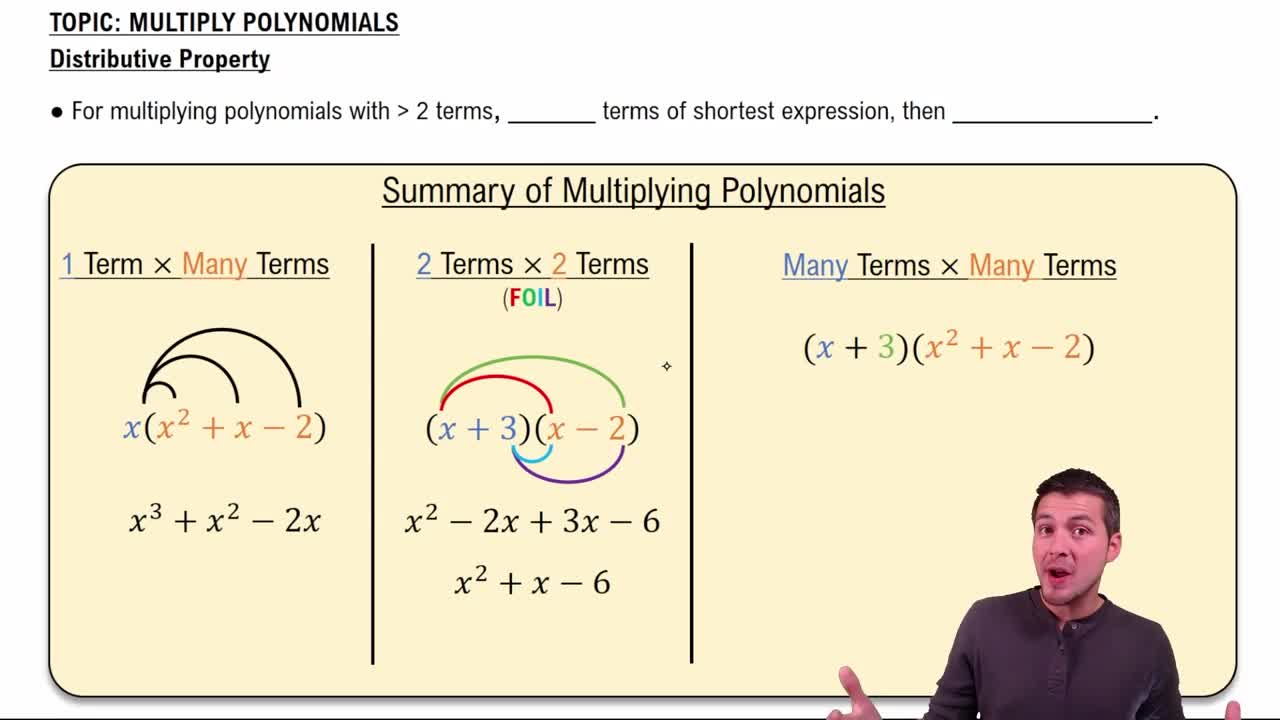
Apply the distributive property (also known as the FOIL method for binomials) to expand the expression: distribute \((a-b)\) across each term in \((a^2+ab+b^2)\).
Multiply \(a\) by each term in \(a^2+ab+b^2\): \(a \cdot a^2\), \(a \cdot ab\), \(a \cdot b^2\).
Multiply \(-b\) by each term in \(a^2+ab+b^2\): \(-b \cdot a^2\), \(-b \cdot ab\), \(-b \cdot b^2\).
Combine all the terms obtained from the multiplication and simplify by combining like terms, if any.
Verified video answer for a similar problem:
This video solution was recommended by our tutors as helpful for the problem above.
Video duration:
7m
Play a video:
0 Comments
Key Concepts
Here are the essential concepts you must grasp in order to answer the question correctly.
Factoring and Expanding Polynomials
Factoring involves breaking down a polynomial into simpler components, while expanding is the process of multiplying these components back out. Understanding how to factor and expand polynomials is crucial for manipulating algebraic expressions, especially when dealing with products like (a−b)(a²+ab+b²).
The Distributive Property states that a(b + c) = ab + ac. This property is essential for expanding products of polynomials, as it allows you to distribute each term in the first polynomial across all terms in the second polynomial, ensuring that all combinations are accounted for in the final expression.
Multiply Polynomials Using the Distributive Property
Special Products
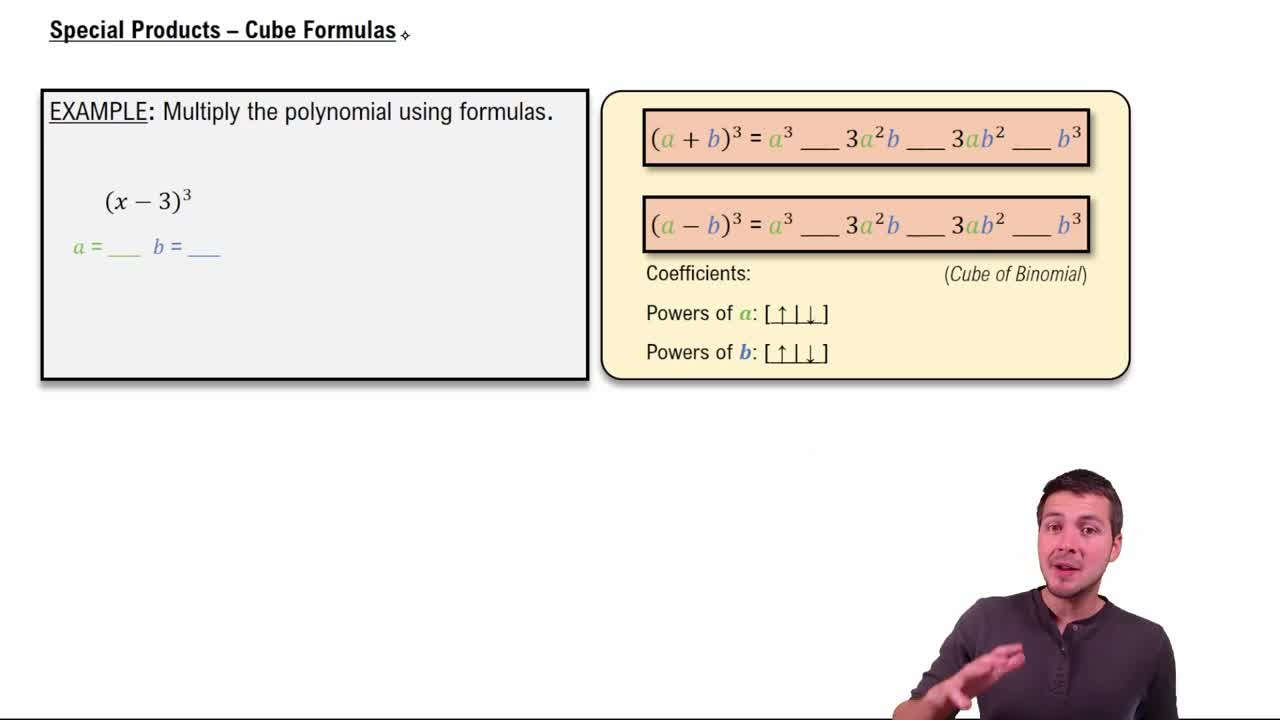
Certain polynomial products follow specific patterns, known as special products. For example, the expression (a−b)(a²+ab+b²) can be recognized as a form of the sum of cubes or the difference of cubes, which can simplify the multiplication process and lead to quicker solutions.

 7:51 minutes
 Verified step by step guidance
 07:30
07:30