In Exercises 29–40, add the polynomials. Assume that all variable exponents represent whole numbers.
(−6x³ + 5x² − 8x + 9) + (17x³ + 2x² − 4x − 13)
Verified step by step guidance
1
Identify the like terms in each polynomial. Like terms have the same variable raised to the same power.
Group the like terms together: \((-6x^3 + 17x^3)\), \((5x^2 + 2x^2)\), \((-8x - 4x)\), and \((9 - 13)\).
Add the coefficients of the like terms for each group: \(-6 + 17\), \(5 + 2\), \(-8 - 4\), and \(9 - 13\).
Write the resulting polynomial by combining the sums of the coefficients with their respective variables and exponents.
Ensure the final polynomial is simplified and written in standard form, which is ordered by descending powers of \(x\).
Verified video answer for a similar problem:
This video solution was recommended by our tutors as helpful for the problem above.
Video duration:
3m
Play a video:
0 Comments
Key Concepts
Here are the essential concepts you must grasp in order to answer the question correctly.
Polynomial Addition
Polynomial addition involves combining like terms from two or more polynomials. Like terms are those that have the same variable raised to the same power. When adding polynomials, you simply add the coefficients of these like terms while keeping the variable part unchanged.
Like terms are terms in a polynomial that share the same variable and exponent. For example, in the polynomial 3x² + 4x², both terms are like terms because they both contain the variable x raised to the power of 2. Identifying and combining like terms is essential for simplifying polynomials.
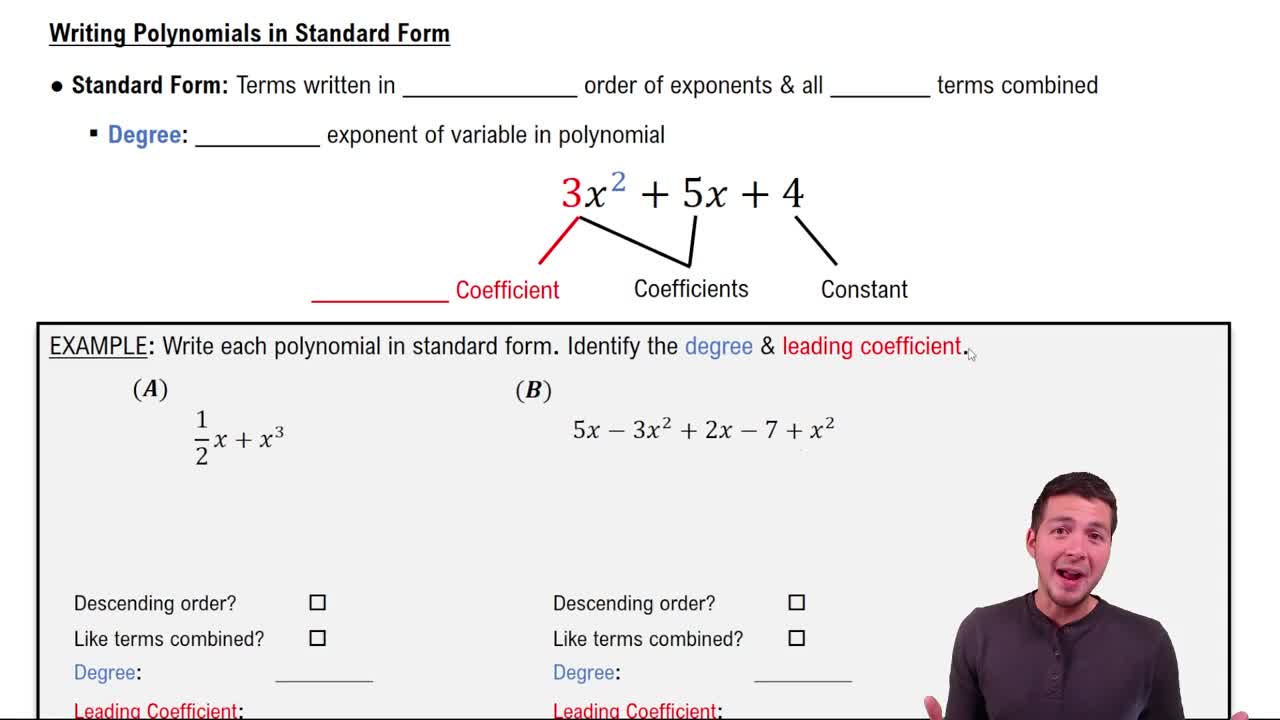
The degree of a polynomial is the highest exponent of the variable in the polynomial. It provides insight into the polynomial's behavior and shape when graphed. For instance, in the polynomial -6x³ + 5x² - 8x + 9, the degree is 3, indicating that the polynomial is cubic.

 3:51 minutes
 Verified step by step guidance
 05:13
05:13