In Exercises 55–64, use the vertical line test to identify graphs in which y is a function of x.
Table of contents
- 0. Review of Algebra4h 18m
- 1. Equations & Inequalities3h 18m
- 2. Graphs of Equations1h 43m
- 3. Functions2h 17m
- 4. Polynomial Functions1h 44m
- 5. Rational Functions1h 23m
- 6. Exponential & Logarithmic Functions2h 28m
- 7. Systems of Equations & Matrices4h 5m
- 8. Conic Sections2h 23m
- 9. Sequences, Series, & Induction1h 22m
- 10. Combinatorics & Probability1h 45m
2. Graphs of Equations
Graphs and Coordinates
Problem 72
Textbook Question
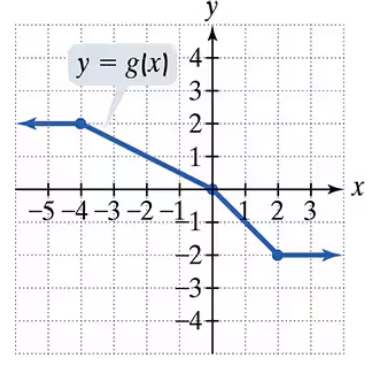
Use the graph of g to solve Exercises 71–76.

Find g(2)
Verified step by step guidance1
Step 1: Understand the problem. The goal is to find g(2), which means determining the value of the function g at x = 2. This involves locating the point on the graph where x = 2 and identifying the corresponding y-coordinate.
Step 2: Locate x = 2 on the graph. On the horizontal axis (x-axis), find the point where x equals 2.
Step 3: Trace vertically from x = 2 to the graph of the function g. Move upward or downward along the vertical line at x = 2 until you intersect the red curve representing the function g.
Step 4: Identify the y-coordinate of the intersection point. The y-coordinate of this point is the value of g(2).
Step 5: Verify the result visually. Ensure that the intersection point corresponds to x = 2 and confirm the y-coordinate by checking the graph's scale.
Verified video answer for a similar problem:This video solution was recommended by our tutors as helpful for the problem above
Video duration:
1mPlay a video:
Was this helpful?
Key Concepts
Here are the essential concepts you must grasp in order to answer the question correctly.
Function Notation
Function notation, such as g(x), is a way to represent a function's output based on its input. In this case, g(2) refers to the value of the function g when the input is 2. Understanding function notation is essential for interpreting and solving problems involving functions.
Recommended video:
Interval Notation
Graph Interpretation
Interpreting a graph involves analyzing the visual representation of a function to extract information about its behavior. For example, to find g(2), one must locate the point on the graph where x equals 2 and read the corresponding y-value. This skill is crucial for solving problems that require understanding the relationship between variables.
Recommended video:
Guided course
Graphs and Coordinates - Example
Coordinate System
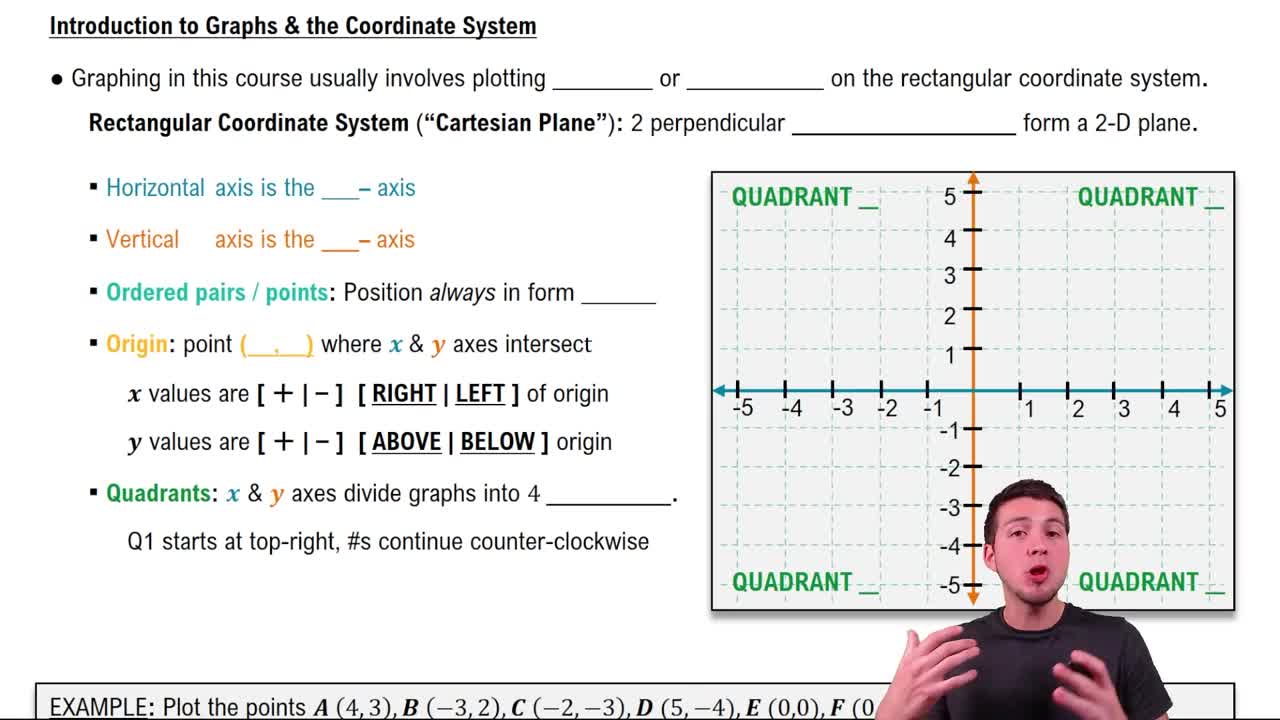
A coordinate system, typically a Cartesian plane, consists of two perpendicular axes: the x-axis (horizontal) and the y-axis (vertical). Each point on the graph is defined by an ordered pair (x, y). Familiarity with the coordinate system is necessary for accurately locating points and understanding the function's behavior across different values.
Recommended video:
Guided course
Graphs & the Rectangular Coordinate System
Watch next
Master Graphs & the Rectangular Coordinate System with a bite sized video explanation from Patrick
Start learningRelated Videos
Related Practice
Textbook Question
968
views