In Exercises 93-94, let f(x) = x² − x + 4 and g(x) = 3x – 5. Find g (1) and f(g(1)).
Verified step by step guidance
1
Step 1: Start by evaluating g(1). To do this, substitute x = 1 into the function g(x) = 3x - 5. This will give you the value of g(1).
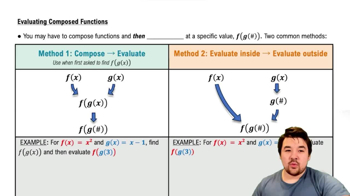
Step 2: Once you have the value of g(1), use it as the input for the function f(x). This means you will substitute g(1) into the function f(x) = x² - x + 4.
Step 3: Replace x in f(x) with the value of g(1) and simplify the expression. This involves squaring the value of g(1), subtracting it, and then adding 4.
Step 4: Carefully simplify the resulting expression from Step 3 to find the value of f(g(1)).
Step 5: Verify your calculations by double-checking each substitution and simplification step to ensure accuracy.
Verified video answer for a similar problem:
This video solution was recommended by our tutors as helpful for the problem above
Video duration:
2m
Play a video:
Was this helpful?
Key Concepts
Here are the essential concepts you must grasp in order to answer the question correctly.
Function Evaluation
Function evaluation involves substituting a specific input value into a function to determine its output. For example, to find g(1), you replace x in the function g(x) = 3x - 5 with 1, resulting in g(1) = 3(1) - 5 = -2. This process is fundamental in understanding how functions operate and interact.
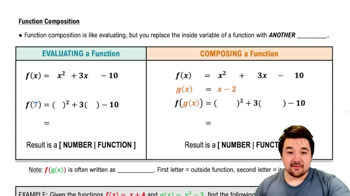
Composition of functions occurs when the output of one function becomes the input of another. In this case, after finding g(1), we use that result as the input for f(x). The notation f(g(1)) signifies that we first evaluate g at 1, then substitute that output into f, illustrating how functions can be combined to produce new outputs.
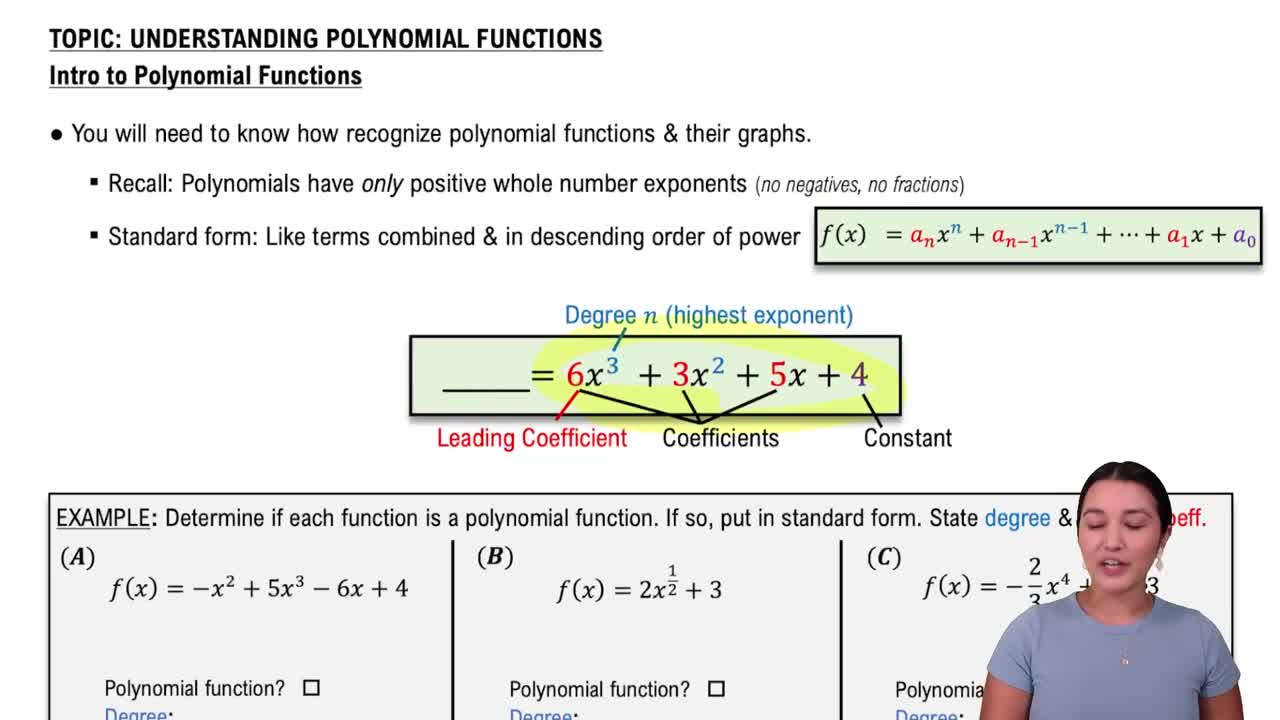
A quadratic function is a polynomial function of degree two, typically expressed in the form f(x) = ax² + bx + c. In this problem, f(x) = x² - x + 4 is a quadratic function where a = 1, b = -1, and c = 4. Understanding the properties of quadratic functions, such as their parabolas and vertex, is essential for analyzing their behavior and outputs.