In Exercises 41–50, subtract the polynomials. Assume that all variable exponents represent whole numbers.
(3x⁴y² + 5x³y − 3y) − (2x⁴y² − 3x³y − 4y + 6x)
Verified step by step guidance
1
Identify the polynomials to be subtracted: \((3x^4y^2 + 5x^3y - 3y)\) and \((2x^4y^2 - 3x^3y - 4y + 6x)\).
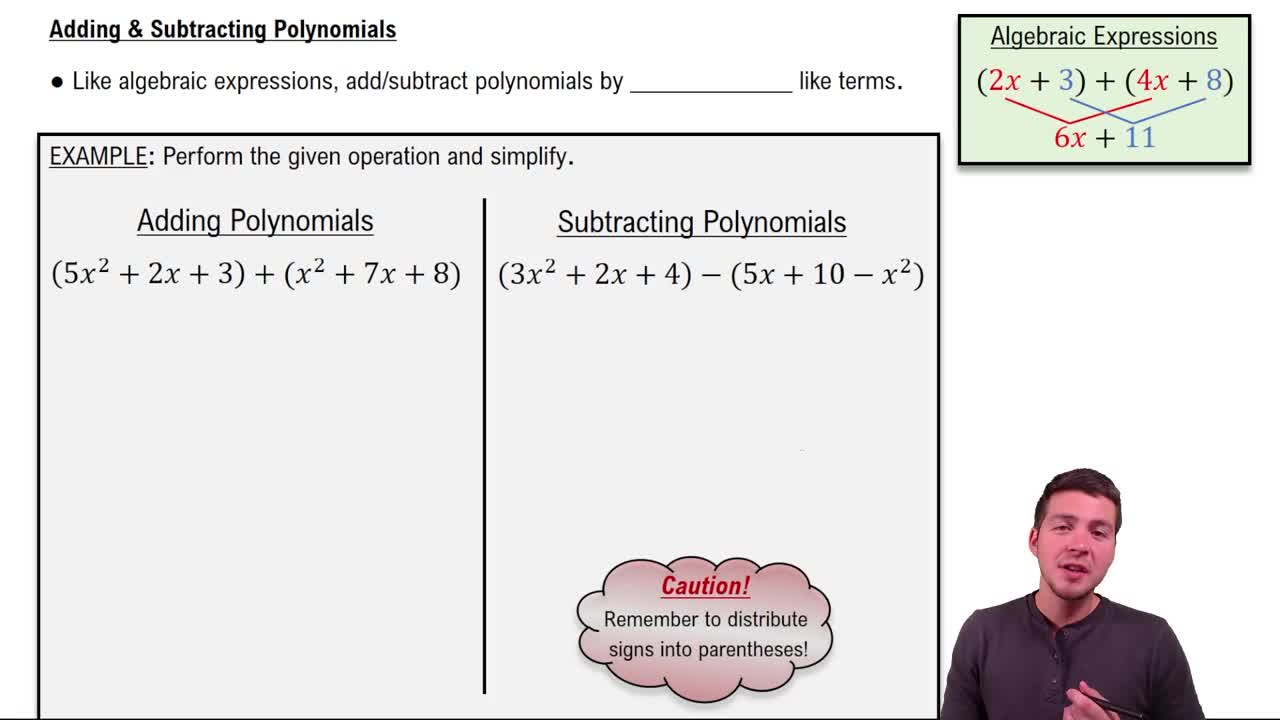
Distribute the negative sign across the second polynomial: \(-(2x^4y^2 - 3x^3y - 4y + 6x) = -2x^4y^2 + 3x^3y + 4y - 6x\).
Rewrite the expression by combining the polynomials: \((3x^4y^2 + 5x^3y - 3y) + (-2x^4y^2 + 3x^3y + 4y - 6x)\).
Group like terms together: \((3x^4y^2 - 2x^4y^2) + (5x^3y + 3x^3y) + (-3y + 4y) + (-6x)\).
Simplify each group of like terms to find the resulting polynomial.
Verified video answer for a similar problem:
This video solution was recommended by our tutors as helpful for the problem above.
Video duration:
5m
Play a video:
0 Comments
Key Concepts
Here are the essential concepts you must grasp in order to answer the question correctly.
Polynomials
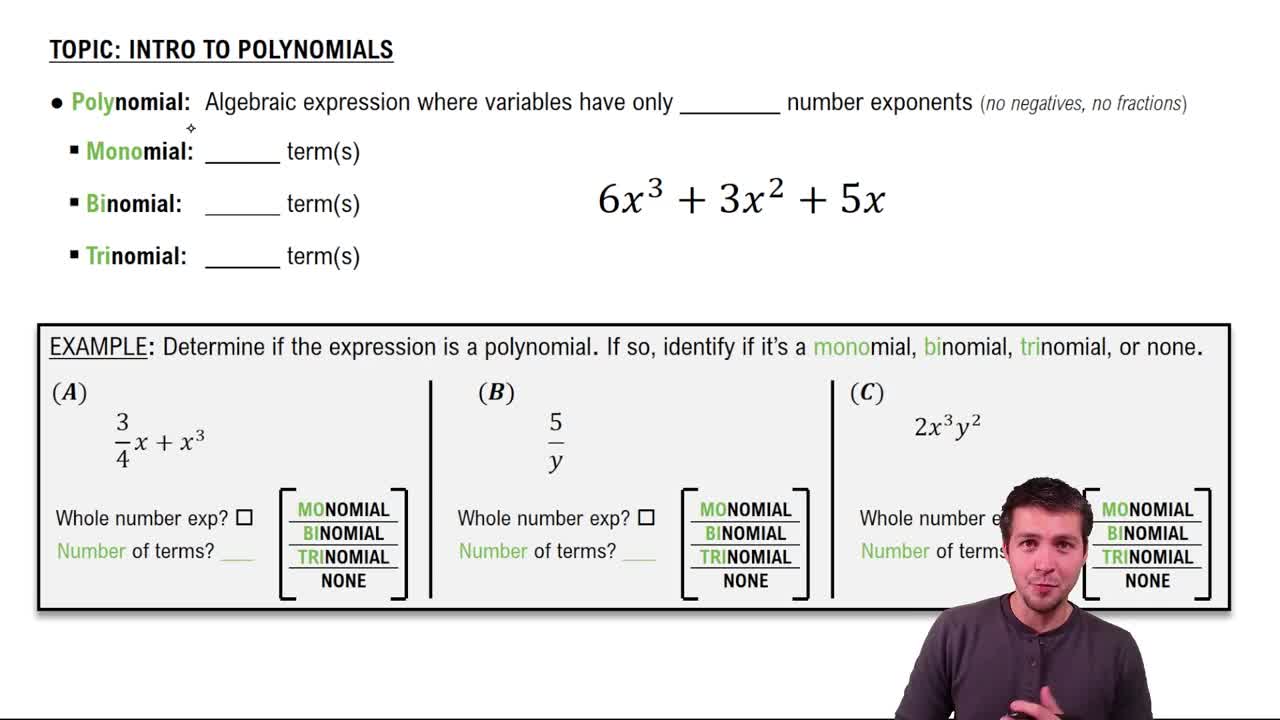
Polynomials are algebraic expressions that consist of variables raised to whole number exponents, combined using addition, subtraction, and multiplication. Each term in a polynomial is made up of a coefficient and a variable part. Understanding the structure of polynomials is essential for performing operations like addition and subtraction.
Subtracting polynomials involves distributing the negative sign across the terms of the polynomial being subtracted and then combining like terms. Like terms are those that have the same variable raised to the same exponent. This process requires careful attention to ensure that all terms are accounted for correctly.
Combining like terms is the process of simplifying an expression by adding or subtracting coefficients of terms that share the same variable and exponent. This step is crucial in polynomial operations, as it reduces the expression to its simplest form, making it easier to interpret and work with.

 5:31 minutes
 Verified step by step guidance
 05:13
05:13