In Exercises 41–50, subtract the polynomials. Assume that all variable exponents represent whole numbers.
(x³ + 7xy − 5y²) − (6x³ − xy + 4y²)
Verified step by step guidance
1
Identify the polynomials to be subtracted: \((x^3 + 7xy - 5y^2)\) and \((6x^3 - xy + 4y^2)\).
Distribute the negative sign across the second polynomial: \(-(6x^3 - xy + 4y^2) = -6x^3 + xy - 4y^2\).
Rewrite the expression by combining the first polynomial with the negated second polynomial: \((x^3 + 7xy - 5y^2) + (-6x^3 + xy - 4y^2)\).
Combine like terms: \(x^3 - 6x^3\), \(7xy + xy\), and \(-5y^2 - 4y^2\).
Simplify each group of like terms to get the final expression.
Verified video answer for a similar problem:
This video solution was recommended by our tutors as helpful for the problem above.
Video duration:
5m
Play a video:
0 Comments
Key Concepts
Here are the essential concepts you must grasp in order to answer the question correctly.
Polynomial Subtraction
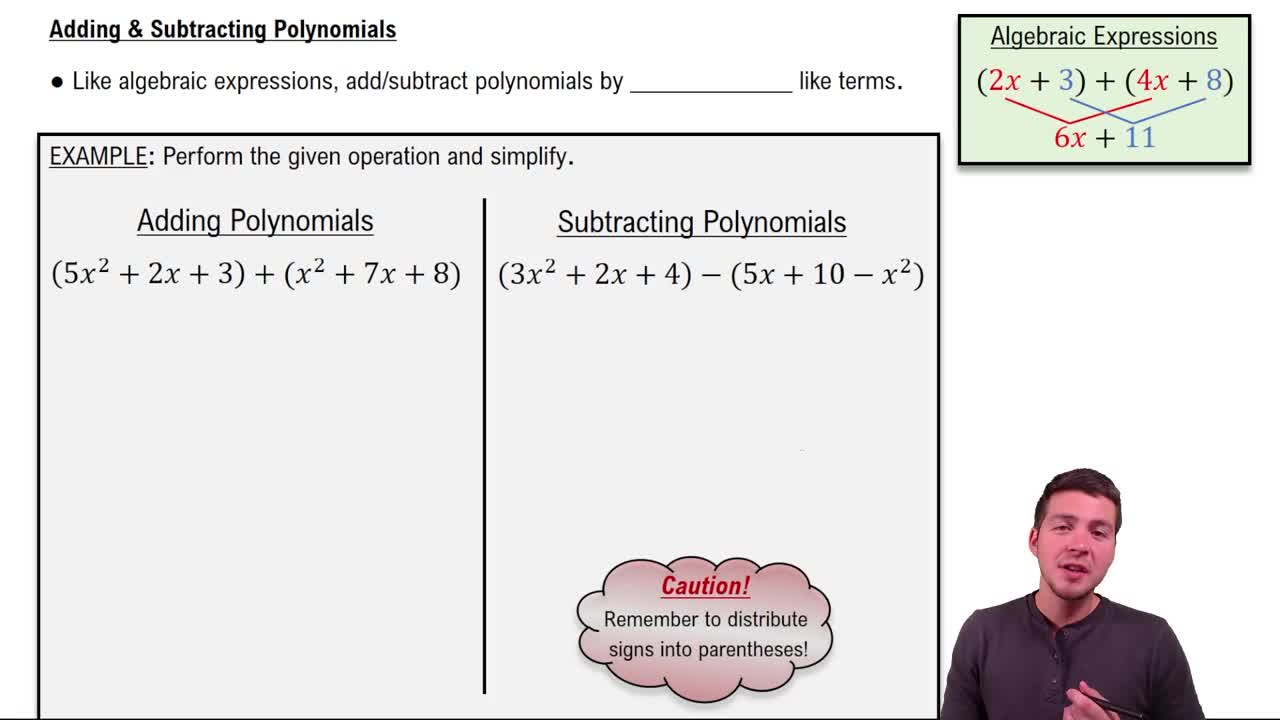
Polynomial subtraction involves taking one polynomial and subtracting another from it. This process requires distributing the negative sign across the second polynomial, effectively changing the signs of its terms before combining like terms. Understanding how to align and combine these terms is crucial for accurate results.
Like terms are terms in a polynomial that have the same variable raised to the same power. For example, in the expression 3x² and 5x², both terms are like terms because they share the same variable and exponent. Identifying and combining like terms is essential for simplifying polynomials correctly.
Exponents indicate how many times a variable is multiplied by itself, and they play a critical role in polynomial expressions. In the context of the given problem, understanding that all variable exponents represent whole numbers ensures that operations are performed correctly, particularly when combining or subtracting terms with different exponents.

 5:09 minutes
 Verified step by step guidance
 03:34
03:34