Rewrite the inequality in terms of \(y\) to make it easier to graph. Start with the given inequality: \$4y - 3x \leq 5$.
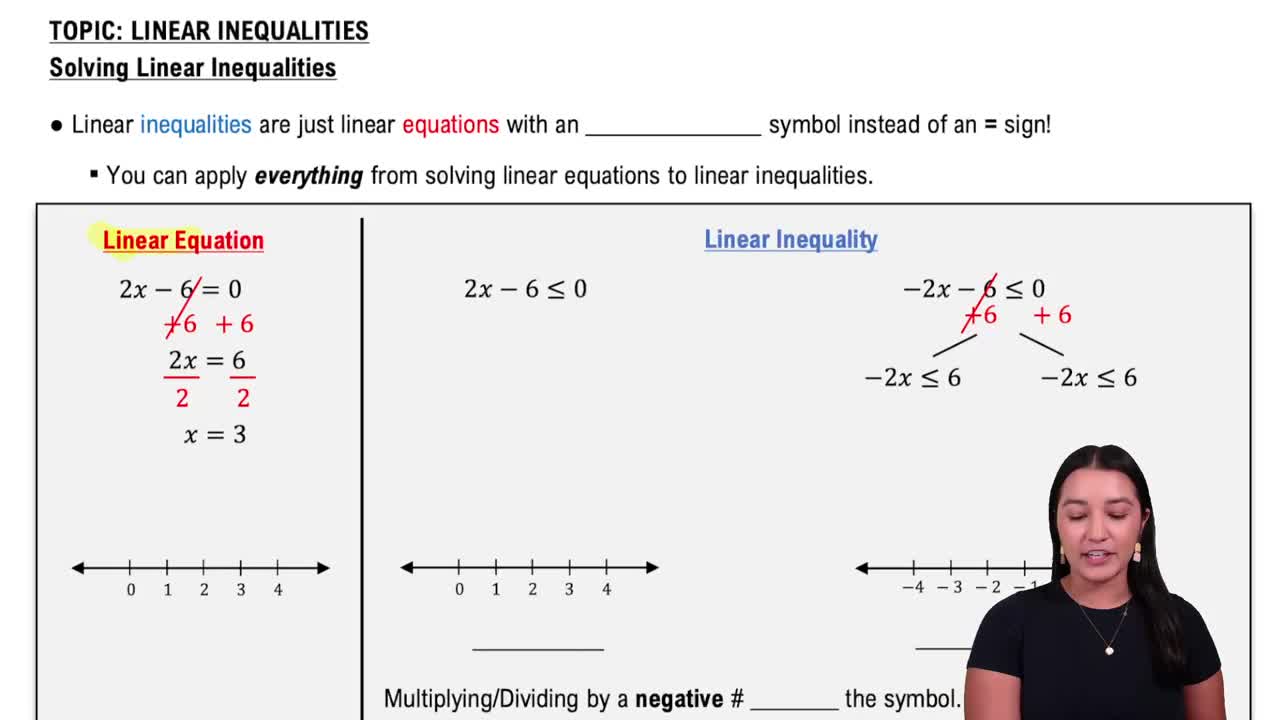
Add \$3x\( to both sides to isolate the \)y\( term: \)4y \leq 3x + 5$.
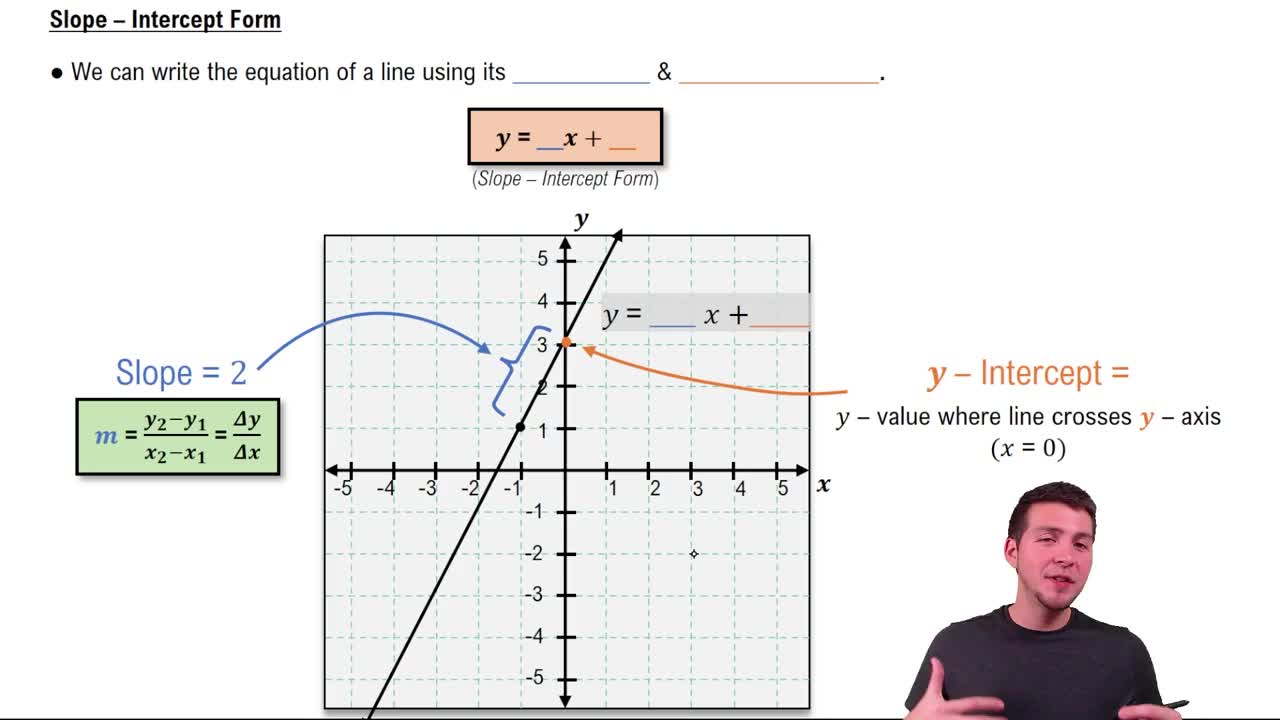
Divide every term by 4 to solve for \(y\): \(y \leq \frac{3}{4}x + \frac{5}{4}\).
Graph the boundary line \(y = \frac{3}{4}x + \frac{5}{4}\). Since the inequality is \(\leq\), use a solid line to indicate that points on the line satisfy the inequality.
Shade the region below the line because \(y\) is less than or equal to the expression on the right side. This shaded area represents all solutions to the inequality.
Verified video answer for a similar problem:
This video solution was recommended by our tutors as helpful for the problem above
Video duration:
4m
Play a video:
Was this helpful?
Key Concepts
Here are the essential concepts you must grasp in order to answer the question correctly.
Graphing Linear Inequalities
Graphing linear inequalities involves first graphing the related linear equation as a boundary line. The inequality symbol determines whether the boundary is solid (≤ or ≥) or dashed (< or >). The solution region is the half-plane where the inequality holds true, which is shaded on the graph.
Rearranging Inequalities into Slope-Intercept Form
To graph the inequality easily, rewrite it in slope-intercept form (y = mx + b). This involves isolating y on one side, which helps identify the slope and y-intercept, making it straightforward to plot the boundary line and determine the shading direction.
After graphing the boundary line, select a test point not on the line (commonly (0,0)) to check if it satisfies the inequality. If it does, shade the region containing that point; if not, shade the opposite side. This confirms the correct half-plane representing the solution set.