Start by rewriting the inequality to isolate the variable y on one side. Given the inequality: \$2x > 3 - 4y\(, subtract 3 from both sides to get: \)2x - 3 > -4y$.
Next, divide both sides of the inequality by -4 to solve for y. Remember, when dividing by a negative number, the inequality sign reverses. So, dividing by -4 gives: \(\frac{2x - 3}{-4} < y\).
Simplify the expression for y: \(y > \frac{3 - 2x}{4}\) (rewriting the inequality in a more standard form). This is the boundary line for the inequality.
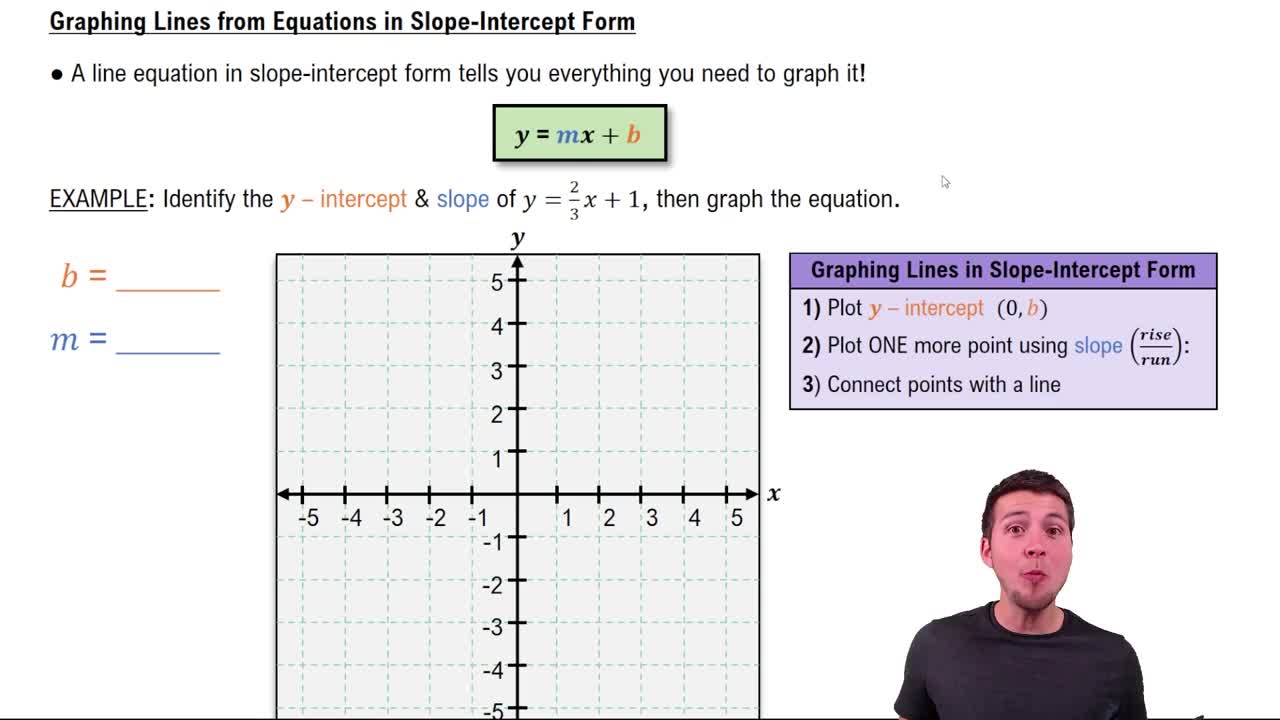
Graph the boundary line \(y = \frac{3 - 2x}{4}\). Since the original inequality is strict (no equal sign), use a dashed line to indicate that points on the line are not included in the solution.
Determine which side of the boundary line to shade by testing a point not on the line, such as the origin (0,0). Substitute into the inequality \$2x > 3 - 4y$ and check if it holds true. Shade the region that satisfies the inequality accordingly.
Verified video answer for a similar problem:
This video solution was recommended by our tutors as helpful for the problem above
Video duration:
5m
Play a video:
Was this helpful?
Key Concepts
Here are the essential concepts you must grasp in order to answer the question correctly.
Inequalities in Two Variables
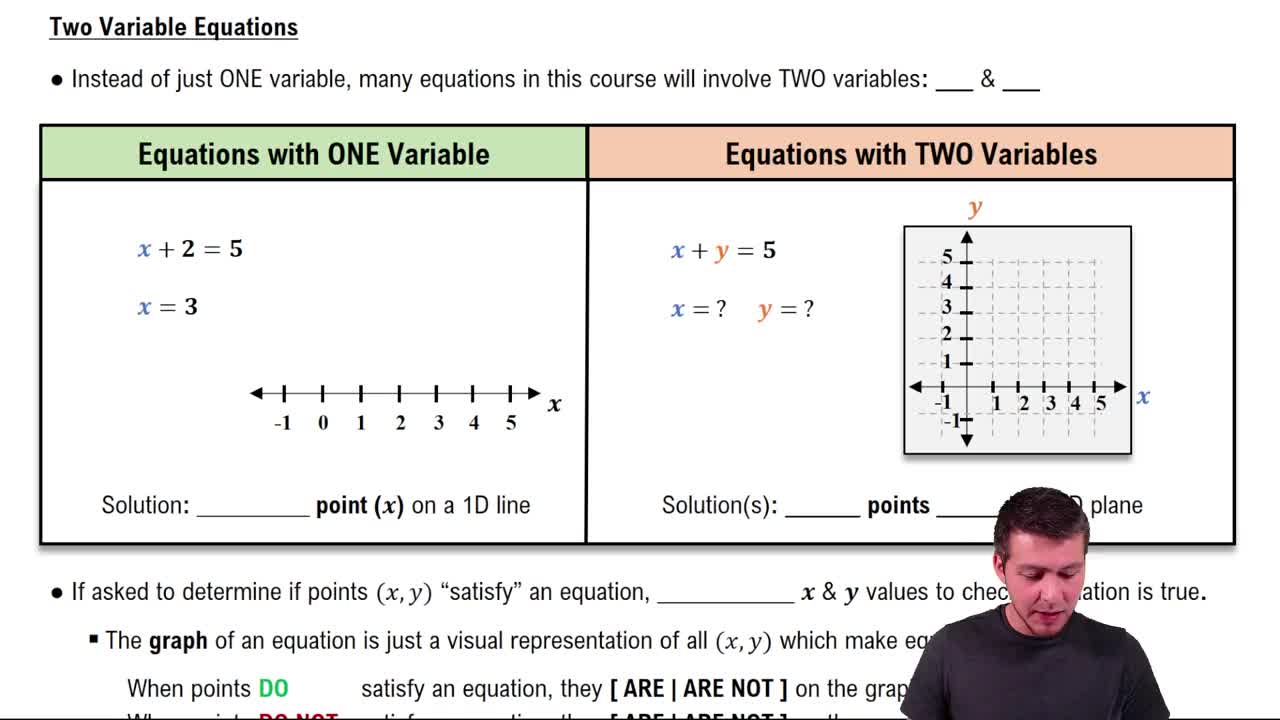
An inequality involving two variables, like x and y, represents a region in the coordinate plane rather than just points. Understanding how to interpret and manipulate these inequalities is essential for graphing the solution set.
Rearranging Inequalities into Slope-Intercept Form
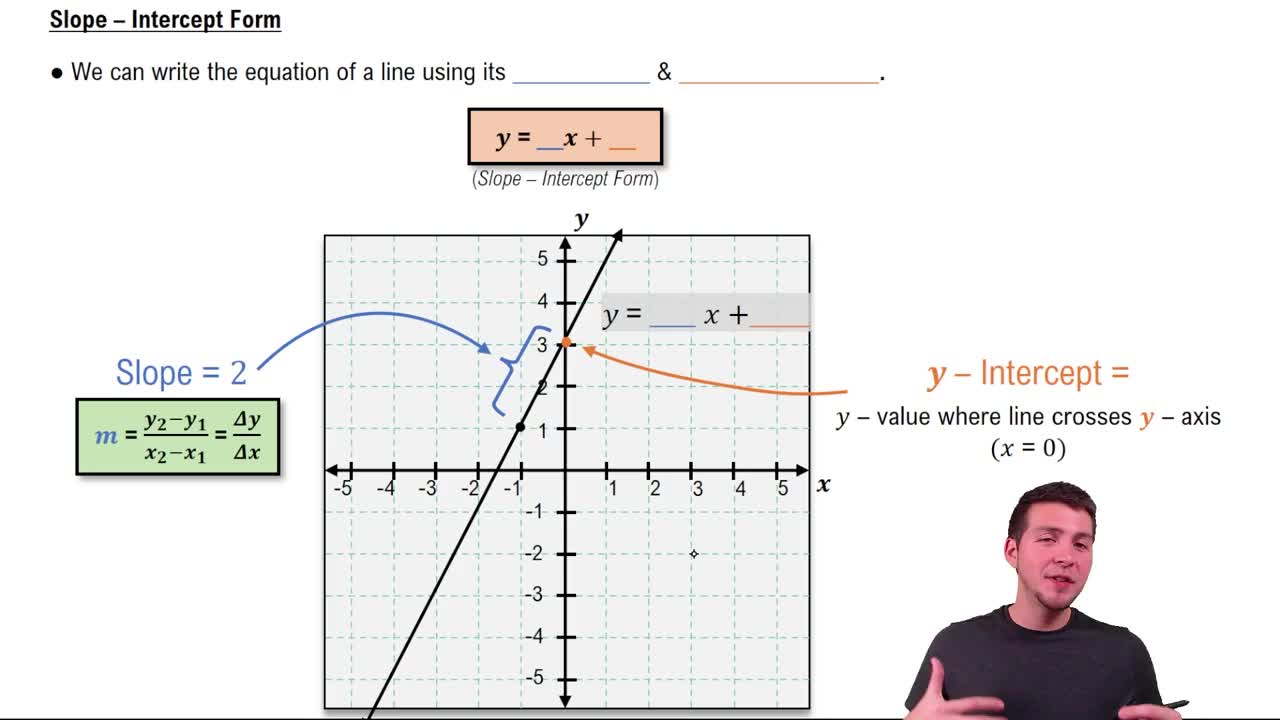
To graph an inequality, it helps to rewrite it in the form y < mx + b or y > mx + b. This involves isolating y on one side, which clarifies the boundary line's slope and intercept, making it easier to plot.
Graphing the Boundary Line and Shading the Solution Region
The boundary line is graphed using the equality version of the inequality. Depending on the inequality sign, the line is solid (≤ or ≥) or dashed (< or >). The solution region is shaded on the side where the inequality holds true.