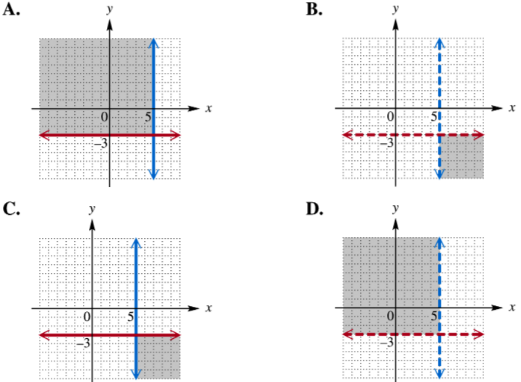
Match each system of inequalities with the correct graph from choices A–D. x ≥ 5 y ≤ -3
Verified step by step guidance
1
Step 1: Understand the inequalities given: \(x \geq 5\) means the solution includes all points to the right of and on the vertical line \(x=5\). \(y \leq -3\) means the solution includes all points below and on the horizontal line \(y=-3\).
Step 2: Identify the boundary lines on the graphs. The vertical line at \(x=5\) should be solid (because of the \geq sign) and the shading should be to the right of this line.
Step 3: The horizontal line at \(y=-3\) should also be solid (because of the \leq sign) and the shading should be below this line.
Step 4: Look for the graph where the shaded region is the intersection of the two conditions: to the right of \(x=5\) and below \(y=-3\). This means the shaded area should be in the lower right quadrant formed by these two lines.
Step 5: Match this description to the correct graph choice. The graph that shows shading to the right of \(x=5\) and below \(y=-3\) with solid boundary lines is the correct match.
Was this helpful?
Key Concepts
Here are the essential concepts you must grasp in order to answer the question correctly.
Graphing Linear Inequalities
Graphing linear inequalities involves shading the region of the coordinate plane that satisfies the inequality. For example, x ≥ 5 means shading all points to the right of the vertical line x = 5, including the line itself if it is solid.
The boundary line of an inequality is drawn as solid if the inequality includes equality (≥ or ≤) and dashed if it does not (> or <). This line divides the plane into two halves, one of which satisfies the inequality.
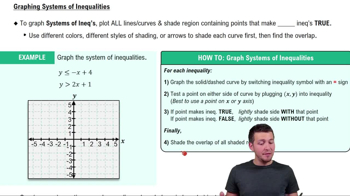
When dealing with a system of inequalities, the solution is the intersection of the shaded regions for each inequality. For x ≥ 5 and y ≤ -3, the solution is where the shaded region to the right of x=5 overlaps with the shaded region below y=-3.