
Ch. 13 - Characterizing and Classifying Viruses, Viroids, and Prions
Bauman - Microbiology with Diseases by Taxonomy 6th Edition
Bauman6th EditionMicrobiology with Diseases by TaxonomyISBN: 9780134832302Not the one you use?Change textbook
Chapter 13, Problem 7

Another name for a complete virus is ___________.
a. Virion
b. Viroid
c. Prion
d. Capsid

Verified step by step guidance
1
Understand the terminology related to viruses: a complete virus particle includes the genetic material (DNA or RNA) enclosed within a protein coat called the capsid, and sometimes an envelope.
Review the options given: 'virion', 'viroid', 'prion', and 'capsid'.
Recall that a 'virion' refers to a fully assembled, infectious virus particle that is complete and capable of infecting a host cell.
Know that a 'viroid' is a small infectious RNA molecule without a protein coat, and a 'prion' is an infectious protein without nucleic acid.
Recognize that 'capsid' is just the protein coat of a virus, not the complete virus particle itself.

Verified video answer for a similar problem:

This video solution was recommended by our tutors as helpful for the problem above.
Video duration:
2m
Was this helpful?

Key Concepts

Here are the essential concepts you must grasp in order to answer the question correctly.

Virion

A virion is the complete, infectious form of a virus outside a host cell, consisting of the viral genome enclosed within a protective protein coat called the capsid. It is capable of infecting a host and initiating viral replication.
Recommended video:
Guided course
03:04
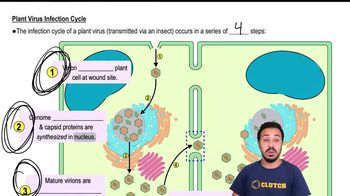
Plant VirusesPlant Virus Infection Cycle

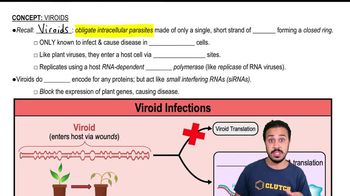
Viroid

Viroids are small, circular RNA molecules that infect plants but lack a protein coat. Unlike viruses, viroids do not form virions and rely entirely on host machinery for replication, causing disease without encoding proteins.
Recommended video:

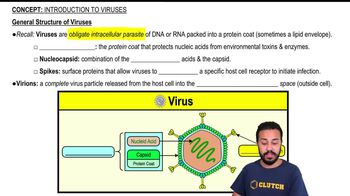
Capsid

The capsid is the protein shell that encases and protects the viral genetic material. It is made of protein subunits called capsomeres and plays a key role in virus attachment and entry into host cells, but alone it is not a complete virus.
Recommended video:
Guided course
04:47
General Structure of Viruses