Ch. 15 - Innate Immunity
Bauman - Microbiology with Diseases by Taxonomy 6th Edition
Bauman6th EditionMicrobiology with Diseases by TaxonomyISBN: 9780134832302Not the one you use?Change textbook
Chapter 15, Problem 6

How do NOD proteins differ from Toll-like receptors?

Verified step by step guidance
1
Understand that both NOD proteins and Toll-like receptors (TLRs) are part of the innate immune system and function as pattern recognition receptors (PRRs) that detect microbial components.
Recognize that Toll-like receptors are membrane-bound receptors located either on the cell surface or within endosomal membranes, where they detect extracellular or endosomal pathogen-associated molecular patterns (PAMPs).
Know that NOD proteins are cytoplasmic receptors, meaning they are located inside the cell, and they detect intracellular bacterial components, such as fragments of peptidoglycan from bacterial cell walls.
Compare the signaling pathways: TLRs typically activate signaling cascades leading to the production of pro-inflammatory cytokines through pathways like NF-κB, while NOD proteins also activate NF-κB but respond specifically to intracellular bacterial invasion.
Summarize the key difference: TLRs detect extracellular or endosomal microbial molecules, whereas NOD proteins detect intracellular bacterial components, reflecting their different cellular localizations and roles in immune surveillance.

Verified video answer for a similar problem:

This video solution was recommended by our tutors as helpful for the problem above.
Video duration:
4m
Was this helpful?

Key Concepts

Here are the essential concepts you must grasp in order to answer the question correctly.

NOD Proteins

NOD proteins are intracellular pattern recognition receptors (PRRs) that detect bacterial peptidoglycan fragments inside the cytoplasm. They play a key role in sensing intracellular pathogens and initiating immune responses by activating signaling pathways like NF-κB.
Recommended video:

Toll-like Receptors (TLRs)

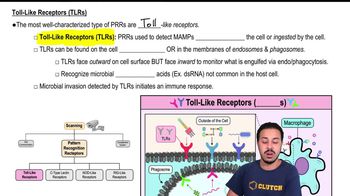
Toll-like receptors are membrane-bound PRRs located on the cell surface or in endosomal compartments. They recognize a broad range of microbial molecules such as lipopolysaccharides and flagellin, triggering innate immune responses by activating inflammatory signaling cascades.
Recommended video:
Guided course
03:35
Toll-Like Receptors

Differences in Localization and Ligand Recognition

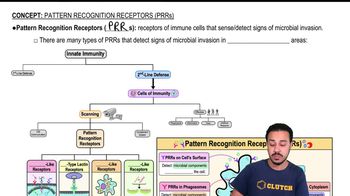
The main difference between NOD proteins and TLRs lies in their cellular location and ligands: NOD proteins detect intracellular bacterial components, while TLRs recognize extracellular or endosomal microbial molecules. This distinction allows the immune system to detect pathogens in different cellular compartments.
Recommended video:
Guided course
04:24
Pattern Recognition Receptors