Ch. 7 - Microbial Genetics
Bauman - Microbiology with Diseases by Taxonomy 6th Edition
Bauman6th EditionMicrobiology with Diseases by TaxonomyISBN: 9780134832302Not the one you use?Change textbook
Chapter 7, Problem 2

List several ways in which eukaryotic messenger RNA differs from prokaryotic mRNA.

Verified step by step guidance
1
Understand that messenger RNA (mRNA) serves as the template for protein synthesis in both prokaryotic and eukaryotic cells, but their structures and processing differ significantly.
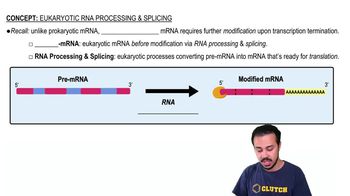
Identify that eukaryotic mRNA typically undergoes extensive processing after transcription, including the addition of a 5' cap, which is a modified guanine nucleotide that protects the mRNA and assists in ribosome binding.
Note that eukaryotic mRNA also has a 3' poly-A tail, a string of adenine nucleotides added post-transcriptionally, which enhances mRNA stability and aids in nuclear export.
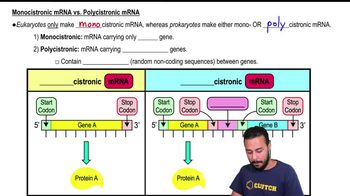
Recognize that eukaryotic mRNA contains introns and exons, requiring splicing to remove non-coding introns before translation, whereas prokaryotic mRNA usually lacks introns and is often polycistronic (encoding multiple proteins).
Understand that eukaryotic mRNA is generally monocistronic (one mRNA codes for one protein), and that eukaryotic mRNA is transported from the nucleus to the cytoplasm, unlike prokaryotic mRNA which is translated immediately after transcription in the cytoplasm.

Verified video answer for a similar problem:

This video solution was recommended by our tutors as helpful for the problem above.
Video duration:
3m
Was this helpful?

Key Concepts

Here are the essential concepts you must grasp in order to answer the question correctly.

mRNA Processing in Eukaryotes

Eukaryotic mRNA undergoes extensive processing including 5' capping, 3' polyadenylation, and splicing to remove introns. These modifications stabilize the mRNA and facilitate its export from the nucleus and translation, unlike prokaryotic mRNA which is typically unprocessed.
Recommended video:
Guided course
02:32
Eukaryotic RNA Processing and Splicing

Monocistronic vs. Polycistronic mRNA

Eukaryotic mRNA is usually monocistronic, meaning it encodes a single protein per mRNA molecule. In contrast, prokaryotic mRNA is often polycistronic, containing multiple coding sequences that allow simultaneous translation of several proteins from one mRNA.
Recommended video:
Guided course
04:19
Monocistronic mRNA vs. Polycistronic mRNA

mRNA Stability and Lifespan

Eukaryotic mRNA generally has a longer half-life due to protective modifications like the 5' cap and poly-A tail, which prevent degradation. Prokaryotic mRNA is more transient, rapidly degraded to allow quick response to environmental changes.
Recommended video:
Guided course
04:19
Monocistronic mRNA vs. Polycistronic mRNA