Ch. 21 - Cardiovascular and Lymphatic Infections
Norman-McKay- Microbiology: Basic and Clinical Principles 2nd Edition
Norman-McKay2nd EditionMicrobiology: Basic and Clinical PrinciplesISBN: 9780137661619Not the one you use?Change textbook
Chapter 21, Problem 13

Why is endocarditis not transmissible from person to person?

Verified step by step guidance
1
Understand the nature of endocarditis: it is an infection of the inner lining of the heart chambers and valves, usually caused by bacteria entering the bloodstream and attaching to damaged heart tissue.
Recognize that endocarditis typically arises from bacteria that are part of the normal flora or from transient bacteremia, such as after dental procedures or intravenous drug use, rather than from direct person-to-person contact.
Consider the mode of transmission: for a disease to be transmissible between people, the infectious agent must be spread through direct contact, respiratory droplets, bodily fluids, or other means that allow transfer from one host to another.
Note that in endocarditis, the bacteria causing the infection are not usually present in a form or location that facilitates transmission (e.g., they are not typically found in respiratory secretions or skin lesions that can spread easily).
Conclude that because the bacteria causing endocarditis require specific conditions to infect the heart and are not spread through casual or direct contact, endocarditis is not transmissible from person to person.

Verified video answer for a similar problem:

This video solution was recommended by our tutors as helpful for the problem above.
Video duration:
3m
Was this helpful?

Key Concepts

Here are the essential concepts you must grasp in order to answer the question correctly.

Pathogenesis of Endocarditis

Endocarditis is an infection of the heart's inner lining, usually caused by bacteria entering the bloodstream and attaching to damaged heart tissue or valves. It develops internally and is not spread through casual contact or respiratory droplets.
Recommended video:
Guided course
02:35
Intro to Bacterial Pathogenesis

Modes of Transmission in Infectious Diseases

Infectious diseases spread through specific routes such as direct contact, airborne droplets, or vectors. Endocarditis lacks a transmission route between individuals because it requires bacteria to enter the bloodstream, often via medical procedures or intravenous drug use.
Recommended video:
Guided course
05:09
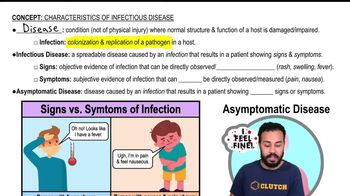
Intro to Characteristics of Infectious Disease

Role of Host Factors in Infection

Host factors like pre-existing heart damage or immune status influence susceptibility to endocarditis. Since the infection depends on these internal conditions rather than external exposure, it is not contagious between people.
Recommended video:
Guided course
01:55
Growth Factors