Ch. 7 - Microbial Genetics
Bauman - Microbiology with Diseases by Taxonomy 6th Edition
Bauman6th EditionMicrobiology with Diseases by TaxonomyISBN: 9780134832302Not the one you use?Change textbook
Chapter 7, Problem 5

Describe the operon model of gene regulation.

Verified step by step guidance
1
Begin by explaining that the operon model is a mechanism of gene regulation found primarily in prokaryotes, where genes with related functions are organized together and controlled as a single unit.
Describe the main components of an operon: the promoter (a DNA sequence where RNA polymerase binds to initiate transcription), the operator (a regulatory DNA segment where a repressor protein can bind), and the structural genes (which code for proteins or enzymes).
Explain how the operon can be regulated by repressors or activators. For example, a repressor protein can bind to the operator to block RNA polymerase, preventing transcription of the structural genes.
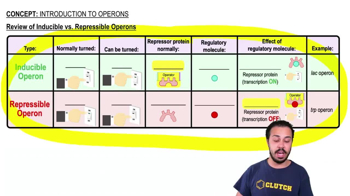
Discuss the difference between inducible and repressible operons. Inducible operons are usually off and can be turned on in response to a specific molecule (inducer), while repressible operons are usually on and can be turned off when a corepressor molecule is present.
Summarize how this model allows bacteria to efficiently control gene expression in response to environmental changes, conserving energy by producing proteins only when needed.

Verified video answer for a similar problem:

This video solution was recommended by our tutors as helpful for the problem above.
Video duration:
2m
Was this helpful?

Key Concepts

Here are the essential concepts you must grasp in order to answer the question correctly.

Operon Structure

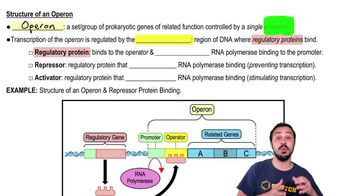
An operon is a cluster of genes under the control of a single promoter and regulatory elements, including an operator. It allows coordinated expression of genes that often encode proteins with related functions, commonly found in prokaryotes like bacteria.
Recommended video:
Guided course
04:23
Structure of an Operon

Regulatory Proteins and Operator

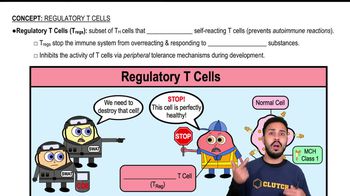
Regulatory proteins, such as repressors or activators, bind to the operator region to control gene expression. Repressors block RNA polymerase binding or progression, inhibiting transcription, while activators enhance transcription by facilitating RNA polymerase action.
Recommended video:
Guided course
03:53
Regulatory T Cells

Inducible and Repressible Operons

Operons can be inducible, activated in response to a substrate (e.g., lac operon), or repressible, turned off by an end product (e.g., trp operon). This allows bacteria to efficiently regulate gene expression based on environmental conditions.
Recommended video:
Guided course
04:02
Review of Inducible vs. Repressible Operons