Ch. 1 - Introduction to Microbiology
Norman-McKay- Microbiology: Basic and Clinical Principles 2nd Edition
Norman-McKay2nd EditionMicrobiology: Basic and Clinical PrinciplesISBN: 9780137661619Not the one you use?Change textbook
Chapter 1, Problem 7

Fill in the blanks: Bacteria are ___________________ cells in the domain ___________________. In contrast, the domain ___________________ includes unicellular and multicellular organisms that are made of ___________________ cells, or cells that have a nucleus and membrane-bound organelles.

Verified step by step guidance
1
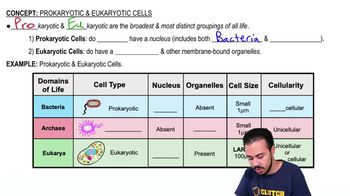
Identify the type of cells bacteria are by recalling their cellular structure. Bacteria lack a nucleus and membrane-bound organelles, so they are classified as ___________________ cells.
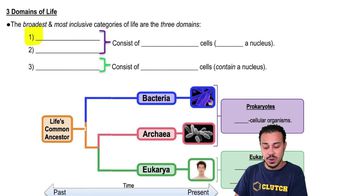
Determine the domain to which bacteria belong. Bacteria are part of the domain ___________________, which includes prokaryotic organisms.
Recognize the domain that includes organisms with cells that have a nucleus and membrane-bound organelles. This domain is ___________________.
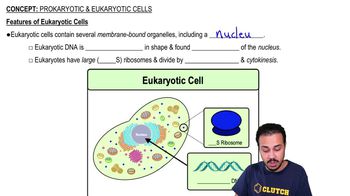
Understand that organisms in this domain can be unicellular or multicellular and are made of ___________________ cells, which are characterized by having a nucleus and membrane-bound organelles.
Fill in the blanks with the correct terms: Bacteria are ___________________ cells in the domain ___________________. In contrast, the domain ___________________ includes unicellular and multicellular organisms that are made of ___________________ cells.

Verified video answer for a similar problem:

This video solution was recommended by our tutors as helpful for the problem above.
Video duration:
2m
Was this helpful?

Key Concepts

Here are the essential concepts you must grasp in order to answer the question correctly.

Prokaryotic Cells

Prokaryotic cells are simple, unicellular organisms that lack a nucleus and membrane-bound organelles. Their genetic material is not enclosed within a nuclear membrane. Bacteria are classic examples of prokaryotic cells.
Recommended video:
Guided course
05:54
Prokaryotic & Eukaryotic Cells

Domains of Life: Bacteria and Eukarya

The domain Bacteria consists of prokaryotic organisms, while the domain Eukarya includes organisms with eukaryotic cells. Eukarya encompasses unicellular and multicellular life forms such as plants, animals, fungi, and protists.
Recommended video:
Guided course
05:20
3 Domains of Life

Eukaryotic Cells

Eukaryotic cells have a true nucleus enclosed by a nuclear membrane and contain membrane-bound organelles like mitochondria and the endoplasmic reticulum. These cells make up organisms in the domain Eukarya.
Recommended video:
Guided course
04:17
Features of Eukaryotic Cells
Related Practice
Textbook Question

Select the most accurate statement.

a. The Gram stain is a simple stain.

b. Bacterial endospores appear green from the acid-fast stain.

c. The acid-fast stain is used to detect bacteria that have a capsule.

d. Bacterial flagella can only be seen with electron microscopes.

e. The mordant in the Gram stain is iodine.

658
views
Textbook Question

Assume you are asked to view and draw all samples at a final magnification of 1000x. If the ocular lens is 10x, what objective lens should be in place as you draft your drawings?

663
views
Textbook Question

Identify the following statements as observations or conclusions.

a. The solution turned red.

b. The bacterium is a rod shape.

c. The cell died due to lack of nutrients.

d. The bacterium is E. coli.

e. The cell is Gram-positive.

f. The bacterium is a pathogen.

g. There are small green structures present upon performing the endospore stain.

h. The solution remained clear after 10 hours of incubation.

i. Fermentation occurred.

j. Life comes from life.

542
views
Textbook Question

Assume that you isolated a unicellular, non-nucleated cell from a deep-sea vent. Select the statement that is least likely regarding the cell you found.

a. The cell is a prokaryote.

b. The cell is a fungus or yeast.

c. The cell is an archaea.

d. The cell is not a pathogen.

e. The cell is in Domain Archaea.

708
views
Textbook Question

Fill in the blanks: In taxonomy, the broadest groupings are called ___________________, which are further subdivided into six different ___________________. The most specific or narrowest grouping is ___________________, which is the ___________________ name in the binomial nomenclature system.

818
views
Textbook Question

How is an opportunistic pathogen different from a pathogen?

1293
views