Textbook Question
What are the four major functions of the endoplasmic reticulum?
153
views

 Martini, Nath, Bartholomew 11th EditionCh. 3 The Cellular Level of OrganizationProblem 17
 Verified step by step guidance
 02:44
02:44
 04:51
04:51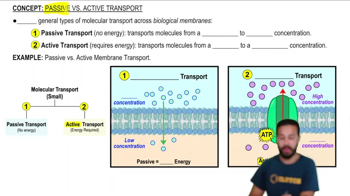 05:05
05:05What are the four major functions of the endoplasmic reticulum?
When a cell is placed in a(n)___solution, the cell will lose water through osmosis. This process results in the___ of red blood cells
(a) hypotonic; crenation
(b) hypertonic; crenation
(c) isotonic; hemolysis
(d) hypotonic; hemolysis
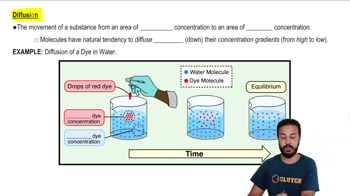
List five important factors that influence diffusion rates.
By what three major transport mechanisms do substances get into and out of cells?
Microvilli are found
(a) Mostly in muscle cells
(b) On the inside of plasma membranes
(c) In large numbers on cells that secrete hormones
(d) In cells that are actively engaged in absorption
(e) Only on cells lining the reproductive tract
Suppose that a DNA segment has the following nucleotide sequence:
CTC–ATA–CGA–TTC–AAG–TTA.
Which nucleotide sequences would a complementary mRNA strand have?
(a) GAG–UAU–GAU–AAC–UUG–AAU
(b) GAG–TAT–GCT–AAG–TTC–AAT
(c) GAG–UAU–GCU–AAG–UUC–AAU
(d) GUG–UAU–GGA–UUG–AAC–GGU