Ch. 29 Development and Inheritance
Martini - Fundamentals of Anatomy & Physiology 11th Edition
Martini, Nath, Bartholomew11th EditionFundamentals of Anatomy & PhysiologyISBN: 9780136874089Not the one you use?Change textbook
Chapter 28, Problem 7

The structure(s) that allow(s) active and passive exchange between the fetal and maternal bloodstreams is/are the 
(a) Yolk stalk
(b) Chorionic villi
(c) Umbilical veins
(d) Umbilical arteries

Verified step by step guidance
1
Step 1: Understand the context of the problem, which involves the exchange of substances between fetal and maternal bloodstreams during pregnancy.
Step 2: Recall that the placenta is the organ responsible for nutrient, gas, and waste exchange between mother and fetus, and it contains specialized structures to facilitate this exchange.
Step 3: Identify the specific structures within the placenta that allow for active and passive exchange. These are the chorionic villi, which are finger-like projections that increase surface area and contain fetal blood vessels surrounded by maternal blood.
Step 4: Recognize that the yolk stalk, umbilical veins, and umbilical arteries have different roles: the yolk stalk is an early embryonic structure, while the umbilical veins and arteries transport blood but do not directly mediate exchange.
Step 5: Conclude that the chorionic villi are the correct structures that allow active and passive exchange between fetal and maternal bloodstreams.

Verified video answer for a similar problem:

This video solution was recommended by our tutors as helpful for the problem above.
Was this helpful?

Key Concepts

Here are the essential concepts you must grasp in order to answer the question correctly.

Chorionic Villi

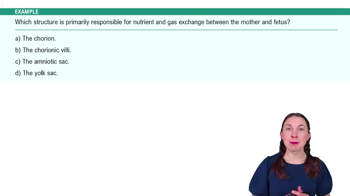
Chorionic villi are finger-like projections of the chorion that extend into the maternal uterine lining. They facilitate the exchange of gases, nutrients, and waste between fetal and maternal blood through a thin barrier, enabling both active and passive transport without direct blood mixing.
Recommended video:
0:55
Placentation Example 2

Active and Passive Exchange Mechanisms

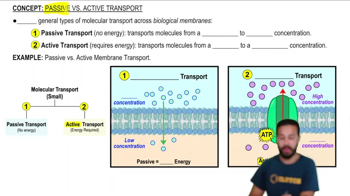
Active exchange involves energy-dependent transport of substances like ions and nutrients against concentration gradients, while passive exchange relies on diffusion or osmosis along concentration gradients. Both mechanisms are essential for efficient fetal-maternal nutrient and gas transfer.
Recommended video:
05:05
Passive vs. Active Transport

Umbilical Vessels (Veins and Arteries)

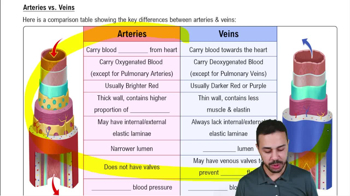
Umbilical veins carry oxygenated blood from the placenta to the fetus, while umbilical arteries transport deoxygenated blood from the fetus to the placenta. These vessels serve as conduits for blood flow but do not directly mediate exchange between maternal and fetal blood.
Recommended video:
7:42
Arteries vs. Veins