Ch. 12 Nervous Tissue
Martini - Fundamentals of Anatomy & Physiology 11th Edition
Martini, Nath, Bartholomew11th EditionFundamentals of Anatomy & PhysiologyISBN: 9780136874089Not the one you use?Change textbook
Chapter 12, Problem 19

What are the structural and functional differences among type A, B, and C fibers?

Verified step by step guidance
1
Step 1: Understand that nerve fibers are classified based on their diameter, myelination, and conduction velocity, which influence their function in the nervous system.
Step 2: Identify that Type A fibers are large-diameter, heavily myelinated fibers, which results in fast conduction speeds. They are further subdivided into alpha, beta, gamma, and delta fibers, each with specific roles such as motor control or sensory input.
Step 3: Recognize that Type B fibers are smaller in diameter than Type A fibers and are lightly myelinated, leading to moderate conduction speeds. They primarily function in autonomic nervous system pathways, especially preganglionic fibers.
Step 4: Note that Type C fibers are the smallest diameter fibers and are unmyelinated, which causes them to have the slowest conduction velocity. They are involved in transmitting pain, temperature, and postganglionic autonomic signals.
Step 5: Summarize the differences by comparing their diameter, degree of myelination, conduction velocity, and functional roles to clearly distinguish among Type A, B, and C fibers.

Verified video answer for a similar problem:

This video solution was recommended by our tutors as helpful for the problem above.
Video duration:
1m
Was this helpful?

Key Concepts

Here are the essential concepts you must grasp in order to answer the question correctly.

Classification of Nerve Fibers

Nerve fibers are categorized into types A, B, and C based on diameter, myelination, and conduction velocity. This classification helps in understanding their roles in transmitting different types of signals within the nervous system.
Recommended video:
08:25
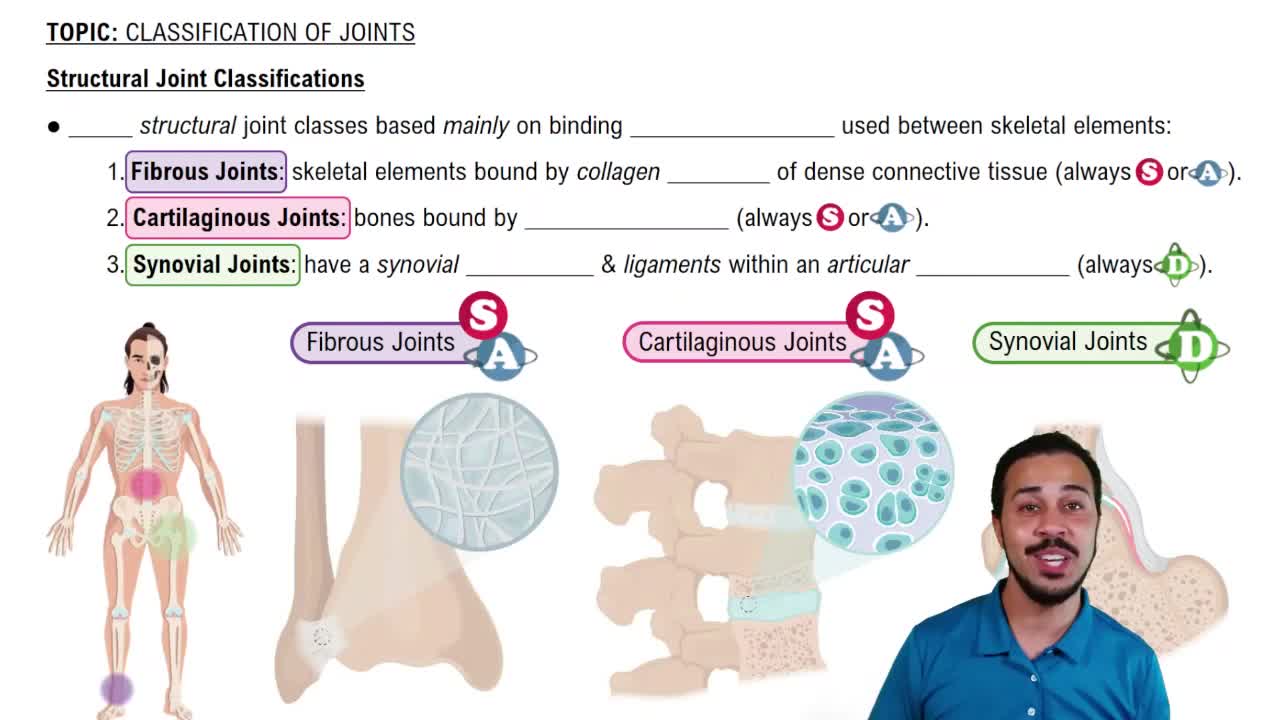
Structural Joint Classifications

Structural Differences Among Fiber Types

Type A fibers are large and heavily myelinated, type B fibers are smaller with light myelination, and type C fibers are the smallest and unmyelinated. These structural variations influence their speed and function in signal transmission.
Recommended video:
Guided course
05:36
3 Types of Protein Fibers

Functional Roles of Fiber Types

Type A fibers conduct rapid signals related to motor control and sensory input, type B fibers primarily carry autonomic preganglionic signals, and type C fibers transmit slow pain and temperature sensations due to their slower conduction velocity.
Recommended video:
Guided course
05:36
3 Types of Protein Fibers