Ch. 2 The Chemical Level of Organization
Martini - Fundamentals of Anatomy & Physiology 11th Edition
Martini, Nath, Bartholomew11th EditionFundamentals of Anatomy & PhysiologyISBN: 9780136874089Not the one you use?Change textbook
Chapter 2, Problem 32

An important buffer system in the human body involves carbon dioxide (CO₂) and bicarbonate ion (HCO₃-) in the reversible reaction
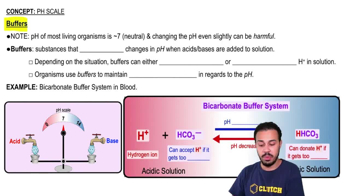
CO₂ + H₂O ⇌ H₂CO₃ ⇌ H⁺ + HCO₃-
If a person becomes excited and exhales large amounts of CO2, how will the pH of the person's body be affected?

Verified step by step guidance
1
Understand the chemical equilibrium involved: CO\_2 reacts with H\_2O to form carbonic acid (H\_2CO\_3), which then dissociates into hydrogen ions (H\^+) and bicarbonate ions (HCO\_3\^-). This is represented by the equation: \(CO\\_2 + H\\_2O \leftrightarrow H\\_2CO\\_3 \leftrightarrow H\^+ + HCO\\_3\^-\)
Recall that pH is a measure of hydrogen ion concentration; an increase in H\^+ concentration lowers pH (more acidic), while a decrease in H\^+ concentration raises pH (more basic).
Consider what happens when a person exhales large amounts of CO\_2: the concentration of CO\_2 in the blood decreases, shifting the equilibrium to the left to produce more CO\_2 and consume H\^+ ions.
Apply Le Chatelier's principle: removing CO\_2 drives the reaction to reduce H\^+ concentration, which means fewer free hydrogen ions in the blood.
Conclude that with fewer H\^+ ions, the pH of the person's body fluids will increase, making the blood more basic (alkaline).

Verified video answer for a similar problem:

This video solution was recommended by our tutors as helpful for the problem above.
Video duration:
4m
Was this helpful?

Key Concepts

Here are the essential concepts you must grasp in order to answer the question correctly.

Carbonic Acid-Bicarbonate Buffer System

This buffer system maintains blood pH by balancing carbon dioxide, carbonic acid, bicarbonate ions, and hydrogen ions. CO₂ reacts with water to form carbonic acid, which dissociates into H⁺ and HCO₃⁻, helping to neutralize pH changes in the body.
Recommended video:
04:19
Carbon

Effect of CO₂ Levels on Blood pH

CO₂ concentration directly influences blood acidity; increased CO₂ shifts the reaction toward more H⁺ production, lowering pH (acidosis), while decreased CO₂ reduces H⁺ concentration, raising pH (alkalosis). Exhaling CO₂ removes acid, increasing pH.
Recommended video:
05:38
Buffers

Le Chatelier’s Principle in Biological Systems

This principle states that a system at equilibrium will adjust to counteract changes. When CO₂ is exhaled rapidly, the equilibrium shifts to produce more CO₂ from H₂CO₃, reducing H⁺ concentration and thus increasing blood pH.
Recommended video:
06:49
Biological Membranes