
Textbook Question
Increased parasympathetic stimulation of the intestine would result in
(a) Decreased motility
(b) Decreased secretion
(c) Decreased sensitivity of local reflexes
(d) Decreased segmentation
(e) None of these
993
views
1
rank

 Verified step by step guidance
 4:24
4:24
 5:08
5:08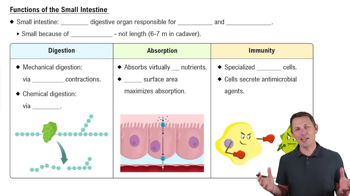 3:44
3:44Increased parasympathetic stimulation of the intestine would result in
(a) Decreased motility
(b) Decreased secretion
(c) Decreased sensitivity of local reflexes
(d) Decreased segmentation
(e) None of these
Name and describe the layers of the digestive tract, proceeding from the innermost layer nearest the lumen to the outermost layer.
What three basic mechanisms regulate the activities of the digestive tract?
Bile release from the gallbladder into the duodenum occurs only under the stimulation of
(a) Cholecystokinin
(b) Secretin
(c) Gastrin
(d) Enteropeptidase
Regional movements that occur in the small intestine and function to churn and fragment the digestive material are called:
(a) Segmentation
(b) Pendular movements
(c) Peristalsis
(d) Mass movements
(e) Mastication
Label the three segments of the small intestine in the following figure.
a. ___
b. ___
c. ___