In Exercises 43–50, convert each equation to standard form by completing the square on x and y. Then graph the hyperbola. Locate the foci and find the equations of the asymptotes.
Table of contents
- 0. Review of Algebra4h 18m
- 1. Equations & Inequalities3h 18m
- 2. Graphs of Equations1h 43m
- 3. Functions2h 17m
- 4. Polynomial Functions1h 44m
- 5. Rational Functions1h 23m
- 6. Exponential & Logarithmic Functions2h 28m
- 7. Systems of Equations & Matrices4h 5m
- 8. Conic Sections2h 23m
- 9. Sequences, Series, & Induction1h 22m
- 10. Combinatorics & Probability1h 45m
8. Conic Sections
Hyperbolas NOT at the Origin
Problem 55
Textbook Question
In Exercises 51–56, graph each relation. Use the relation's graph to determine its domain and range.
Verified step by step guidance1
Recognize that the given equation \(\frac{y^2}{16} - \frac{x^2}{9} = 1\) represents a hyperbola centered at the origin. This is because it matches the standard form of a vertical hyperbola: \(\frac{y^2}{a^2} - \frac{x^2}{b^2} = 1\) where \(a^2 = 16\) and \(b^2 = 9\).
Identify the values of \(a\) and \(b\) by taking square roots: \(a = 4\) and \(b = 3\). These values help determine the shape and orientation of the hyperbola.
To graph the hyperbola, plot the vertices on the \(y\)-axis at \((0, \pm a)\), which are \((0, \pm 4)\). These points are where the hyperbola intersects the \(y\)-axis.
Determine the domain by solving for \(x\) in terms of \(y\). Rearrange the equation to isolate \(x^2\): \(\frac{y^2}{16} - 1 = \frac{x^2}{9}\). Then multiply both sides by 9 to get \(x^2 = 9\left(\frac{y^2}{16} - 1\right)\). For \(x^2\) to be non-negative (real \(x\) values), the expression inside the parentheses must be greater than or equal to zero. Use this to find the range of \(y\) values that produce real \(x\) values, which will help determine the domain of the relation.
Similarly, determine the range by considering the possible \(y\) values. Since the hyperbola opens vertically, \(y\) can take any real value such that the expression under the square root for \(x\) is valid. Use the inequality from the previous step to find the exact range of \(y\) values.
Was this helpful?
Key Concepts
Here are the essential concepts you must grasp in order to answer the question correctly.
Hyperbola Equation and Standard Form
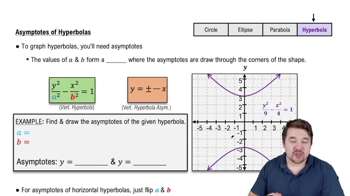
A hyperbola is a conic section defined by an equation where the difference of squared terms equals a constant, such as \( \frac{y^2}{a^2} - \frac{x^2}{b^2} = 1 \). This form indicates a vertical transverse axis, with vertices at \( (0, \pm a) \). Understanding this standard form helps in identifying the shape and orientation of the graph.
Recommended video:
Asymptotes of Hyperbolas
Domain and Range of Relations
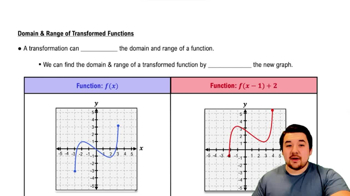
The domain of a relation is the set of all possible x-values, while the range is the set of all possible y-values. For hyperbolas, these sets depend on the equation's restrictions and asymptotes. Determining domain and range from the graph involves analyzing where the curve exists along the x- and y-axes.
Recommended video:
Domain & Range of Transformed Functions
Graphing Conic Sections
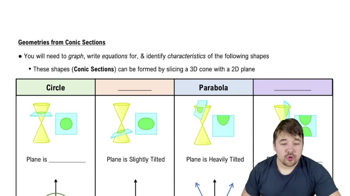
Graphing conic sections like hyperbolas requires plotting key points such as vertices and asymptotes, which guide the curve's shape. For the given equation, asymptotes are lines that the hyperbola approaches but never touches, found by setting the equation equal to zero. Accurate graphing aids in visualizing the relation and extracting domain and range.
Recommended video:
Geometries from Conic Sections
Watch next
Master Graph Hyperbolas NOT at the Origin with a bite sized video explanation from Patrick
Start learningRelated Videos
Related Practice
Textbook Question
11
views