In Exercises 43–50, convert each equation to standard form by completing the square on x and y. Then graph the hyperbola. Locate the foci and find the equations of the asymptotes.
Table of contents
- 0. Review of Algebra4h 18m
- 1. Equations & Inequalities3h 18m
- 2. Graphs of Equations1h 43m
- 3. Functions2h 17m
- 4. Polynomial Functions1h 44m
- 5. Rational Functions1h 23m
- 6. Exponential & Logarithmic Functions2h 28m
- 7. Systems of Equations & Matrices4h 5m
- 8. Conic Sections2h 23m
- 9. Sequences, Series, & Induction1h 22m
- 10. Combinatorics & Probability1h 45m
8. Conic Sections
Hyperbolas NOT at the Origin
Problem 55
Textbook Question
Identify each equation without completing the square. 100x2 - 7y2 + 90y - 368 = 0
Verified step by step guidance1
Rewrite the given equation to group the terms involving \( y \) together: \( 100x^2 - 7y^2 + 90y - 368 = 0 \).
Focus on the quadratic terms: \( 100x^2 \) and \( -7y^2 \). Notice that the \( x^2 \) term is positive and the \( y^2 \) term is negative, which suggests the equation might represent a hyperbola.
Look at the linear term in \( y \), which is \( 90y \). This term shifts the center of the conic but does not change its fundamental type.
Recall the general forms of conic sections:
- Circle: \( Ax^2 + Ay^2 + ... = 0 \) with equal coefficients for \( x^2 \) and \( y^2 \)
- Ellipse: \( Ax^2 + By^2 + ... = 0 \) with \( A \) and \( B \) positive and unequal
- Hyperbola: \( Ax^2 - By^2 + ... = 0 \) or \( -Ax^2 + By^2 + ... = 0 \) with opposite signs for \( x^2 \) and \( y^2 \)
- Parabola: only one squared term
Based on the signs and coefficients of the squared terms, identify the conic as a hyperbola without completing the square.
Verified video answer for a similar problem:This video solution was recommended by our tutors as helpful for the problem above
Video duration:
3mPlay a video:
Was this helpful?
Key Concepts
Here are the essential concepts you must grasp in order to answer the question correctly.
Types of Conic Sections
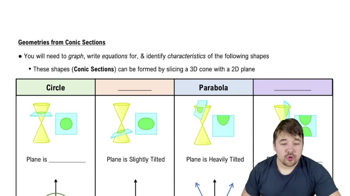
Conic sections are curves obtained by intersecting a plane with a cone, including circles, ellipses, parabolas, and hyperbolas. Each type has a distinct general equation form, and identifying the conic involves analyzing the coefficients of the squared terms and their signs.
Recommended video:
Geometries from Conic Sections
General Form of a Conic Equation
The general second-degree equation Ax² + Bxy + Cy² + Dx + Ey + F = 0 represents conic sections. By examining coefficients A and C, and the presence or absence of the Bxy term, one can classify the conic without completing the square.
Recommended video:
Geometries from Conic Sections
Discriminant of a Conic Section
The discriminant, given by B² - 4AC, helps identify the conic type: if it is less than zero, the conic is an ellipse or circle; if zero, a parabola; and if greater than zero, a hyperbola. This method allows classification without rewriting the equation.
Recommended video:
Geometries from Conic Sections
Watch next
Master Graph Hyperbolas NOT at the Origin with a bite sized video explanation from Patrick
Start learningRelated Videos
Related Practice
Textbook Question
10
views